
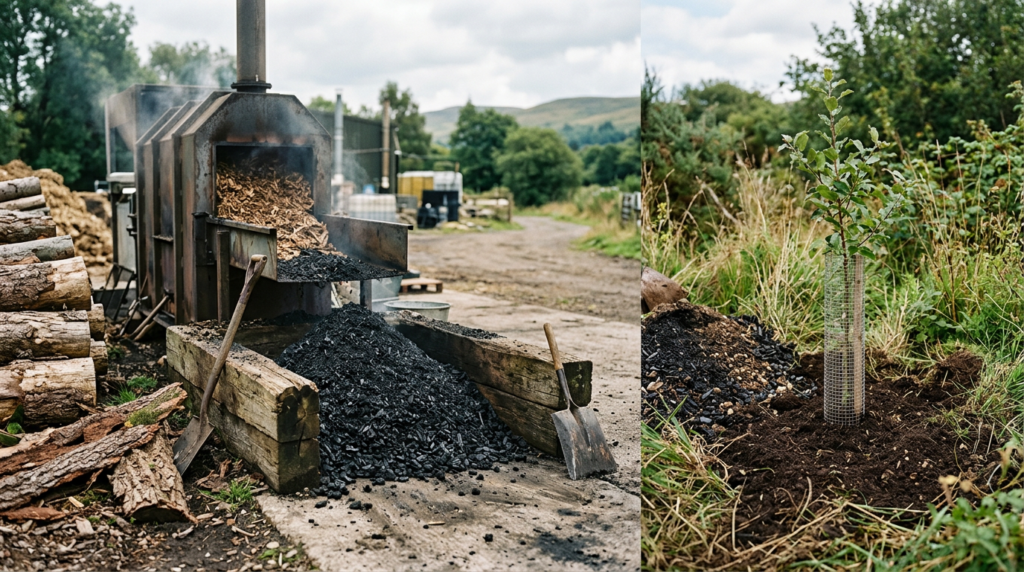
Navigating the Biochar Registry Landscape
For carbon project developers, selecting a crediting standard is one of the most consequential decisions in the project lifecycle. In the carbon dioxide removal (CDR) sector, two methodologies dominate industrial biochar deployment: Verra’s VCS VM0044 (Methodology for Biochar Utilization in Soil and Non-Soil Applications) and the Puro Standard Biochar Methodology governed by Puro.earth. While both frameworks translate stable biogenic carbon into tradeable carbon removal credits, their structural expectations differ significantly across feedstock eligibility, decay calculations, end-use tracking, and verification logistics.
Choosing between Verra and Puro.earth directly dictates equipment specifications, supply chain documentation, laboratory testing regimens, and operational cash flows. A miscalculation at the methodology selection phase can lead to costly retrofits, delayed issuances, or stranded credit volumes. This technical guide assesses both frameworks from an implementation perspective to assist project developers in aligning their operational realities with registry requirements.
Feedstock Eligibility and Sustainability Guardrails
Both methodologies enforce strict biomass sourcing criteria to ensure that biochar production does not drive land-use change, deforestation, or competition with primary food production. However, their compliance pathways and documentation requirements vary.
Verra VM0044 Feedstock Requirements
Verra anchors its feedstock criteria within the wider VCS Program guidelines, demanding rigorous chain-of-custody documentation. Under VM0044, permissible feedstocks primarily include processing residues, post-consumer wood waste, and agricultural or forest residues that would otherwise emit carbon through decay or uncontrolled burning under the project baseline.
- Chain of Custody: Developers must establish full traceability to the origin of the biomass. If utilizing forestry residues, projects often need to demonstrate third-party certification (such as FSC or PEFC) or perform comprehensive regional biomass availability assessments to confirm the extraction does not impair ecosystem health or soil productivity.
- Counterfactual Baseline: VM0044 requires explicit justification of the baseline fate of the biomass. If the counterfactual treatment of the waste biomass involves decay, controlled combustion, or open burning, developers must quantify baseline emissions using project-specific or standardized baseline equations.
- Exclusions: Dedicated timber harvesting solely for biochar production is disallowed. Any feedstock categorized as invasive species must align with regional environmental authority eradication plans to prevent perverse incentives.
Puro Standard Biochar Feedstock Requirements
Puro.earth requires that all biomass inputs qualify as sustainably sourced, non-fossil carbon. The Puro Standard Biochar Methodology categorizes eligible biomass into waste, by-products, and secondary residues from agriculture, forestry, and wood processing industries.
- Sustainable Sourcing Verification: Puro accepts recognized certifications (such as PEFC, FSC, SBP, or local statutory agricultural permits) to establish sustainable forest or crop management. For agricultural residues, developers must verify that residue removal does not exceed sustainable harvest rates, preserving local soil organic matter.
- Waste Status Confirmation: Puro requires documentary proof that the feedstock lacks higher-value cascading uses in the local economy. Developers must secure producer declarations confirming the material is considered secondary residue or waste at the point of generation.
- Material Purity: Puro places considerable emphasis on chemical screening before processing. Treated wood containing halogenated organic compounds, heavy metals, or synthetic resins is strictly excluded unless the developer can demonstrate thorough decontamination and testing regimes that comply with regional environmental safety limits.
Pyrolysis Processing and Operational Emission Accounting
The core carbon accounting formula for biochar projects requires subtracting operational emissions—termed project emissions—from gross carbon sequestered. Both standards require precise accounting of all greenhouse gas (GHG) sources within the project boundary.
Emissions Boundaries in VM0044
Verra VM0044 establishes an exhaustive boundary that encompasses biomass collection, transport, pre-drying, mechanical sizing, pyrolysis reactor operations, product quenching, handling, and distribution to the end user. Key technical demands include:
- Methane and Non-CO2 Gases: Methane slip and volatile organic compound (VOC) emissions during thermal conversion must be accounted for. If syngas or pyrolysis gases are not combusted with high thermal efficiency, substantial deductions apply. Continuous flaring or thermal energy recovery systems must be monitored using calibrated sensors.
- Auxiliary Energy Consumption: All grid electricity, diesel fuel for internal handling, and auxiliary fuels used for reactor start-up must be metered continuously and deducted from total carbon removal claims.
- Life-Cycle Scope: Verra enforces an extensive downstream emission accounting approach, requiring project developers to deduct emissions associated with transporting the finished biochar to the physical application site.
Emissions Boundaries in the Puro Standard
Puro.earth accounts for operational emissions from the point of biomass collection up to the gate of the production facility, alongside downstream transport emissions to the point of application. Puro CO2 Removal Certificates (CORCs) are calculated on a net-negativity basis:
- Combustion Efficiency: Puro requires that pyrolysis plants achieve complete combustion of volatile gases to prevent methane and carbon monoxide leakage. Plants must be equipped with temperature monitoring and gas combustion chambers that maintain regulatory operational temperatures to ensure clean destruction of volatiles.
- Process Heat Integration: Puro encourages and provides specific tracking for projects that capture and utilize excess thermal energy generated during pyrolysis. If thermal energy replaces fossil heat, it enhances project viability, although crediting is focused strictly on the net durable removal stored in the biochar itself.
- Direct Transport Accounting: Developers can use default emission factors or actual fuel logs for transport phases, providing flexibility based on whether local distribution logistics are managed in-house or through commercial third-party carriers.
Permanence, Stability Metrics, and Decay Calculations
Permanence is the defining metric of durability in biochar carbon removal. Because biochar is not an inert rock, a small fraction of its carbon decays over decades and centuries. Both registries handle this decay through scientific permanence deductions, but their underlying calculation approaches diverge.
Verra’s Approach to Permanence and Decay
Verra VM0044 employs conservative decay modeling to calculate the persistent carbon fraction remaining after 100 years. The permanence factor is not a flat number; it is derived from physicochemical analysis and environmental conditions:
- H:Corg Ratio: The molar ratio of hydrogen to organic carbon (H:Corg) is used as the primary laboratory proxy for aromatic condensation and biochar stability. Verra requires the H:Corg ratio to be strictly below 0.7 to qualify for crediting, with lower values indicating greater resistance to microbial oxidation.
- Soil Temperature and Kinetic Modeling: VM0044 incorporates soil temperature variables when biochar is applied to land. The methodology provides mathematical functions reflecting higher oxidation rates in warmer soils, adjusting the permanence factor based on the geographic destination of the biochar.
- Standard Crediting Horizon: VCS credits biochar based on the carbon expected to remain stored for a minimum of 100 years, applying statistical confidence discounts where empirical degradation models show variability.
Puro.earth’s Approach to Permanence
Puro.earth similarly uses the H:Corg threshold to evaluate structural stability, applying a standard analytical framework to discount for degradation over a century-long horizon:
- Stability Thresholds: Biochar must demonstrate an H:Corg ratio of less than 0.7. Material showing lower ratios qualifies for higher baseline stability preservation, rewarding operators running high-temperature, optimized thermal conversion processes.
- 100-Year Durability Factor: Puro applies a standardized decay factor over a 100-year accounting window based on peer-reviewed biochar degradation literature. The standard net carbon removal formula deducts an established percentage to account for the labile fraction that breaks down in environmental settings within the initial crediting decade.
- Non-Soil Sink Durability: For biochar embedded in permanent physical matrices, such as concrete or asphalt, Puro recognizes that carbon degradation pathways differ significantly from open-soil degradation, allowing alternative durability modeling provided the matrix integrity is verified.
Eligible End-Use Sinks and Downstream Traceability
Producing high-grade biochar does not generate a carbon credit under either standard; the carbon is only deemed removed once the material is permanently sequestered in an approved sink. Tracking this handoff represents a major operational hurdle for developers.
Verra VM0044 Sinks
VM0044 permits applications in agricultural soils, forestry substrates, and non-soil engineered applications. However, the administrative burden of verifying end-use is high:
- Custody Verification: Developers must document the complete supply chain from production facility to end user. For agricultural use, this includes securing signed delivery declarations, GPS coordinates of application parcels, and application rate logs.
- Non-Soil Applications: When biochar is incorporated into materials such as ready-mix concrete or composite building materials, developers must verify that the manufacturing process does not oxidize the carbon (e.g., combustion during clinker production) and that the product remains stable across its functional lifecycle.
- Risk of Reversal: If biochar is utilized in applications where it might be exposed to high-heat processes or deliberate combustion later in its lifecycle, the volume is disqualified.
Puro Standard Sinks
Puro.earth provides structured pathways for biochar disposal across three primary sink categories: agriculture and soil improvement, urban substrates (such as green roofs and tree pits), and permanent building materials.
- Direct Application Tracking: Puro requires developers to provide sales records, transport bills of lading, and end-user confirmation forms. For large agricultural distribution networks, bulk buyers or distributor aggregation models are accepted, provided traceability mechanisms confirm the biochar was applied to land rather than stored indefinitely.
- Industrial Material Integration: Puro has detailed protocols for biochar integrated into building products, such as concrete, insulation panels, and mortar. The methodology requires testing to confirm that the material meets regional civil construction durability standards and that the carbon is physically bound.
- Audit Sampling: Third-party auditors (Puro-approved verifiers) conduct physical and digital audits, cross-referencing customer delivery dockets against batch production logs to eliminate double-claiming or unauthorized storage.
Monitoring, Reporting, and Verification (MRV) Realities
Operational complexity during verification often dictates the administrative overhead of a project. The two standards demand distinct testing frequencies, sampling protocols, and monitoring infrastructures.
| Dimension | Verra (VCS VM0044) | Puro.earth Biochar |
|---|---|---|
| Primary Stability Indicator | Molar H:Corg ratio < 0.7 with environmental decay adjustments | Molar H:Corg ratio < 0.7 with standardized 100-year degradation models |
| Feedstock Logging | Strict batch-level source tracking, baseline counterfactual modeling | Certified sourcing documentation or waste classification declarations |
| Process Emissions | Exhaustive boundary: direct metering of auxiliary fuel, electricity, flaring, transport | Net-negative balance: process inputs, VOC destruction confirmation, transport fuel logs |
| Approved End-Use Sinks | Soil, agroforestry, non-soil composite materials (strict chain of custody) | Soil, urban substrate, construction materials (concrete, asphalt) |
| Verification Infrastructure | Independent VCS validation and verification bodies (VVBs) | Puro-accredited third-party auditing bodies |
| Testing Requirements | Accredited lab testing for proximate/ultimate analysis, PAHs, heavy metals | European Biochar Certificate (EBC) or IBI-aligned testing regimens |
Laboratory Testing and Compliance
Both methodologies demand that biochar batches undergo comprehensive characterization at ISO 17025-accredited laboratories. Required testing parameters include:
- Elemental Analysis: Total carbon (C), organic carbon (Corg), hydrogen (H), nitrogen (N), and oxygen (O).
- Toxicological Contaminants: Heavy metals (lead, cadmium, arsenic, chromium, copper, nickel, zinc, mercury), polycyclic aromatic hydrocarbons (PAHs), dioxins, furans, and polychlorinated biphenyls (PCBs).
- Physical Metrics: Specific surface area, water holding capacity, pH, electrical conductivity, and dry matter content.
Under Puro.earth, alignment with the European Biochar Certificate (EBC) or International Biochar Initiative (IBI) testing standards is common practice, simplifying testing workflows for European and North American operators. Verra accepts these frameworks but requires explicit reconciliation of laboratory procedures against VCS-specific precision rules.
Selecting the Optimal Methodology for Your Project
Choosing between Verra VM0044 and Puro.earth requires matching the project’s geographic footprint, capital profile, and technical operational capacity with registry parameters:
- Operational Scale and Regional Focus: Puro.earth maintains an established footprint in commercial, equipment-level biochar deployments, particularly in Europe, North America, and parts of the Asia-Pacific. Verra’s VCS network is globally recognized and often preferred by developers operating across Latin America, Africa, and Southeast Asia, where VCS infrastructure is well understood by local stakeholders and national regulatory bodies.
- Buyer Preferences and Commercial Offtake: Corporate buyers focused exclusively on engineering-grade CDR through dedicated procurement platforms frequently prioritize Puro CORCs due to the registry’s explicit focus on durable removals. Conversely, buyers seeking large-scale diversified portfolios across both nature-based and technological removals often lean toward Verra’s Verified Carbon Units (VCUs).
- Digital MRV Integration: Both standards increasingly require high-resolution data capture. Implementing automated sensor architectures—continuous temperature logging, mass balance scales, and digital identity tags for outgoing shipments—lowers auditing friction and eliminates reconciliation discrepancies under both VM0044 and the Puro Standard.
- Capital Planning: Developers must factor in the timeline and audit sequencing of each standard. Review cycles, methodology revision procedures, and verification body availability differ across the two registries and fluctuate throughout the year; developers should assess current market conditions and auditor availability before finalizing their project schedule.
Ultimately, a biochar project’s carbon accounting integrity depends on precise operational execution. By evaluating feedstock stability, emissions controls, and downstream distribution models against the technical parameters of VM0044 and Puro.earth, developers can build durable carbon removal operations that stand up to regulatory, technical, and market scrutiny.
To evaluate methodology alignment, design your biochar carbon accounting framework, or integrate digital MRV solutions for your facility, contact our project development team at ForestTwin.