
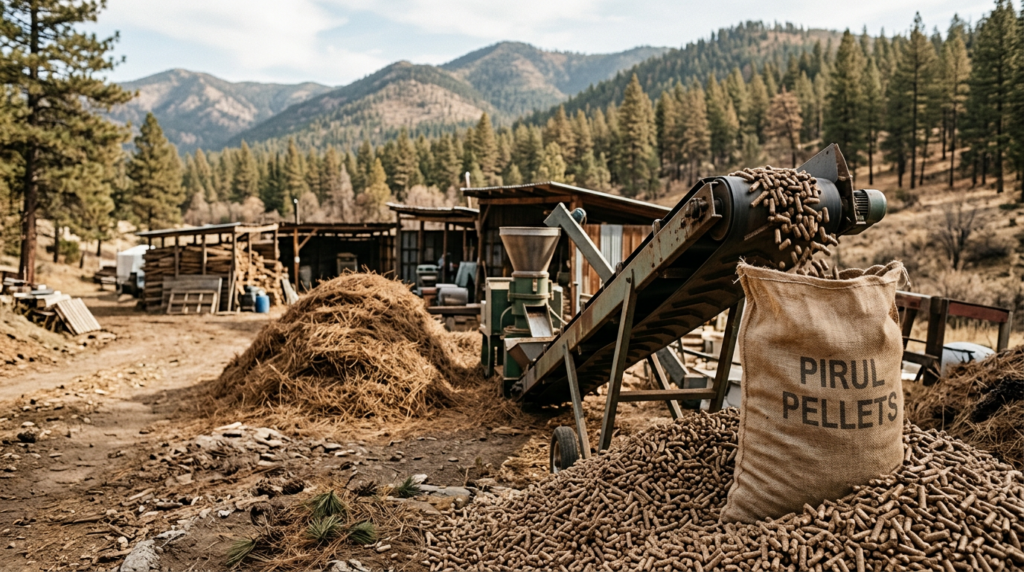
The Pirul Challenge in the Himalayan Forest Ecosystem
In the sub-tropical and temperate forests of the Central and Western Himalayas, particularly across Uttarakhand and Himachal Pradesh, the Chir pine (Pinus roxburghii) dominates vast tracts of land. Every year between March and June, these trees shed substantial quantities of dry, resinous needles known locally as pirul. Because pirul decomposes slowly due to its high lignin and wax content, it creates an impermeable, highly flammable blanket across the forest floor.
This seasonal accumulation carries severe ecological consequences. Left unmanaged, dry pine needles serve as primary tinder for destructive wild forest fires. These surface fires routinely sweep across slopes, destroying undergrowth, killing seedlings of broadleaf species like oak (Quercus leucotrichophora), reducing soil moisture retention, and releasing stored carbon into the atmosphere. The thick layer of needles also acts as a physical barrier that prevents rain from infiltrating the soil and inhibits the germination of native plants.
Traditional forest management methods have struggled to contain the scale of this problem across difficult mountain terrain. However, turning pirul from a wildfire hazard into a solid biofuel pellet establishes an operational framework that directly supports environmental management and rural economic stability.
The Supply Chain: From Forest Floor to Pelleting Facilities
Constructing a functional biomass supply chain in mountainous topography requires careful orchestration. Raw pine needles have low bulk density, making raw transportation economically inefficient beyond very short distances. The supply chain must be structured around localized collection, distributed pre-processing, and centralized densification.
1. Community-Based Collection
Collection operations rely heavily on decentralized networks, predominantly organized through local village councils (Van Panchayats), women's self-help groups (SHGs), and rural cooperatives. Harvesters use simple rakes to clear needles along critical fire corridors, forest ridges, and zones adjacent to human settlements. Manual harvesting requires careful protocol: workers avoid sweeping down to bare mineral soil to prevent erosion, focusing instead on clearing excess fuel loads from vulnerable zones.
2. Local Aggregation and Pre-Processing
Gathered needles are bundled into low-weight bales at neighborhood aggregation points. Because raw needles are bulky and loose, early aggregation reduces handling overhead. At these intermediate depots, the material undergoes preliminary sun-drying to lower moisture levels below twenty percent, followed by mechanical chopping or rough shredding to decrease volume before transit to processing mills.
3. Densification and Pelleting
At the processing facility, chopped needles enter hammer mills to achieve uniform particle size. Unlike certain agricultural residues that demand external starch or chemical binders, pirul contains natural resins that soften under heat and pressure during the extrusion process. The pulverized needles are pressed through industrial ring dies or flat dies to produce dense, standardized cylindrical pellets. The finished pellets feature high density, standardized moisture content (typically below ten percent), and predictable combustion profiles, transforming an erratic forest residue into an industrial-grade commodity.
Mitigating Wildfire Risk Through Targeted Fuel-Load Management
Wildfire behavior depends on three core elements: weather, topography, and fuel. While forest managers cannot alter climatic conditions or slope angles, they can manipulate fuel availability. Removing pirul addresses the primary fuel component that enables surface fires to initiate and spread rapidly into the canopy.
Active extraction around community forests, roadsides, and ridge tops creates strategic fire breaks. When a fire encounters an area cleared of dry needles, its flame length and rate of spread drop substantially, granting forest departments and community volunteers the time needed to contain the blaze. Furthermore, removing the thick needle carpet allows dormant seeds of broadleaf species to contact mineral soil, fostering natural regeneration and gradually shifting monoculture pine stands toward biodiverse mixed forest ecosystems.
By treating needle collection as systematic preventative maintenance rather than an ad-hoc emergency intervention, regional authorities and land managers can preserve carbon stocks contained within living trees and topsoil that would otherwise be lost to seasonal burn cycles.
Socioeconomic Resilience and Rural Income Diversification
Mountain economies in the Himalayan states often suffer from limited industrial employment, out-migration of working-age populations, and vulnerable subsistence agriculture. Establishing a predictable market for collected pirul introduces an accessible seasonal income stream directly into rural households.
Direct Monetary Compensation for Harvesters
Under formal procurement systems, collectors receive direct compensation based on the weight of clean, dry needles brought to aggregation centers. Because the primary harvesting season (spring and early summer) coincides with a period before major summer agricultural cycles begin, needle gathering provides supplementary earnings without displacing traditional farming obligations.
Decentralized Value Creation
Pelleting facilities and aggregation hubs generate secondary employment opportunities for machinery operators, quality assessors, warehouse handlers, and local logistics providers. Rather than exporting raw resources out of mountain communities, regional densification ensures that value-addition steps occur close to the resource origin, retaining capital within local administrative zones.
Industrial Utility: Clean Heat, Power, and Coal Substitution
Pelletized pine needles provide an effective alternative for commercial and industrial facilities working to reduce their reliance on fossil fuels, particularly coal. When converted into pellets, pirul features properties suitable for combustion in standard solid-fuel systems:
- High Calorific Value: Due to natural resin content, pirul pellets yield energy outputs competitive with commercial non-coking coal and superior to many agricultural straw pellets.
- Low Ash Content: The ash content of pirul pellets is typically modest compared to heavy industrial coals, reducing slagging and ash-handling expenses in industrial boilers.
- Drop-in Utility: Standardized pellets can be co-fired alongside coal in thermal plants or consumed directly in biomass boilers across food processing, pharmaceutical, cement, and hospitality operations.
- Pyrolysis Feedstock: Beyond direct combustion, pirul pellets serve as a uniform feedstock for industrial pyrolysis units, generating high-carbon biochar for agricultural soil remediation and industrial carbon sequestration projects.
By substituting coal with pirul pellets in regional boilers, industrial consumers directly reduce their Scope 1 greenhouse gas emissions while sourcing fuel from supply chains that suppress local wildfire hazards.
Digital MRV and Traceability in Forest Residue Supply Chains
Modern sustainability markets and compliance frameworks require rigorous verification of origin, labor equity, and environmental impacts. Developing an informal collection activity into an enterprise-grade biomass supply requires digital Monitoring, Reporting, and Verification (dMRV) systems.
Using geotagged tracking applications, procurement managers record the precise forest coordinates where needles are gathered. Digital scale integrations at aggregation points log weight, moisture content, and supplier identifications directly onto cloud-based ledgers. This verifiable trail confirms that material originates from sustainable fire-mitigation corridors rather than clear-felled zones or ecologically protected reserves.
Traceable dMRV data provides corporate buyers with the clear chain-of-custody documentation required under global reporting standards, proving both the biogenic nature of the fuel and the socio-ecological benefits generated along the collection route.
Policy Alignment and Market Integration
The conversion of pine needles into commercial pellets aligns with several national and international environmental priorities. In India, policy initiatives emphasize the co-firing of biomass pellets in thermal power stations to displace thermal coal and cut air pollution. Pirul pellets provide a dependable source of forest-based biomass that does not compete with agricultural animal fodder.
Concurrently, programs like the Green Credit Programme (GCP) administered by the Ministry of Environment, Forest and Climate Change (MoEFCC) establish market-based incentives for voluntary environmental actions, such as forest fire prevention, eco-restoration, and soil-moisture conservation. Systematic pirul extraction ties directly into these metrics by reducing fire occurrences and enabling natural vegetation recovery.
From a corporate disclosure standpoint, entities engaging with these supply chains can document concrete carbon mitigation under frameworks such as IFRS S2 (Climate-related Disclosures), while addressing social equity targets under broader sustainability mandates. Rather than treating wildfire prevention as an unrecoverable public expense, the model demonstrates that targeted private sector procurement can fund long-term ecosystem management.
Organizations looking to integrate verified biomass fuels, initiate regional fire-prevention carbon programs, or implement dMRV-backed supply chains can connect with the ForestTwin team to evaluate technical pathways and implementation models at https://foresttwin.com/contact/.