
Navigating the Distinction Between Carbon Avoidance and Removal
Corporate carbon procurement has shifted from an era of simple volume matching to one defined by rigorous scrutiny, regulatory alignment, and accounting integrity. As standards such as the Science Based Targets initiative (SBTi) and the Oxford Principles for Net Zero Aligned Carbon Offsetting gain prominence, sustainability leaders face increased expectations from investors, board audit committees, and civil society. Meeting these expectations requires understanding the operational, environmental, and legal distinctions between carbon avoidance and carbon removal credits.
Historically, corporate buyers treated carbon credits as interchangeable commodities. An avoided metric ton of carbon dioxide equivalent (tCO2e) generated by preserving standing forest was often reported identically to a metric ton captured from ambient air and stored geologically or pyrogenically. Today, greenhouse gas accounting standards require corporate buyers to report removals and avoidance separately. Confusing the two risks accusations of greenwashing, regulatory non-compliance, and financial misstatement under emerging reporting regimes like IFRS S2.
Defining Carbon Avoidance Credits
Carbon avoidance credits, often referred to as reduction or prevention credits, represent interventions that prevent emissions that would have occurred under a business-as-usual baseline. The core premise is counterfactual: without the revenue or intervention of the carbon finance project, an emission source would have entered or remained in the atmosphere.
Common Avoidance Project Types
- Avoided Deforestation (REDD+): Compensating forest managers, communities, or landowners to prevent the legal or illegal conversion of forested land into agriculture or commercial development.
- Clean Cookstoves and Fuel Switching: Distributing efficient biomass stoves or cleaner fuels to displace non-renewable biomass harvest and inefficient thermal combustion in households.
- Renewable Energy Displacement: Installing grid-connected solar, wind, or hydro capacity in developing power grids to displace fossil fuel power generation.
- Methane Capture: Capturing fugitive methane emissions from landfills, agricultural waste lagoons, or abandoned mines, followed by flaring or conversion to energy.
The Structural Challenges of Avoidance
While avoidance projects can provide valuable transition capital and protect vulnerable ecosystems, they introduce inherent accounting complexities. First, they rely on counterfactual baselines. A project developer must project what would have happened in the absence of carbon credit revenue over a multi-year horizon. Proving that deforestation, methane emissions, or fossil fuel consumption was averted requires complex economic modeling that remains susceptible to over-crediting risks.
Second, leakage poses a perpetual challenge. Protecting a forest tract in one jurisdiction may simply displace logging or agricultural conversion to an adjacent, unprotected boundary. Third, avoidance does not reduce the absolute concentration of carbon dioxide already circulating within the biosphere and atmosphere; it merely slows the rate of new additions.
Defining Carbon Removal Credits
Carbon dioxide removal (CDR) projects physically extract carbon dioxide from the atmosphere and store it durably in biological, mineral, geological, or product reservoirs. Unlike avoidance, which functions against a hypothetical baseline, removal is measured as a direct physical flux: carbon is captured from the active carbon cycle and isolated in a long-term sink.
The Removal Spectrum: Nature-Based to Engineered
- Afforestation, Reforestation, and Revegetation (ARR): Establishing new trees on degraded or non-forested land. Carbon is sequestered in biological biomass (trunks, roots, canopy) and underlying soil.
- Biochar Production: Converting sustainable biomass through high-temperature pyrolysis in an oxygen-limited environment into a stable, porous carbon form. When applied to soils or non-combustible materials, biochar locks carbon into recalcitrant structures that resist microbial decay.
- Enhanced Rock Weathering (ERW): Spreading finely ground silicate or carbonate minerals across agricultural soils to accelerate natural carbonation reactions, capturing dissolved inorganic carbon that eventually drains into oceans.
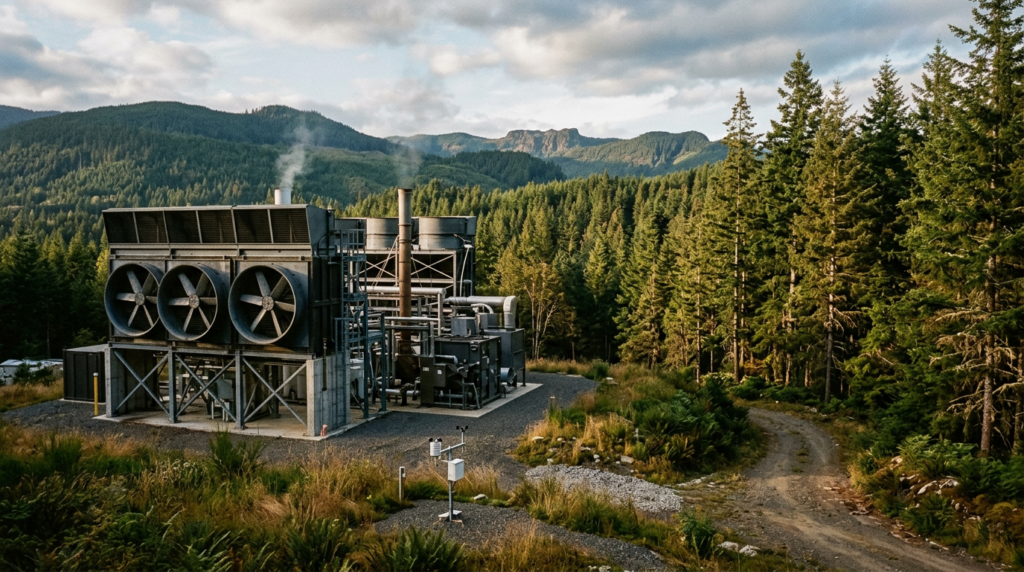
- Direct Air Carbon Capture and Storage (DACCS): Mechanical systems that extract ambient CO2 via chemical contactors, followed by deep subterranean mineralisation or geological injection into saline aquifers.
The Durability Spectrum: Why Permanence Matters
Not all carbon storage is created equal. The duration of time that carbon remains isolated from the atmosphere is known as permanence or durability. Storage duration ranges from decades to thousands of years, and this divergence dictates how credits must be factored into corporate balance sheets and climate targets.
Short-to-Medium Term Durability (10 to 100 Years)
Biological reservoirs, including standing forests and surface soil carbon, operate on short-to-medium cycles. While ecologically essential, these reservoirs remain vulnerable to reversals. Wildfires, pathogen outbreaks, changing rainfall patterns, and geopolitical shifts can cause stored carbon to return to the atmosphere prematurely. When an afforestation project burns, the removal is reversed, requiring buffer pool compensations or legal liability mechanisms to maintain the integrity of retired credits.
Long-Term to Permanent Durability (100 to 1,000+ Years)
Pyrogenic carbon capture through biochar and geological mineralisation through DACCS or enhanced weathering offer high durability. Pyrolysis transforms labile plant carbon into stable aromatic structures that resist decomposition for centuries under typical soil conditions. Because the carbon is no longer subject to rapid biological decay, the risk of involuntary reversal is minimal compared to standing vegetation.
Buyers should evaluate cost against durability. Nature-based biological credits typically carry lower initial capital expenses but introduce ongoing monitoring obligations and reversal risks. Long-duration solutions often require higher upfront procurement budgets but offer near-zero reversal risk, satisfying stringent long-term corporate decarbonisation mandates.
What Corporate Buyers Must Verify Before Purchase
Procurement teams must move beyond standardized registry labels and conduct independent, technical due diligence. Relying solely on a registry certificate without verifying underlying methodologies exposes organisations to brand, financial, and legal liabilities. Use the following five-point checklist to evaluate credit quality.
1. Absolute Additionality and Counterfactual Integrity
Verify that the project would not have been commercially viable, legally mandated, or practically feasible without carbon finance. For avoidance projects, scrutinize the baseline scenario. Did the forest face genuine, verifiable development pressure? For renewable energy avoidance, has the regional grid already achieved financial parity without carbon offsets? For removal projects like biochar, verify that the biomass feedstock was genuinely destined for decay or open burning rather than diverted from existing high-value industrial uses.
2. Digital Measurement, Reporting, and Verification (dMRV)
Outdated carbon projects have historically relied on infrequent manual field sampling, proxy estimation formulas, and sporadic site visits. Modern buyers should require digital MRV (dMRV) frameworks that incorporate sensor networks, satellite earth observation, and immutable data tracking. For biochar facilities, buyers must demand continuous pyrolyzer operating data, feed-to-biochar yield mass balances, and laboratory proximate/ultimate analyses verifying high organic carbon fractions (typically above 80%) and low hydrogen-to-carbon (H:C) ratios.
3. Reversal Risk and Buffer Pool Mechanics
If purchasing credits with biological durability, review the carbon registry's reversal risk assessment and buffer pool allocation. Ask the following questions:
- What percentage of issued credits was deposited into a collective buffer pool to insure against natural disasters?
- Does the project developer hold localized insurance or contractual liability to replace reversed credits?
- Are physical risks (such as drought indices and fire history) tracked using real-time remote sensing over the contractual lifespan?
4. Social Safeguards, Biodiversity, and Co-Benefits
A credit cannot be assessed solely on carbon metrics. Projects that displace local communities, harm indigenous land tenure, or deplete groundwater can create severe environmental and social liabilities. Review the Free, Prior, and Informed Consent (FPIC) documentation. For soil and forestry initiatives, verify that multi-species native plantings are prioritized over industrial monocultures. In regional frameworks, such as projects aligned with India's Green Credit Programme administered by the MoEFCC, review how non-carbon environmental actions (such as water harvesting and sustainable agro-forestry) complement core carbon interventions.
5. Clear Title, Double Counting, and Registry Governance
Confirm that the credits are registered on an established registry with distinct, serialized identification codes that prevent double issuance. In cross-border transactions, verify whether the project requires an Article 6.2 or 6.4 authorization from the host country under the Paris Agreement. If an enterprise intends to use the credits toward compliance goals or international accounting, the host country must apply a Corresponding Adjustment to ensure the emission reduction is not claimed simultaneously by both the purchasing corporate and the host nation.
Aligning Carbon Purchases with Financial and Sustainability Disclosures
Carbon accounting is rapidly converging with standard corporate financial reporting. Under the International Sustainability Standards Board (ISSB) standards—specifically IFRS S1 and IFRS S2—enterprises must disclose how they use carbon credits to achieve emission targets, explicitly reporting:
- The proportion of target achievements reliant on credits versus direct Scope 1, 2, and 3 abatement.
- The verification schemes, registry identifiers, and underlying standards governing each credit batch.
- The balance between carbon avoidance and durable physical removals.
- The nature of the carbon sinks and the durability profile of the storage mechanisms.
Furthermore, internal auditors and financial reporting teams evaluating balance sheet holdings must treat carbon credits with the same rigor applied under IFRS 9 (financial asset valuation) and IFRS 15 (contract liabilities). Forward purchase agreements, off-take arrangements, and internal carbon shadow pricing structures must reflect the technical quality and regulatory validity of the underlying credits.
Building a Resilient Procurement Strategy
A resilient climate strategy does not demand the immediate, exclusive procurement of ultra-durable removals at the expense of all other solutions. Rather, it requires a clear-eyed portfolio approach. While companies drive deep internal decarbonisation, near-term transition investments can integrate verified, high-quality avoidance projects to address current footprint liabilities. Concurrently, companies must steadily scale their allocation toward durable, verifiable removal assets—such as biochar and engineered sequestration—to match future net-zero claims.
By insisting on transparent baselines, dMRV data trails, robust social safeguards, and absolute additionality, corporate buyers can ensure their capital drives measurable carbon management while shielding their balance sheets from regulatory and reputational risk.
To design a verified procurement portfolio, evaluate biochar supply pipelines, or align your carbon asset strategy with IFRS S1 and S2 disclosure requirements, reach out to our team at ForestTwin Sustainability Advisory.