
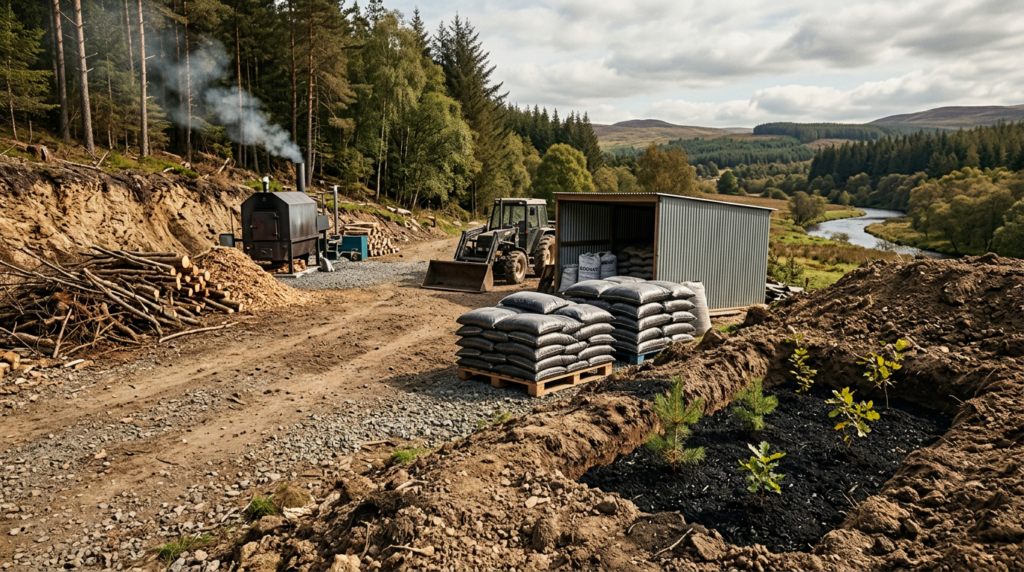
The Integrity Imperative in Biochar Carbon Removal
In the voluntary and compliance carbon markets, biochar carbon dioxide removal (CDR) has gained prominence because of its technical permanence and quantifiable physical properties. However, buyers, independent auditors, and registries demand complete operational transparency before issuing certified carbon sink credits (such as CORCs or Verified Carbon Units). A single missing link in documentation—whether an undocumented feedstock shipment, an unmonitored pyrolysis temperature dip, or vague end-use records—can invalidate an entire production batch.
Creating bankable, verified biochar carbon credits requires a continuous chain of custody and objective operational evidence. This evidence chain spans five primary stages: feedstock provenance, production logging, laboratory characterization, mass balance accounting, and physical end-use application. Understanding how these stages interconnect enables project operators and developers to establish durable compliance mechanisms from the outset.
Stage 1: Biomass Sourcing and Sustainability Proof
The carbon accounting framework begins long before feedstock enters the pyrolysis reactor. Certification standards, including Puro.earth, Verra (methodology VM0044), and the European Biochar Certificate (EBC), establish strict eligibility criteria regarding biomass origin to ensure that harvesting does not deplete natural carbon stocks or disrupt protected ecosystems.
To satisfy auditors, project developers must collect and maintain comprehensive origin documentation:
- Chain-of-Custody Documentation: Delivery manifests, weighbridge tickets, and contracts with timber mills, agricultural processors, or forestry authorities establishing clear legal ownership.
- Baseline Assessment Records: Evidence demonstrating that the biomass was genuine residue or waste that would have otherwise decomposed aerobically or been openly burned, rather than primary timber harvested specifically for biochar generation.
- Moisture and Contamination Logs: Intake testing reports confirming the biomass is free of chemical preservatives, treated wood coatings, plastics, and excessive inorganic soil.
Without traceable feedstock origins, registries cannot determine the project baseline, which halts validation before processing even begins.
Stage 2: Pyrolysis Operational Logs and Process Monitoring
Transforming raw biomass into recalcitrant carbon requires consistent thermal conditions. During pyrolysis, volatile matter is driven off, leaving a stable aromatic carbon matrix. Because carbon stability directly correlates with peak operating temperatures and residence times, third-party validation requires granular production logs.
Modern digital measurement, reporting, and verification (dMRV) setups capture continuous sensor streams rather than relying on manual paper entries. Auditors review the following operational records:
- Temperature Profiles: Continuous thermocouple data logging the highest treatment temperature (HTT) in the reactor core. Standard protocols typically require consistent temperatures above 500 degrees Celsius to guarantee the breakdown of labile organic compounds.
- Residence Time Logs: Conveyor feed rates, screw auger speeds, or batch duration records demonstrating that the feedstock spent sufficient time at the target temperature.
- Energy and Emissions Accounting: Fuel inputs (if external energy is used during start-up), electricity consumption meters, and documentation showing that pyrolysis syngas is effectively flared or combusted for process heat rather than vented directly to the atmosphere as unburned methane.
- Batch Run Sheets: Shift logs that tie specific feedstock lots directly to designated biochar output containers, establishing an unbroken identification numbering system.
Stage 3: Laboratory Characterization and Carbon Stability Testing
Physical production records indicate process consistency, but independent laboratory testing validates the actual chemical carbon sink value. Every certification standard mandates sampling protocols governed by ISO or ASTM testing standards.
Composite samples from distinct production runs must be sent to accredited third-party laboratories to measure specific stability and safety parameters:
- Hydrogen-to-Carbon (H:Corg) Ratio: This represents the primary metric of stability. Standard frameworks generally require an atomic H:Corg ratio below 0.7 (and often below 0.4 for higher permanence ratings), proving that the carbon is bound in polycyclic aromatic structures rather than unstable aliphatic chains.
- Oxygen-to-Carbon (O:Corg) Ratio: An additional indicator used to determine structural stability and assess potential long-term degradation in soil environments.
- Total and Organic Carbon Content: Testing to quantify the exact percentage of elemental carbon in the dry matter, which forms the numerical basis for carbon credit volume calculations.
- Contaminant Screening: Detailed assays verifying that heavy metals (such as lead, cadmium, arsenic), polycyclic aromatic hydrocarbons (PAHs), polychlorinated biphenyls (PCBs), and dioxins fall well below regulatory ecological thresholds.
Lab certificates must be tied directly to production batch numbers through documented chain-of-custody forms filled out during sampling.
Stage 4: Mass Balance and Storage Accounting
Carbon quantification relies on a strict mass balance calculation reconciling the biomass entering the facility, the biochar produced, and the carbon losses across the operational boundary. A failure to balance inputs against outputs raises fraud red flags during desk reviews.
Auditors look for explicit reconciliations covering:
- Dry-Matter Intake vs. Yield: Calculating the yield percentage based on bone-dry feedstock input weight versus total biochar dry weight produced. Yields that drift significantly outside standard technical expectations for a given technology require technical justification.
- Quenching Water Adjustments: Biochar is commonly quenched with water upon discharge to halt combustion and manage dust. Weighbridge and moisture sensor readings must be mathematically reconciled to distinguish between dry biochar mass and added moisture.
- Bagging and Serialized Storage: Finished biochar must be stored in secure, weather-protected environments with unique serialized lot numbers affixed to super-sacks or storage bays. Internal inventory movements must be tracked in warehouse management systems to prevent double-counting or unrecorded losses.
Stage 5: End-Use Application Evidence
A biochar carbon sink is only permanent if the biochar is placed into an environment where it will not be combusted as fuel. If a producer sells biochar to a third party that subsequently burns it for thermal energy, no net carbon removal occurs. Therefore, credit issuance depends on definitive proof of non-destructive application.
Registries demand rigorous documentation establishing the final sink destination, which most commonly falls into agricultural soil amendment or non-combustible material applications (such as concrete or asphalt aggregates):
- Custody Transfer Contracts: Sales agreements that explicitly prohibit the buyer from using the biochar as fuel and assign carbon credit ownership rights exclusively to the project developer.
- Delivery and Transport Proof: Bill of lading documents, freight carrier receipts, and delivery confirmations signed by the end-user.
- Application Logs and Geolocation Data: GPS-tagged photographs or machinery logs showing the biochar being incorporated into agricultural land, forestry tracts, or construction materials. In distributed smallholder or multi-farm models, projects utilize mobile dMRV applications to collect point coordinates, field boundary polygons, and operator signatures directly at the site of spreading.
Stage 6: Registry Validation, Verification, and Issuance
Once all raw data, laboratory analyses, mass balance models, and application proofs are assembled, the project developer presents the portfolio to an independent validation and verification body (VVB). The VVB conducts a desk audit and an on-site facility inspection to confirm that physical realities match the submitted logs.
During registry review:
- The auditor verifies the baseline calculations, ensuring that all upstream emissions (transport of feedstock, processing energy) and downstream emissions (distribution, spreading) are subtracted from the gross carbon removed.
- A permanence factor and standard uncertainty deduction are applied in accordance with the chosen registry methodology.
- The registry reviews the VVB report, verifies that no duplicate credits exist in other registries, and officially issues serialized carbon removal credits into the developer’s registry account.
Building Institutional Readiness for dMRV
Managing the biochar evidence chain using fragmented spreadsheets and manual paper logs creates significant operational friction, limits audit turnaround times, and increases certification failure risk. As registries tighten requirements regarding data provenance and anti-double-counting controls, industrial operators are transitioning to automated digital measurement, reporting, and verification platforms.
Digital systems collect telemetry directly from kiln controllers, integrate with weighbridge scales, link directly to lab information systems, and track field application via geofenced mobile tools. This creates an unalterable, chronological data pathway that streamlines the external audit process, reduces validation cycles, and produces high-integrity credits that withstand rigorous buyer due diligence.
Whether you are designing a new biochar production facility, preparing an existing plant for registry listing, or developing the compliance mechanisms required for carbon credit issuance, ForestTwin provides end-to-end support across project design, dMRV implementation, and certification navigation. To review your operational data pipeline and assess your project’s readiness for carbon sink certification, contact our technical advisory team.