
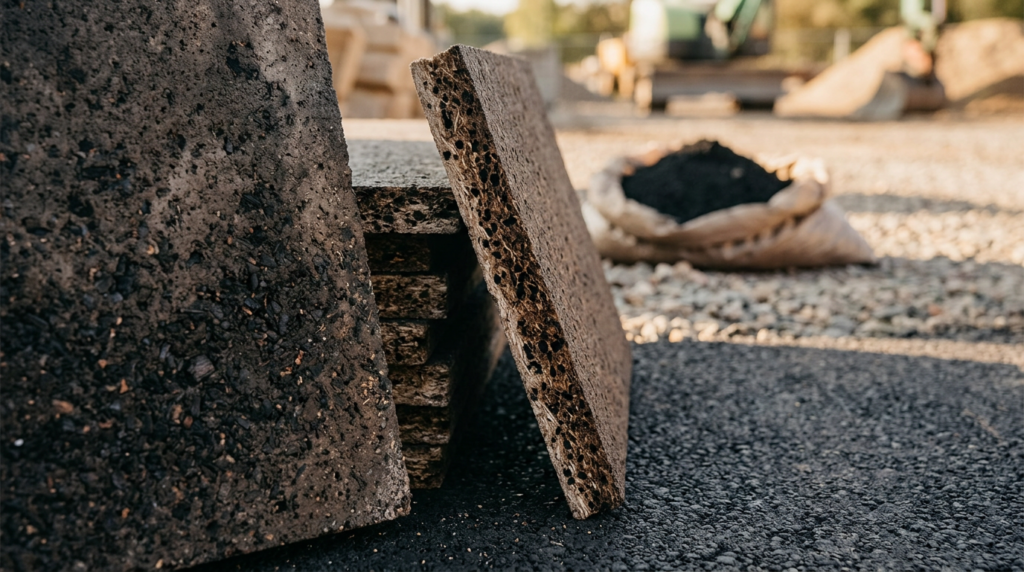
Decarbonizing the Built Environment with Pyrogenic Carbon
The construction sector faces an urgent mandate to reduce embodied carbon across its supply chains. Traditional building materials—chiefly ordinary Portland cement, bitumen-based asphalt, and resin-bound composite boards—carry substantial greenhouse gas footprints derived from energy-intensive extraction, chemical calcination, and fossil-based refining. Addressing these emissions requires not only process efficiency gains but also the direct integration of stable, carbon-negative mineral fillers and admixtures.
Biochar, produced through the controlled pyrolysis of sustainably sourced biomass under oxygen-limited conditions, presents a technically viable pathway for physical carbon sequestration within infrastructure. When incorporated into building matrices, the recalcitrant carbon structures within biochar are locked away from the atmospheric carbon cycle for decades or centuries. Beyond its role as an inert carbon sink, biochar functions as a functional micro-filler and modifier. However, translating laboratory success to industrial specification requires a grounded understanding of how biochar influences rheology, mechanical strength, durability, and processing requirements across diverse material systems.
Biochar in Concrete and Cementitious Matrices
Concrete is the most consumed synthetic material on Earth, and ordinary Portland cement production accounts for a substantial fraction of global industrial carbon dioxide emissions. The introduction of biochar into cementitious mixtures typically follows two pathways: as a supplementary cementitious material (SCM) or partial binder replacement, and as a partial replacement for fine aggregates like silica sand.
Mechanisms of Action and Hydration Kinetics
Biochar particles possess highly porous internal architectures and vast specific surface areas. When milled to a fine particulate size comparable to cement grains, biochar can exert a micro-filler effect, packing into interstitial voids within the hydrating cement paste. This micro-filler action refines the pore network, densifying the interfacial transition zone (ITZ) between the paste and surrounding aggregates.
Additionally, biochar exhibits distinct water absorption-desorption behavior. Its internal micro- and mesopores can draw in batch water during initial mixing and progressively release it as the matrix cures. This process mirrors internal curing, sustaining relative humidity inside the hardening concrete and promoting continuous hydration of unreacted clinker phases. The result is often an observed reduction in early-age autogenous shrinkage cracking, provided the mix design accounts for initial moisture equilibrium.
Mechanical and Durability Characteristics
The structural performance of biochar-augmented concrete depends heavily on particle size distribution, feedstock morphology, pyrolysis temperature, and the dosage rate by weight of binder:
- Compressive and Flexural Strength: Low-dose additions, typically within low single-digit weight percentages of cement, frequently sustain or marginally improve compressive and flexural strength. The internal curing effect and matrix densification offset the loss of reactive clinker. However, exceeding optimal dosing thresholds often causes strength regressions, as excess porous carbon increases total porosity or agglomerates, creating local stress concentrations.
- Water Permeability and Sorptivity: A refined pore structure can decrease water sorptivity and reduce the penetration of external moisture. This confers benefits for freeze-thaw durability and resistance to aggressive ionic penetration, such as sulfate and chloride attack, protecting embedded steel reinforcement from premature corrosion.
- Thermal and Acoustic Performance: Due to its low skeletal density and air-trapping porous structure, concrete containing biochar demonstrates reduced thermal conductivity. This property makes it appealing for structural masonry units, insulated panels, and lightweight screeds where thermal resistance lowers operational heating and cooling demands.
Operational and Mix Formulation Trade-Offs
Integrating biochar into ready-mix or precast operations introduces clear rheological challenges. Biochar’s high affinity for water readily saps free water from the fresh paste, leading to sharp declines in slump and workability. To maintain required placement characteristics, concrete technologists must adjust water-reducing admixtures or superplasticizers, or explore pre-soaking the biochar prior to batching. Sourcing teams must also establish tight specifications for ash content, pH, volatile matter, and organic contaminants, as variable residual organics can impede cement hydration reactions or cause variable setting times.
Biochar as an Asphalt Binder Modifier and Aggregate Filler
Bituminous pavements represent another high-volume sink for biochar integration. In road construction, biochar is evaluated primarily as an asphalt binder modifier to alter viscoelastic performance or as an alternative mineral filler within hot-mix asphalt (HMA) and warm-mix asphalt (WMA) designs.
Viscoelasticity and Rutting Resistance
Asphalt pavements suffer from two opposing operational failure modes: rutting at elevated summer temperatures and thermal cracking during sub-zero conditions. When blended into bitumen at high shear, finely ground biochar acts as a stiffening agent. It increases the complex shear modulus and reduces phase angles across high service temperatures, reflecting enhanced elastic response and reduced permanent deformation under repetitive axle loading.
The interaction between polar functional groups on the biochar surface and bitumen fractions can also stabilize lighter malthene phases, lowering the pavement’s susceptibility to rutting and moisture-induced stripping. Because biochar is composed of rigid carbon skeletons, its introduction as a mineral filler in stone-matrix or dense-graded asphalt improves structural stability when aggregate skeletons bear heavy traffic loads.
Aging and Oxidation Mitigation
Bitumen degrades over its service life through oxidative aging and exposure to ultraviolet (UV) radiation, which hardens the asphalt and induces brittle cracking. The deep black pigmentation and radical-trapping surface characteristics of certain biochars allow them to absorb UV radiation and mitigate photo-oxidation. Biochar particles distributed throughout the binder layer can slow the rate of carbonyl and sulfoxide formation, preserving binder ductility and delaying fatigue failure over prolonged environmental exposure.
Processing Realities in Pavement Infrastructure
Despite its promise, deploying biochar in asphalt plants presents operational constraints that must be handled systematically:
- High-Temperature Blending Viscosity: Increasing biochar dosage increases binder viscosity at elevated temperatures, which can necessitate higher mixing and compaction temperatures unless combined with warm-mix chemical additives. Higher plant temperatures risk increasing fuel consumption, which could offset a portion of the embodied carbon savings.
- Low-Temperature Ductility: While biochar enhances high-temperature stiffness, excessive stiffening can impair low-temperature relaxation properties, potentially raising the risk of thermal fatigue cracking in cold climates. Balancing binder grades is critical.
- Batching and Dust Control: Bulk biochar can be prone to dust generation and particulate suspension during dry-feed processes, requiring enclosed pneumatic conveying systems or masterbatch pelletization to comply with workplace safety standards.
Biochar in Building Boards and Interior Composites
Beyond structural and civil works, biochar shows significant utility in non-structural interior systems, specifically drywall, gypsum plasterboards, acoustic tiles, and wood-plastic composites (WPCs).
Gypsum Plasterboards and Drywall
Gypsum boards are widely deployed for interior partitions, ceiling systems, and fire-rated assemblies. Incorporating biochar into the gypsum core serves multiple functional roles:
- Weight Reduction: Replacing a fraction of calcined gypsum stucco with lightweight biochar reduces the dead weight of individual boards, lowering logistics emissions and facilitating manual handling during site installation.
- Humidity Buffering: Biochar’s open microporous matrix acts as a passive moisture buffer, absorbing ambient water vapor during high-humidity cycles and releasing it as indoor air dries, contributing to healthier indoor environmental quality (IEQ).
- Thermal and Acoustic Damping: Porous gypsum-biochar cores offer superior sound transmission loss and improved acoustic attenuation relative to standard dense plasterboards, alongside incremental gains in thermal resistance.
Fiberboards and Wood-Plastic Composites
In medium-density fiberboards (MDF), particleboards, and exterior decking panels, biochar can partially substitute for wood flour or cellulosic fibers. In polymer composites (such as polyethylene or polypropylene-based WPCs), biochar provides structural reinforcement, enhances flexural modulus, and limits moisture absorption that normally causes swelling, fungal decay, and biological degradation in wood-fiber systems.
Furthermore, biochar promotes fire safety. When exposed to flame, biochar does not volatilize easily; instead, it acts as an expanded thermal barrier and char layer that slows heat transfer through the board and limits smoke development. Nevertheless, manufacturers must formulate their resin systems carefully, as biochar’s porous surface can soak up expensive polymeric binders like MDI or phenol-formaldehyde, demanding refined surface-treatment or particle-sizing strategies.
Carbon Accounting, dMRV, and Life-Cycle Realities
The carbon sequestration potential of biochar in built infrastructure cannot be taken on assumption; it must be verified through empirical Life Cycle Assessments (LCAs) and rigorous digital Measurement, Reporting, and Verification (dMRV) frameworks.
Durable Storage and Permanence
Unlike agricultural soils, where biochar remains subject to potential tilling, physical erosion, and biotic perturbation over centuries, biochar entombed within alkaline concrete or encapsulated within impermeable asphalt binders is highly protected from environmental degradation. These building matrices provide an exceptionally durable repository for biogenic carbon, preventing oxidation back into atmospheric carbon dioxide.
To generate credible carbon removal credits or substantiate Environmental Product Declarations (EPDs), practitioners must verify the molar hydrogen-to-carbon (H/C_org) ratio of the biochar, ensuring it falls well below standardized international durability limits (such as those established by the European Biochar Certificate or the International Biochar Initiative). Low H/C ratios demonstrate high aromaticity and chemical recalcitrance.
Regulatory Alignment and Corporate Reporting
For industrial corporations and developers aligning their balance sheets with sustainability frameworks, integrating verified carbon-storing materials directly influences Scope 3 emissions calculations under the Greenhouse Gas Protocol. Furthermore, these practices intersect with financial disclosures mandated by frameworks such as IFRS S2 (Climate-related Disclosures), where organizations must quantify climate-related physical and transition risks along with tangible decarbonization initiatives.
Deploying biochar within regional schemes, such as India’s Green Credit Programme governed by the Ministry of Environment, Forest and Climate Change (MoEFCC), requires transparent traceability from the source of residual agricultural or forestry biomass through pyrolysis processing and final incorporation into the built asset. Digital MRV architectures automate this data trail, eliminating reliance on discontinuous manual records and ensuring additionality and permanence remain beyond dispute.
Industrial Adoption Challenges and Quality Benchmarks
Widespread commercialization of biochar-amended construction materials will not depend on academic proof of concept; it hinges on strict quality assurance and industrial scale. Material specifiers, structural engineers, and contractors require uniform, predictable performance across every batch.
Key engineering hurdles currently being addressed across the sector include:
- Feedstock Homogeneity: Pyrolyzing mixed municipal wastes or contaminated organic streams introduces heavy metals, high chlorine concentrations, or variable ash contents that degrade concrete chemistry and promote steel rebar corrosion. Sourcing must focus on uniform, clean agricultural residues or managed silvicultural byproducts.
- Standardization and Codification: Standard-setting bodies like ASTM International, the European Committee for Standardization (CEN), and national bureaus are progressively developing targeted specifications for biochar as a concrete additive and asphalt modifier. Until biochar is formally written into prescriptive building codes, projects must operate under performance-based specifications, requiring extensive pre-pour test regimes.
- Cost-Performance Parity: While the carbon removal attributes of biochar carry real value, the raw material must compete against cheap, incumbent mineral fillers like limestone dust, fly ash, and slag. Balancing procurement costs requires optimized dosing that captures both mechanical performance benefits and carbon revenue streams.
As the construction ecosystem shifts toward low-carbon procurement standards, biochar transitions from an experimental additive to a standardized industrial ingredient. By pairing disciplined material science with transparent carbon accounting, developers can convert foundational infrastructure into durable, high-performance carbon sinks.
To evaluate certified biochar sourcing for building materials, integrate verifiable carbon project development, or structure your corporate decarbonization reporting, connect with our industrial advisory team at ForestTwin Contact.