
The Denominator Problem in Biochar Carbon Removal
When buyers and project developers evaluate biochar, confusion often arises around the core metric: cost per tonne. In agricultural markets, biochar is priced per metric ton of physical material delivered to the field. In carbon dioxide removal (CDR) markets, credits are issued per metric ton of net carbon dioxide equivalent (tCO2e) permanently stored. These two figures are never identical, and conflating them leads to mispriced risk, distorted project pro formas, and flawed procurement decisions.
Transforming raw biomass into verified CDR credits involves material shrinkage and parasitic emissions. Raw agricultural residues or forestry thinnings contain substantial moisture and volatile matter. Thermal conversion under oxygen-limited conditions yields biochar with a fixed carbon content that represents only a fraction of the original biomass weight. Furthermore, net credit generation requires subtracting the cradle-to-grave greenhouse gas emissions of the entire operation: transport, pre-processing, auxiliary fuel, processing electricity, packaging, distribution, and soil application.
To establish a reliable cost structure for biochar CDR, developers and buyers must examine the five distinct cost layers that determine the true economics per sequestered tonne: feedstock acquisition and preparation, pyrolysis equipment depreciation and operation, downstream logistics and distribution, measurement, reporting, and verification (MRV), and project-level risk buffers. Pricing must always be verified against real-time operational balance sheets rather than theoretical models.
Feedstock Sourcing, Logistics, and Pre-Treatment
Feedstock represents the foundational input and one of the most volatile variables in biochar economics. A project relying on agricultural waste like crop husks, bagasse, or pruned orchard wood must account for seasonal availability, competing regional uses, and significant pre-processing requirements.
The physical journey of biomass incurs three primary operational expenses:
- Aggregation and Inbound Freight: Biomass is low in bulk density. Transporting loose or bulky residues across long distances quickly introduces prohibitive transport costs and diminishes net carbon accounting through diesel consumption. Sourcing radii are typically restricted to manageable geographical zones to maintain project additionality and cost containment.
- Moisture Reduction: Fresh or field-collected biomass frequently holds high moisture levels. Pyrolysis requires feedstock dried to specific thresholds to maintain thermodynamic efficiency. Drying methods—whether utilizing recovered pyrolysis off-gases, ambient air sheds, or dedicated drying units—incur measurable capital depreciation, energy consumption, or extended storage footprints.
- Size Reduction and Homogenization: Continuous-feed pyrolysis kilns require consistent particle sizes. Chipping, shredding, pelletizing, or screening add equipment wear-and-tear, maintenance costs, and electrical loads that must be accounted for before the material ever enters the reactor.
Opportunity costs also cannot be ignored. Even if biomass is designated as waste, competing localized demands—such as animal bedding, biomass power generation, or direct soil incorporation—can alter acquisition costs across different operating cycles.
Pyrolysis Technology: CAPEX Amortization and Operating Overhead
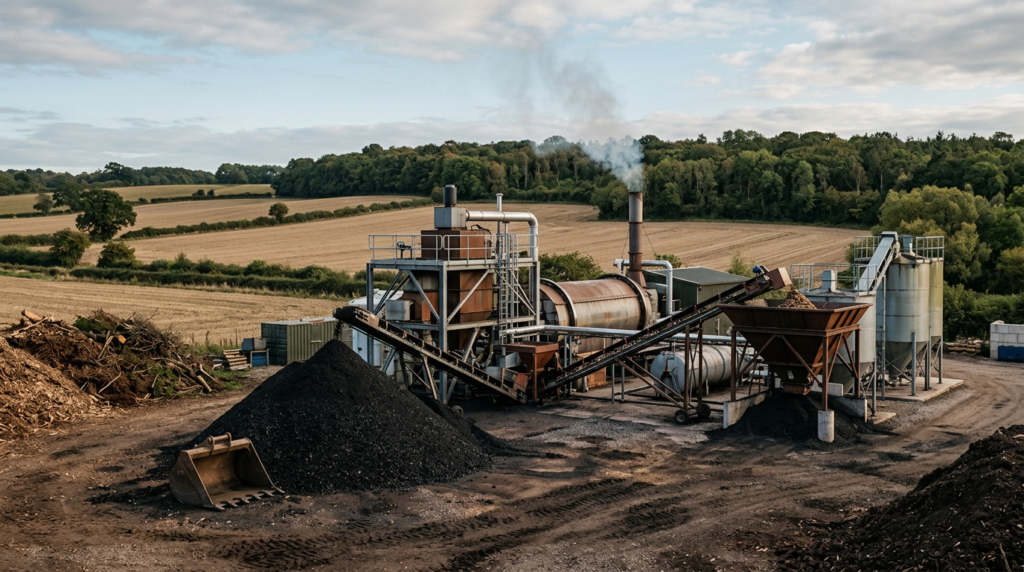
The conversion unit is the central capital asset of any biochar enterprise. Pyrolysis systems vary significantly in design, ranging from decentralized batch kilns to high-throughput, continuous industrial retorts. The economic profiles of these systems reflect fundamentally different engineering approaches.
Capital Expenditure (CAPEX) Amortization
Industrial-scale continuous reactors require substantial upfront capital. These systems feature automated feeding, advanced heat-exchange recovery, continuous process control instrumentation, and flue gas scrubbing. High-volume throughput distributes this large capital expense across tens of thousands of tonnes over the plant’s operating lifespan. Conversely, modular or batch kilns carry significantly lower initial price tags but generate lower output per unit of time, shifting the unit economics away from capital amortization and toward operational labor.
Operating Expenditure (OPEX)
Operational costs at the processing facility encompass several continuous inputs:
- Thermal and Electrical Balance: While modern continuous systems utilize syngas to sustain internal reactor temperatures, auxiliary fuels are required for startup phases. Auxiliary power is also required for drives, fans, blowers, and safety mechanisms.
- Labor and Technical Oversight: Facilities require skilled operators to maintain process consistency, manage variable feed rates, and monitor emissions abatement equipment. Highly automated systems lower direct labor hours per tonne but demand higher technical compensation.
- Refractory and Component Maintenance: Exposure to extreme temperatures, thermal cycling, corrosive volatile vapors, and abrasive biomass dust causes continuous wear on screws, seals, and refractory linings. Unscheduled downtime reduces cumulative output, directly inflating the per-tonne overhead allocation.
Downstream Logistics, Storage, and Final Application
A biochar credit cannot be issued while the physical carbon remains sitting in bags at the production yard. Permanence protocols require evidence of stable placement in an eligible sink, most commonly agricultural soil, compost blending, or non-degradable industrial matrices like concrete.
Moving biochar from the kiln to its permanent resting location involves dedicated post-production steps:
- Quenching and Conditioning: Fresh biochar is pyrophoric and prone to auto-ignition. It must be safely quenched with water or blended with compost or moist organic matter before transport. This step adds weight and volume, directly increasing downstream hauling costs.
- Dust Mitigation and Containment: Handling fine, dry biochar poses particulate inhalation hazards and environmental dispersion challenges. Containment bags, specialized bulk transport, or pelletization add material handling costs.
- Application Mechanics: Spreading biochar across agricultural acreage requires agricultural machinery, fuel, and field labor. In many developer models, the biochar is provided at subsidized rates or for free to local farmers to ensure secure, documented placement, meaning the carbon removal credit must absorb the full economic cost of application.
The MRV Layer: Testing, Verification, and Registry Overhead
Digital measurement, reporting, and verification (dMRV) together with carbon registry overhead form a mandatory layer of cost that directly influences the final credit price. Without exhaustive empirical verification, biochar is simply an agricultural amendment, not an institutional-grade carbon removal asset.
MRV costs are divided into technical validation and administrative registry fees:
- Laboratory Characterization: Standards such as the European Biochar Certificate (EBC), Puro.earth, or Carbon Standards International mandate rigorous composite sampling. Tests must confirm the hydrogen-to-organic-carbon (H:Corg) ratio to substantiate permanent mineralization, along with tests for heavy metals, polycyclic aromatic hydrocarbons (PAHs), and total organic carbon content. Each testing cycle adds recurring laboratory expenses.
- Digital Tracking and Sensor Networks: Traceability from biomass source to applied acre requires robust data platforms. Sensor logging of kiln temperatures, automated weight-scale integrations, and digital chain-of-custody documentation represent recurring software and integration expenses.
- Third-Party Audits: Independent validation and verification bodies (VVBs) must inspect production facilities, review operations data, verify emissions deductions, and ensure registry standards are met. VVB site audits, desk reviews, and travel logistics introduce significant fixed costs per issuance event.
- Issuance and Account Maintenance Fees: Registries charge account maintenance fees, methodology development levies, and direct issuance fees per generated credit. These fixed per-tonne fees set a firm administrative floor beneath CDR pricing.
Project Finance, Working Capital, and Developer Risk Margins
The final component of biochar CDR unit economics covers project financing and risk mitigation. Building a durable carbon removal business requires working capital to bridge the months-long gap between biomass procurement, biochar production, soil application, lab analysis, third-party verification, and credit issuance.
Lenders and equity partners demand a return commensurate with project risk. Furthermore, project developers must hold risk buffers: setting aside non-marketed credits to account for potential reversal events, unexpected downtime, regulatory changes, or feedstock price spikes. The developer margin must also fund commercial origination, legal compliance, and long-term data custody obligations that extend decades beyond the year of initial production.
Evaluating Biochar CDR Procurement Objectively
For corporate buyers and project investors, dissecting these cost layers provides a defense against unrealistic claims. Low-priced biochar credits frequently indicate that a project has omitted critical lifecycle emissions, operates with inadequate MRV, or shifts the financial burden of transport and application onto rural recipients without verified permanence.
A rigorous economic framework exposes the dependencies of the physical process. As technology options mature, feedstock supply chains formalize, and registry requirements standardize, the margin for hidden costs diminishes. Understanding the structural costs of biomass, conversion, transport, and certification allows market participants to negotiate clear contracts, design resilient facilities, and verify that every purchased tonne corresponds to verifiable, permanent atmospheric removal.
Whether designing a project finance facility, selecting appropriate thermal conversion equipment, or structuring durable biochar carbon removal agreements, transparent economics are mandatory. Contact the carbon removal and MRV specialists at ForestTwin to review project fundamentals, establish robust dMRV frameworks, or structure compliant offtake portfolios: https://foresttwin.com/contact/?utm_source=blog&utm_medium=organic&utm_campaign=seo_engine.