
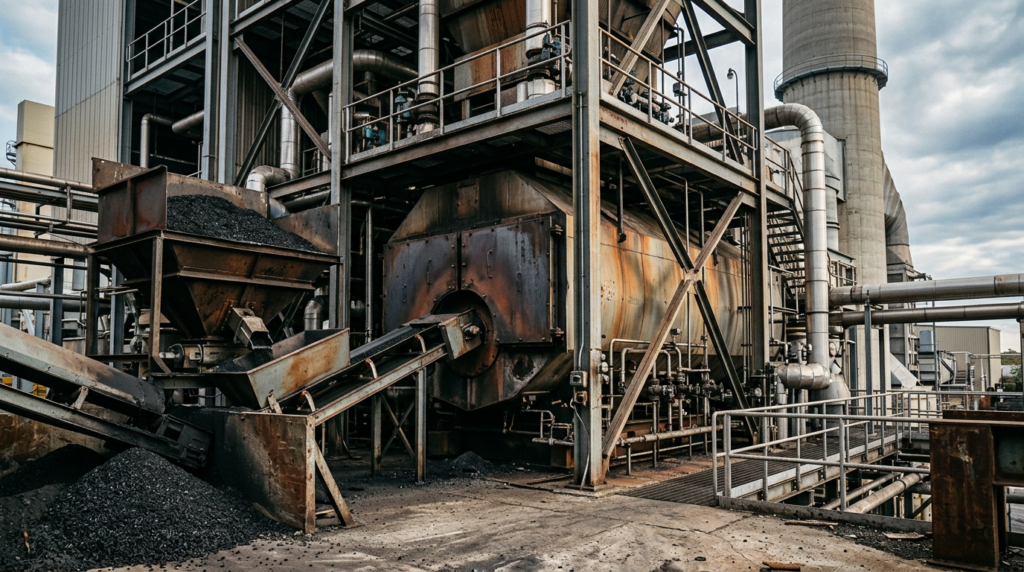
Industrial Decarbonization and the Biochar Dilemma
Industrial facilities operating solid-fuel boilers face intense scrutiny regarding their greenhouse gas emissions. Heavy industries, pulp and paper producers, chemical processing plants, and power generation units increasingly evaluate solid biofuels to displace thermal coal. Raw biomass pellets and agricultural residues serve as common replacements, but their handling challenges—high moisture content, low energy density, biological degradation during storage, and poor grindability—often constrain co-firing ratios to modest percentages.
Biochar, produced via the thermochemical conversion of biomass in an oxygen-limited environment (pyrolysis), offers an alternative solid fuel profile. Pyrolysis upgrades raw biomass into a carbon-dense, hydrophobic, easily pulverized material with characteristics approaching or matching various grades of thermal coal. However, utilizing biochar as a combustible fuel presents an immediate strategic conflict: should an enterprise burn biochar to reduce Scope 1 emissions, or should that material be preserved and soil-applied to generate verified Carbon Dioxide Removal (CDR) credits?
Answering this question requires rigorous thermodynamic calculations, carbon accounting discipline, and financial modeling. Evaluating the trade-offs between thermal substitution and permanent carbon storage clarifies where capital and resources yield the highest climate and financial return.
Thermodynamic Profile and Combustion Dynamics
To assess the technical feasibility of co-firing biochar with coal or other primary solid fuels, plant engineers must examine the material’s physical and thermodynamic properties relative to raw feedstocks and pulverized coal.
Energy Density and Higher Heating Value
Raw biomass typically carries a Higher Heating Value (HHV) between 16 and 19 MJ/kg on a dry basis, coupled with moisture levels that can range from 15% to more than 50%. This high moisture content depresses the Lower Heating Value (LHV) and demands significant latent heat for water vaporization during combustion, which reduces total boiler thermal efficiency.
In contrast, the pyrolysis process drives off high-oxygen volatile matter and concentrated moisture, yielding a biochar with an HHV typically between 24 and 30 MJ/kg depending on feedstock selection and process temperatures. This brings biochar directly into parity with sub-bituminous and bituminous industrial steaming coals. Because biochar is hydrophobic, it reabsorbs minimal atmospheric moisture, stabilizing its as-fired calorific value throughout transit and storage.
Volatiles, Fixed Carbon, and Grindability
The operational behavior of biochar inside a utility or industrial boiler diverges markedly from raw biomass:
- Volatile Matter to Fixed Carbon Ratio: Raw biomass is dominated by volatile matter (often 70% to 80%), leading to rapid gas-phase ignition and long, luminous flames. Biochar features low volatile content (often 10% to 25%) and high fixed carbon (typically 65% to 85%). Its combustion mechanism is dominated by char oxidation, resembling anthracite or low-volatile bituminous coal. Flame stability requires careful burner adjustment and primary air-to-fuel ratio control.
- Hardgrove Grindability Index (HGI): Fibrous raw biomass resists conventional pulverizers (bowl mills, roller mills, and ball mills), causing mill binding and elevated auxiliary power consumption. The thermal degradation of hemicellulose and lignin during pyrolysis creates a brittle matrix that fractures easily. The HGI of biochar is substantially higher than raw biomass, allowing it to be co-milled with coal in existing coal pulverization infrastructure without severe capacity derating.
- Ash Chemistry and Slagging: Agricultural residues can carry elevated levels of potassium, sodium, and silica, which produce low-melting-point eutectic phases that exacerbate slagging and fouling on heat exchanger tubes. Biochar concentrates the inorganic fractions of its input feedstock. If produced from high-alkali agricultural residues, the ash deposition risk remains significant; if derived from clean woody biomass, the ash content is low, with refractory characteristics that integrate smoothly into standard boiler ash handling circuits.
The Energy Math: Fuel Substitution Ratios
Quantifying the thermal replacement capability of biochar requires an input-output energy balance. In a baseline scenario, an industrial boiler fires thermal coal to generate process steam. Introducing biochar displaces a portion of this fossil fuel input based on effective energy parity.
The mass replacement ratio depends entirely on the respective net calorific values (NCV) or lower heating values of the fuels as received:
Mass of Coal Replaced = Mass of Biochar Fired × (NCV of Biochar / NCV of Coal)
Because raw biomass contains elevated moisture, its effective NCV often forces an industrial facility to burn 1.5 to 2.0 metric tons of raw biomass to displace 1.0 metric ton of standard industrial coal. Biochar, by contrast, frequently achieves replacement ratios near 1.0 to 1.2 tons of biochar per ton of coal, depending on coal grade.
Furthermore, because biochar lacks moisture-induced sensible and latent heat penalties, the overall boiler efficiency curve remains largely stable. Auxiliary power demands also stabilize: the mill grinding power per megawatt thermal (MWth) matches coal operations much closer than raw biomass pellet co-firing, protecting the plant from parasitic load penalties that lower overall net plant heat rate.
The Carbon Math: Co-Firing vs. Durable CDR
While the thermal energy balance of biochar is favorable, the carbon accounting equations reveal a stark divergence between combustion and soil or materials sequestration.
Scenario A: Co-Firing Biochar (Emissions Avoidance)
Under international greenhouse gas accounting frameworks, such as the GHG Protocol and ISO 14064-1, biomass is categorized as biogenic carbon. When biochar is fired in a boiler:
- Biogenic Emissions: The carbon stored in the biochar oxidizes into carbon dioxide (CO2) and exits the flue stack. Under corporate inventories, this biogenic CO2 is reported outside of Scope 1 or treated as climate-neutral at the point of combustion, under the assumption that the carbon was captured from the atmosphere during biomass growth.
- Fossil Emissions Displaced: Scope 1 emissions decrease in direct proportion to the displaced coal. Burning one metric ton of typical thermal coal generates between 2.0 and 2.4 metric tons of fossil CO2 emissions. If 1.1 metric tons of biochar displace 1.0 metric ton of coal, the facility directly reduces its Scope 1 emissions by roughly 2.0 to 2.4 metric tons of fossil CO2.
- Net Balance: Fossil fuel consumption drops, Scope 1 reporting improves, and biogenic carbon returns to the active biospheric cycle. No net atmospheric removal occurs; this is strictly an avoided emissions intervention.
Scenario B: Biochar for Durable CDR (Atmospheric Removal)
When high-carbon biochar is applied to soil, incorporated into concrete, or embedded in stable materials, the carbon is sequestered out of the active carbon cycle for centuries. Major durability standards (such as Puro.earth, Verra VCS VM0044, or Carbon Standards International) quantify the carbon dioxide removal achieved per metric ton of pure biochar:
- Carbon Concentration: High-temperature biochar typically contains 75% to 85% elemental carbon.
- Stoichiometric Conversion: Every metric ton of pure elemental carbon represents approximately 3.67 metric tons of biogenic CO2 equivalent drawn down from the atmosphere via photosynthesis (44/12 molecular weight ratio).
- Permanence and Reversibility Deductions: Accounting standards apply durability discounts based on the hydrogen-to-carbon (H:C_org) ratio. An H:C_org ratio below 0.4 indicates high polyaromatic condensation, typically yielding a certified durability factor exceeding 100 to 1,000 years.
- Lifecycle Deductions: Emissions associated with biomass gathering, processing, pyrolysis thermal inputs, and final transport must be subtracted from gross removals (cradle-to-grave lifecycle analysis).
- Net Balance: One dry metric ton of premium biochar, sequestered permanently, generates approximately 2.2 to 2.8 metric tons of net verified CO2 removal (CDR).
Economic Decision Framework: When Burning Beats CDR (and Vice Versa)
Deciding whether to co-fire biochar or monetize it as a CDR asset depends on the relative economics of fuel cost, carbon pricing, compliance requirements, and dMRV (digital Measurement, Reporting, and Verification) overhead.
When Burning Biochar Is the Rational Choice
Thermal utilization becomes economically advantageous under specific conditions:
- High Delivered Fossil Fuel Costs: When industrial coal, natural gas, or fuel oil prices are exceptionally high, the avoided fuel cost per gigajoule (GJ) provides immediate operational savings that can outweigh the net revenues of third-party carbon credits.
- Direct Carbon Tax / Cap-and-Trade Penalties: Facilities covered under strict compliance programs (such as the EU Emissions Trading System, high-rate national carbon taxes, or emerging Asian compliance schemes) pay cash penalties for every ton of Scope 1 fossil CO2 emitted. If the marginal cost of a compliance allowance exceeds the net margins achievable from issuing voluntary CDR credits, displacing fossil fuel directly within Scope 1 boundaries is financially superior.
- Mandatory Co-Firing Policies: Regulatory directives, such as national policies mandating biomass blending in thermal facilities (for instance, directives managed under environmental ministries), create legal compliance imperatives that supersede voluntary credit sales.
- Low Quality / High Contamination Feedstock: Biochar produced from municipal green waste, specific sludges, or heterogeneous refuse may possess high ash levels, heavy metals, or volatile organic compounds that disqualify it from agricultural application or high-tier CDR standards. If the material satisfies regional air quality and boiler emission limits, thermal recovery is its highest-value use.
When Selling Biochar as CDR Is the Rational Choice
Monetizing biochar for carbon removal credits dominates under the following conditions:
- High Premium for Durable Removals: Verified, durable CDR credits trade at significant premiums compared to conventional avoidance credits or low-cost carbon allowances. Because permanent carbon removals are scarce, buyers with net-zero mandates actively seek biochar credits with robust digital verification.
- Abundant Low-Cost Alternative Biomass: If a boiler can achieve its decarbonization targets using raw biomass, low-grade forestry residues, or inexpensive agricultural pellets without requiring refined biochar, allocating biochar to combustion destroys financial value. Raw residues cannot qualify for high-durability CDR, but biochar can.
- Compliance Flexibility: Where corporate sustainability disclosures (such as IFRS S2 or regional reporting guidelines) prioritize Scope 3 neutrality or durable carbon removals alongside operational reductions, maintaining the carbon permanence of biochar delivers broader stakeholder and market value.
Operational, Safety, and Compliance Considerations
Transitioning from pure coal or raw biomass to biochar co-firing introduces unique engineering factors that industrial operators must navigate:
Combustion and Environmental Controls
Because biochar features low volatile content, burner configurations must ensure stable ignition. Low-NOx burners designed for high-volatile fuels may require primary air adjustments to avoid flame detachment or late ignition. Conversely, because biochar generally contains very low sulfur compared to standard thermal coals, co-firing reduces sulfur dioxide (SO2) flue gas concentrations, relieving load on wet or dry flue gas desulfurization systems.
Dust Explosion and Storage Safety
Pyrolyzed material is dry, brittle, and prone to dust generation. Biochar dust can form explosive mixtures with air within enclosed conveyor systems, silos, and mills. Industrial facilities must verify that fire suppression, explosion venting, and grounding protocols comply with relevant industrial safety standards (such as NFPA 652 and NFPA 654) before processing significant volumes through conventional coal-handling circuits.
Digital MRV and Traceability
Whether biochar is directed to an industrial burner or an agricultural field, traceability is foundational. Determining the net greenhouse gas impact requires absolute certainty regarding biomass origin, chain of custody, and production parameters. Digital Measurement, Reporting, and Verification (dMRV) systems ensure that the energetic and biogenic attributes of the material are accounted for precisely once. Double-counting—claiming an avoided Scope 1 emission inside an industrial boiler while attempting to claim a carbon removal credit on the voluntary market—violates GHG Protocol guidelines and International Sustainability Standards Board (ISSB) principles, presenting severe legal and reputational risks.
Aligning Boiler Operations with Carbon Accounting Strategy
Industrial organizations must avoid treating biochar merely as an energy commodity or strictly as an environmental offset. It sits uniquely at the intersection of thermal performance and atmospheric carbon accounting. Determining the optimal allocation of biochar demands an integrated review combining thermodynamics, boiler engineering, regional regulatory frameworks, and market-driven carbon mechanisms.
By applying formal energy and carbon balances to their specific operating profiles, industrial energy managers and sustainability directors can select the fuel and carbon pathways that optimize operational reliability, regulatory compliance, and economic returns.
To evaluate biochar co-firing feasibility, quantify project-specific energy and carbon trade-offs, or implement robust dMRV frameworks for corporate sustainability and compliance reporting, visit ForestTwin to speak with our technical advisory team.