
Understanding India’s Green Credit Programme (GCP)
India’s Ministry of Environment, Forest and Climate Change (MoEFCC) notified the Green Credit Rules under the Environment (Protection) Act, 1986, establishing a market-based mechanism designed to incentivize voluntary environmental actions. Known as the Green Credit Programme (GCP), this initiative operates independently of, but complementary to, carbon credit markets. While carbon credits strictly measure greenhouse gas reductions or removals, green credits reward a broader spectrum of positive ecological interventions, ranging from afforestation and water harvesting to sustainable agriculture and waste management.
For corporate enterprises, industrial developers, and institutional landholders, the GCP establishes a structured pathway to align sustainability targets with quantifiable, tradable environmental assets. Understanding how the program is governed, which activities qualify, and the process for credit issuance is essential for businesses planning their domestic environmental strategies in India.
The Regulatory and Administrative Architecture
The Green Credit Programme is designed with a tiered governance structure to maintain administrative oversight, technical rigor, and registry transparency:
- Steering Committee: Headed by senior administrative officials from line ministries, industry associations, and domain specialists, the committee oversees program policies, recommends activities, and monitors overall implementation.
- Administrator (ICFRE): The Indian Council of Forestry Research and Education (ICFRE), an autonomous body under MoEFCC based in Dehradun, serves as the program administrator. ICFRE develops methodologies, approves operational guidelines, establishes technical thresholds, registers entities, and supervises credit issuance.
- Designated Verification Agencies: Accredited third-party auditing institutions evaluate project proposals, conduct baseline studies, carry out on-site inspections, and verify performance data before submitting reports to ICFRE.
- Digital Registry and Trading Platform: A dedicated online portal handles participant registration, project enrollment, credit issuance, and transaction settlement, ensuring traceable lifecycle tracking of every issued credit.
Eligible Environmental Activities Under the Framework
The Green Credit Rules outline eight core environmental activities eligible for credit generation over the program’s lifecycle. While tree plantation has served as the initial focus area, the overarching framework includes:
1. Tree Plantation
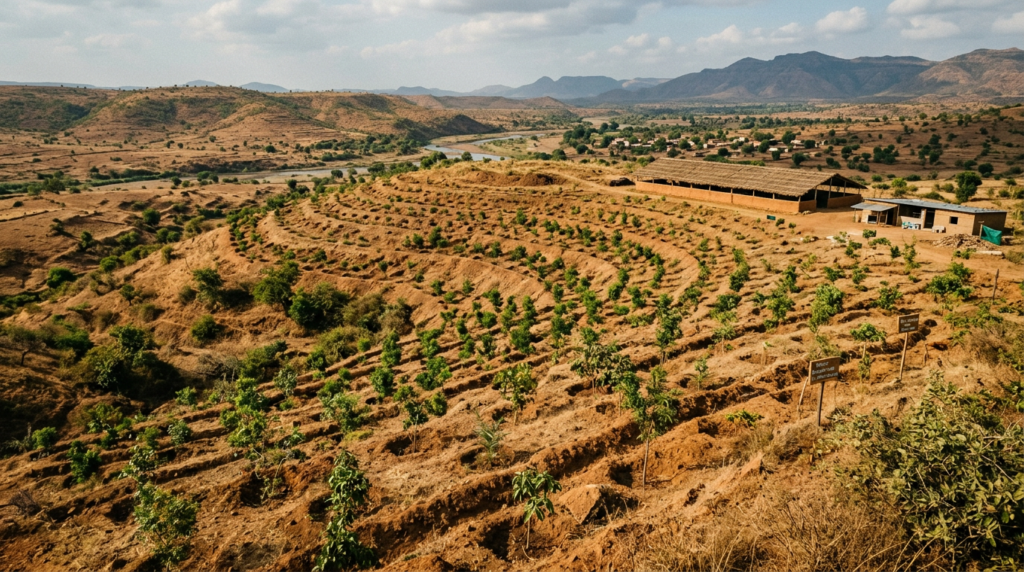
Afforestation and reforestation interventions implemented on degraded forest lands, waste lands, panchayat common lands, mined-out areas, and industrial green belts. Projects are evaluated on species diversity, native canopy coverage, survival rates over designated maturity periods, and ecosystem restoration indices rather than single-species biomass alone.
2. Water Management
Initiatives aimed at water harvesting, water conservation, wastewater treatment, water-use efficiency improvements, and the restoration of degraded water bodies, such as community ponds, stepwells, and urban lakes.
3. Sustainable Agriculture
Practices that regenerate soil organic carbon, reduce synthetic input dependence, optimize micro-irrigation, and improve agricultural biodiversity. This includes organic farming, natural farming, and the integration of biochar and biological soil conditioners.
4. Waste Management
Establishment of infrastructure for circular resource management, including the collection, segregation, and processing of municipal solid waste, construction and demolition debris, and industrial non-hazardous byproducts.
5. Air Pollution Reduction
Deploying technical or biological measures that measurably improve ambient air quality, suppress fugitive industrial emissions, or mitigate crop residue burning through biological conversion technologies.
6. Mangrove Conservation and Restoration
Ecological restoration of coastal mangrove ecosystems to enhance coastal resilience, protect shoreline habitats, and rehabilitate coastal biodiversity corridors.
7. Ecomark Labeling
Promoting consumer products that comply with low-impact manufacturing criteria through verified resource conservation, non-toxic formulations, and extended lifecycle responsibility.
8. Sustainable Building and Infrastructure
Construction approaches incorporating low-embodied-energy materials, integrated renewable energy, onsite circular water systems, and rigorous building efficiency standards.
Step-by-Step Implementation: How Enterprises Earn Green Credits
Participating in the Green Credit Programme requires a methodological approach across planning, baseline assessment, field execution, and ongoing verification. The standard project lifecycle follows distinct stages:
Stage 1: Site Identification and Baseline Determination
Enterprises identify land parcels or facilities suitable for eligible interventions. In tree plantation models, projects frequently engage state forest departments or local administrative bodies to access degraded land banks. Before any ground-level activity commences, an accredited agency establishes an environmental baseline, documenting existing canopy cover, soil quality, water tables, and biodiversity metrics.
Stage 2: Project Registration
The project developer submits an application via the centralized Green Credit web portal. The submission includes detailed project plans, target timelines, geo-tagged land coordinates, species selection schedules (for afforestation), water management designs, and operational maintenance budgets.
Stage 3: Project Implementation and Maintenance
The entity executes the approved activities in strict accordance with methodologies issued by ICFRE. In afforestation projects, technical protocols mandate the use of indigenous species suited to local agro-climatic zones, density limits per hectare, and designated post-plantation maintenance intervals to secure healthy survival rates. For soil enhancement practices, the application of stabilized carbon like biochar can be incorporated to improve moisture retention and nutrient capacity.
Stage 4: Digital Monitoring, Reporting, and Verification (dMRV)
Continuous monitoring is a mandatory compliance component. Rather than relying solely on periodic manual inspections, modern GCP workflows integrate digital MRV technologies. These tools employ high-resolution satellite imagery, multispectral drone scans, soil sensors, and mobile apps with time-stamped, geo-referenced field inputs to confirm physical development and asset health.
Stage 5: Independent Audit and Credit Issuance
A designated verification agency assesses the digital records and carries out periodic ground truthing. Upon successful verification that performance benchmarks have been satisfied, the audit report is transmitted to ICFRE. Once approved, the administrator issues Green Credits directly to the participant’s registry account.
Corporate Value and Financial Disclosure Integration
Green Credits offer enterprise participants concrete benefits that extend beyond symbolic sustainability achievements. Their integration into formal reporting architectures enhances regulatory compliance and operational standing:
- SEBI BRSR Core Compliance: Indian listed entities reporting under the Business Responsibility and Sustainability Reporting (BRSR) mandate must disclose resource consumption, waste diversion, water stewardship, and ecological efforts. Verified GCP activities furnish auditable data directly applicable to Principle 6 (Environment) disclosures.
- IFRS S1 and S2 Alignment: Global institutional investors require standardized physical and transition risk disclosures under the International Sustainability Standards Board (ISSB) frameworks. GCP activities—such as watershed preservation or biological carbon restoration—act as tangible risk-mitigation measures against water stress and localized environmental hazards.
- Corporate Environmental Offsetting: Enterprises can retain green credits for internal sustainability compliance, utilize them for voluntary corporate claims, or trade them on designated platforms to counter-parties seeking environmental compliance offsets.
Key Technical and Operational Challenges to Navigate
While the Green Credit Programme offers a structured market mechanism, enterprises must address several operational factors during project development:
- Land Title and Tenure Verification: Identifying clear, unencumbered land with defined user rights is critical. Partnering with local authorities, state forest departments, or established agrarian collectives reduces disputes around long-term land access.
- Permanence and Survival Risks: Environmental projects are exposed to climate events, pests, and resource scarcity. Afforestation requires active care protocols, drought management strategies, and biological amendments to safeguard sapling survival through dry seasons.
- Data Authenticity: Regulatory authorities demand auditable provenance. Using paper-based records or unverified field logs introduces audit friction. Deploying robust digital MRV platforms prevents data discrepancies and accelerates verification timelines.
- Methodological Revisions: As ICFRE refines activity-specific methodologies, technical parameters, density requirements, and equivalence formulas may be adjusted. Enterprises should ensure their technical teams review current MoEFCC and ICFRE circulars before committing capital.
How ForestTwin Supports Your Green Credit Lifecycle
Successfully navigating the Green Credit Programme requires a balance of forestry science, regulatory comprehension, and technical data architecture. Fusionpact’s sustainability business, ForestTwin, acts as a registered GCP participant, delivering end-to-end guidance for corporations, industrial developers, and institutional investors across India.
ForestTwin manages the complete project value chain. We assist clients with land suitability assessments, soil optimization through high-grade biochar applications, native species selection, and community-partnered planting models. Our proprietary digital MRV platform provides real-time canopy tracking, biomass expansion analytics, and continuous telemetry to meet verification standards under designated agencies.
Furthermore, our sustainability advisory team connects project outcomes directly to your compliance and capital market strategies. We assist in structuring project data to satisfy SEBI BRSR Core indicators, align with IFRS S1 and S2 climate-related financial disclosures, and preserve auditable provenance for environmental assets on the national registry.
To discuss your organization’s land assets, explore eligible activities under the Green Credit Programme, or implement digital verification for your environmental initiatives, contact our advisory team today: Speak with a ForestTwin Specialist.