
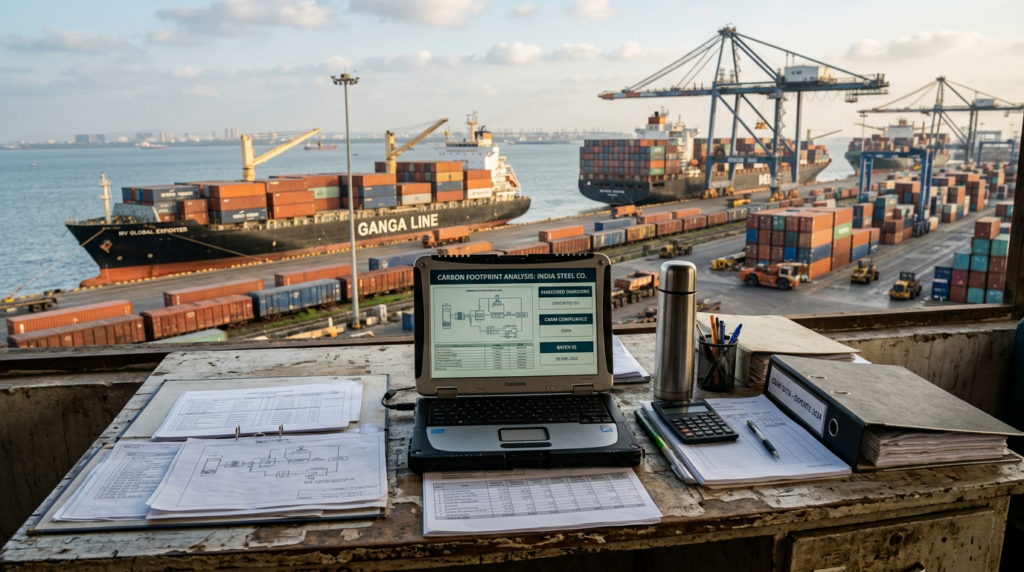
The Shift from European Regulation to Indian Factory Floors
For decades, trade negotiations and environmental policies operated in distinct spheres. Cross-border commercial contracts hinged on pricing, dimensional tolerances, quality certifications, and delivery timelines. However, the European Union’s Carbon Border Adjustment Mechanism (CBAM) has fundamentally altered this arrangement. While CBAM is an EU regulation directed at entities importing goods into the European customs territory, its operational burden falls squarely on non-EU manufacturers.
Indian industrial exporters—specifically those producing iron, steel, aluminium, cement, fertilizers, and hydrogen—are finding that regulatory mandates passed in Brussels now dictate the contents of procurement contracts in Mumbai, Jamshedpur, and Chennai. European industrial buyers are no longer simply requesting material test certificates; they are dispatching detailed technical templates requiring granular greenhouse gas emission data per tonne of finished product.
Understanding how CBAM functions, why European counterparties are demanding this data, and how to accurately compute embedded emissions has shifted from a corporate social responsibility talking point into a non-negotiable commercial requirement.
The Core Mechanism of the EU CBAM
CBAM was designed to equalize the price of carbon paid by European domestic producers under the EU Emissions Trading System (EU ETS) with the carbon embedded in imported goods. Under the EU ETS, domestic heavy industries must acquire allowances for each tonne of carbon dioxide equivalent (tCO2e) emitted during production. To prevent ‘carbon leakage’—the practice where European businesses relocate production to jurisdictions with less stringent environmental rules, or replace domestic supply with carbon-intensive imports—CBAM places a corresponding charge on designated goods entering the bloc.
The regulation is split into two phases: a transitional phase focused on monitoring, calculation, and reporting without financial penalties, followed by a definitive regime. In the definitive period, European importers will be legally required to purchase digital CBAM certificates corresponding to the greenhouse gas emissions embedded in imported shipments, calculated using weekly average EU ETS allowance auctions.
Although European importers purchase the certificates, the commercial reality cascades directly up the supply chain. If an Indian exporter cannot furnish actual, methodology-compliant data, the importer must apply conservative standard default values determined by the European Commission. These default values are systematically set at punitive levels—frequently representing the average emission intensity of the highest-emitting exporting installations. High assumed emissions translate directly into substantial CBAM certificate costs for the importer, making non-reporting or high-emission suppliers economically unviable.
Understanding Embedded Emissions: Simple vs. Complex Goods
CBAM does not evaluate enterprise-wide corporate footprints under traditional Scope 1, Scope 2, and Scope 3 greenhouse gas accounting frameworks. Instead, it measures specific embedded emissions assigned to individual product batches according to strict technical boundaries outlined in Annex III of the CBAM Regulation.
Under CBAM rules, goods are classified into two categories that dictate reporting complexity:
- Simple Goods: Materials produced entirely from zero-emission inputs or materials whose production processes yield directly measurable carbon releases without using intermediate materials with embedded emissions. In heavy manufacturing, very few commercial exports meet this criteria.
- Complex Goods: Products whose manufacturing process incorporates other covered materials, termed ‘precursors.’ Most steel products, engineered fasteners, structural profiles, and refined alloys fall into this category.
For complex goods, the total specific embedded emissions per unit of product consist of both the direct emissions occurring within the physical production installation and the indirect and direct emissions embedded in all consumed precursor inputs. This structure means an Indian steel fabricator cannot limit data collection to their own heating furnaces and rolling operations; they must account for the emissions generated by the primary blast furnace, direct reduced iron (DRI) plant, or electric arc furnace (EAF) where the raw steel originated.
The Anatomy of a Buyer Data Request
When an EU customer contacts an Indian supplier regarding CBAM, the documentation is typically aligned with the European Commission’s standardized communication template. Rather than asking for a broad corporate sustainability report, the template requests precise operational metrics categorized across distinct parameters:
1. Direct Emissions (Process and Combustion)
Direct emissions account for greenhouse gases released from sources inside the installation boundary. This includes the burning of fossil fuels (such as natural gas, coking coal, fuel oil, or diesel) in furnaces, kilns, or on-site captive power systems, as well as process emissions released through chemical reactions, such as the calcination of limestone in clinker production or fluxing agents in basic oxygen furnaces.
2. Indirect Emissions (Electricity Consumption)
Indirect emissions reflect the greenhouse gas emissions tied to the production of electricity consumed during manufacturing. Under CBAM specifications, calculating indirect emissions requires rigorous documentation of the electricity source. If a factory relies on the central Indian grid, regional baseline grid emission factors must be applied unless clear documentation proves direct line connections to renewable assets or long-term power purchase agreements (PPAs) that fulfill the EU’s strict verification criteria.
3. Precursor Attribution
For any complex good, the reporting company must isolate each precursor consumed, determine its specific mass balance relative to finished output, and acquire documented embedded emissions from the upstream producer. If the upstream supplier is third-party or uncooperative, calculating the combined footprint requires using default rules that substantially increase the declared carbon intensity of the final product.
4. Production Process Boundaries and System Allocation
Heavy industrial facilities frequently operate multiple production lines, some dedicated to export markets and others to domestic applications. CBAM prohibits spreading low emissions artificially across production routes. Facilities must identify specific production processes (‘routes’)—for instance, separating scrap-based electric arc furnace steel from pig-iron-reliant basic oxygen furnace steel—and assign actual mass, energy, and emissions flows directly to the relevant production unit.
Why Indian Industrial Exporters Face Structural Challenges
The manufacturing ecosystem in India features technical characteristics that make immediate CBAM compliance demanding without deliberate data infrastructure investments:
- Energy Mix and Captive Generation: A significant portion of Indian heavy manufacturing depends on captive thermal power generation (predominantly coal-fired) to insulate operations from regional grid instability. Captive thermal energy drives up the specific direct and indirect emissions per tonne of finished product relative to European competitors relying on lower-carbon energy mixes.
- Subcontracting and Upstream Opacity: In downstream engineering and light metal production, materials often pass through multiple intermediate processors—such as standalone rerolling mills, annealing facilities, and surface treatment workshops. Tracing verified primary smelting data across these decentralized layers requires administrative coordination that traditional procurement channels were never constructed to handle.
- Discrepancies with National Protocols: Many Indian industrial installations already monitor fuel use and operational metrics under national initiatives such as the Perform, Achieve and Trade (PAT) scheme or the Green Credit Programme administered by the Ministry of Environment, Forest and Climate Change (MoEFCC). However, system boundaries, allocation rules, and global warming potential (GWP) metrics used in domestic schemes do not automatically align with the explicit criteria set by European regulations.
Bridging the Data Gap: Operational and Digital Alignment
Addressing CBAM demands requires moving away from manual, end-of-quarter spreadsheet reconciliation toward auditable data management systems. Because European importers face regulatory audits and strict administrative fines for incorrect submissions, they will increasingly demand that emissions data submitted by Indian vendors be verified by accredited third-party bodies.
To build an auditable embedded-emissions profile, industrial producers should focus on establishing clear technical structures within their operations:
Digital Measurement, Reporting, and Verification (dMRV)
Manual data collection introduces transcription errors and lacks the immutable provenance needed for European regulatory audits. Deploying digital Measurement, Reporting, and Verification (dMRV) frameworks enables facilities to capture continuous, sensor-level telemetry from fuel meters, weighbridges, electrical substations, and production run outputs. By tethering raw operational activity directly to emission calculation models, manufacturers can produce verifiable batch-level carbon certificates that can withstand scrutiny.
Coordinating Enterprise Disclosures with Product Footprints
Forward-thinking organizations do not treat CBAM in isolation. Enterprise-level sustainability disclosures—such as those governed by the International Financial Reporting Standards (IFRS S1 and S2) or the Business Responsibility and Sustainability Reporting (BRSR) framework in India—rely on many of the same physical data inputs as CBAM. Designing an enterprise data model that serves corporate financial disclosures while simultaneously mapping mass and energy balances for CBAM prevents redundant investments and conflicting corporate data points.
Developing Decarbonization Pathways and On-Site Abatement
Once emission sources are accurately quantified at the unit level, leadership teams can prioritize investments that actively reduce CBAM certificate exposure. Interventions may include transitioning auxiliary thermal systems to high-temperature biochar or biomass alternatives, securing verified green power through open-access agreements, or adopting advanced scrap-management protocols to lower virgin raw material requirements.
Practical Next Steps for Commercial and Plant Teams
If embedded-carbon questionnaires have already reached your sales or commercial operations desks, taking an organized approach protects valuable European customer relationships:
- Identify Covered Tariff Codes: Review all products exported to the European Union against the Combined Nomenclature (CN) codes covered by CBAM. Verify whether shipments fall under covered categories such as basic iron and steel, aluminium shapes, or derived fasteners.
- Map the Physical Production Boundary: Work with plant engineering teams to delineate physical battery limits for each covered product line. Map every fuel, electricity, steam, and raw material input consumed across the manufacturing cycle.
- Engage Tier-1 and Tier-2 Suppliers: For all complex goods, reach out immediately to suppliers of precursor inputs (such as ingots, billets, hot-rolled coils, or chemicals). Alert them to upcoming data requirements and request facility-specific emissions data rather than waiting for formal buyer audit deadlines.
- Run Preliminary Gap Calculations: Calculate production route emissions against EU CBAM formulas to determine how actual installation intensity compares to international benchmarks and standard default values.
The era of treating carbon accounting as a peripheral public relations exercise is over. As embedded-carbon calculations integrate directly into trade compliance, financial invoicing, and international contract viability, Indian manufacturers that construct rigorous, verifiable emissions measurement workflows will secure durable commercial advantages in the global marketplace.
To establish verified carbon accounting systems, prepare for international trade compliance, or consult on corporate sustainability disclosures, connect with the technical advisory team at ForestTwin by visiting https://foresttwin.com/contact/.