
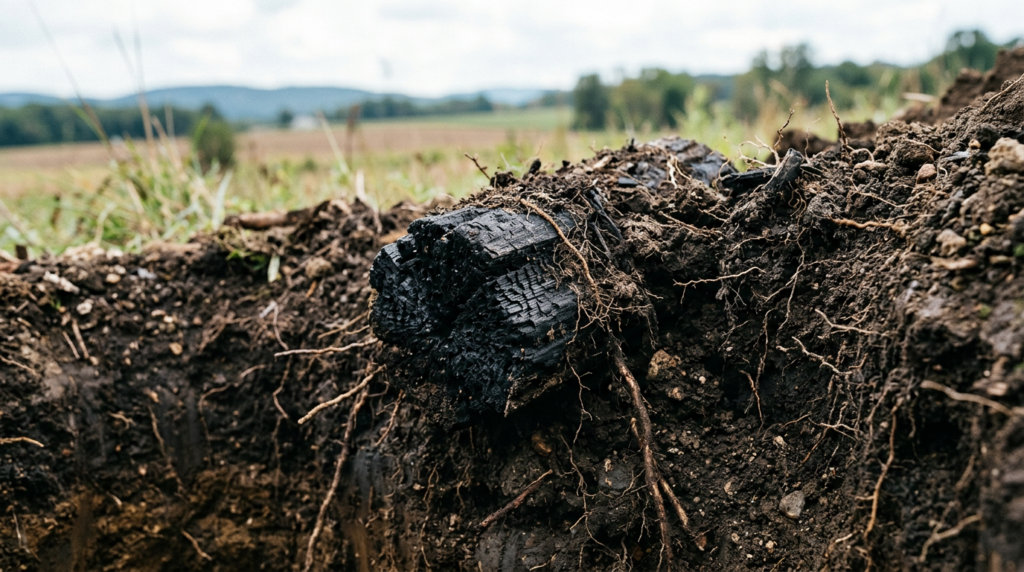
Understanding Durability in Carbon Dioxide Removal
As corporate carbon management matures, sustainability directors and carbon market participants increasingly distinguish between short-duration biological storage and durable carbon dioxide removal (CDR). While traditional forestry and soil enrichment projects provide critical ecological benefits, their carbon storage is vulnerable to reversal via wildfires, pest outbreaks, land-use change, and biological decay over decades. Consequently, the durable CDR sector evaluates carbon removal pathways against century-scale standards.
Biochar carbon removal (BCR) has gained substantial ground within high-integrity voluntary and compliance carbon systems. Methodologies managed by standard-setters such as Puro.earth, Verra (VM0044), and the European Biochar Certificate (EBC) credit biochar as a durable carbon sink capable of sequestering carbon for centuries. However, justifying a 100-plus-year removal claim requires rigorous physical, chemical, and mathematical evidence. This guide examines the molecular mechanics of biochar stability, empirical degradation models, and the conservative accounting frameworks that govern high-integrity credits.
Molecular Mechanics: From Cellulose to Aromatic Carbon
To understand why biochar resists decomposition, one must examine what occurs during pyrolysis—the thermal decomposition of organic material at elevated temperatures (typically 450°C to 800°C) under oxygen-limited conditions.
Natural biomass consists primarily of cellulose, hemicellulose, and lignin. In these raw states, carbon atoms are linked within aliphatic structures, predominantly composed of single carbon-carbon and carbon-hydrogen bonds alongside reactive oxygen functional groups. Soil microorganisms possess enzymes (such as cellulases, endoglucanases, and peroxidases) evolved specifically to metabolize these aliphatic arrangements, rapidly breaking down organic matter and returning carbon to the atmosphere as carbon dioxide through heterotrophic respiration.
Pyrolysis fundamentally alters this biochemical dynamic. As biomass passes thermal thresholds within a controlled reactor, dehydration, depolymerization, and decarboxylation eliminate volatile organic compounds and volatile oxygenated functional groups. The remaining carbon atoms condense into planar, hexagonal rings featuring double and single bonds in alternating structures, known as fused polycyclic aromatic hydrocarbons.
These aromatic sheets arrange in turbostratic structures—stacked, graphene-like microcrystalline domains with high thermodynamic stability. The high bond dissociation energy of aromatic carbon-carbon double bonds, combined with low accessibility for water and biological enzymes, creates an environment hostile to microbial consumption. Instead of providing an accessible metabolic substrate, the polycyclic core functions as a durable physical and chemical matrix capable of persisting in the soil profile.
The H/Corg Ratio: The Definitive Proxy for Stability
A central tenet of biochar science and certification standards is that permanence cannot be assumed simply because biomass was exposed to heat; it must be empirically demonstrated on a batch-by-batch basis. The primary, internationally accepted benchmark for evaluating the degree of aromatic condensation is the molar ratio of hydrogen to organic carbon, expressed as H/Corg.
Why the H/Corg Ratio Matters
Hydrogen atoms attach primarily to the periphery of aromatic rings or within residual aliphatic chains. Carbon atoms situated within the interior of condensed polycyclic sheets, by contrast, share bonds exclusively with other carbon atoms. Therefore, a low hydrogen-to-carbon ratio directly reflects a high degree of aromatic condensation and an absence of easily degradable aliphatic compounds.
- Unprocessed Biomass: Natural woody and agricultural biomass typically exhibits an H/C ratio between 1.4 and 1.8.
- Sub-optimal or Torrefied Biomass: Biomass treated at low temperatures (below 350°C) typically yields an H/Corg between 0.7 and 1.2, retaining considerable aliphatic structures prone to microbial degradation.
- Certified Biochar: Both the International Biochar Initiative (IBI) and the European Biochar Certificate (EBC) set an absolute upper limit of 0.7 for the molar H/Corg ratio. Material exceeding 0.7 cannot be certified as biochar.
- High-Permanence Biochar: Pyrolysis regimes operating at controlled temperatures above 550°C to 650°C typically achieve H/Corg ratios well below 0.4. Research indicates that materials with H/Corg below 0.4 possess predominantly persistent aromatic networks with minimal labile components.
By determining the total organic carbon content via dry combustion and acid treatment (to subtract inorganic carbonates), and measuring hydrogen content, certified laboratories provide project developers with the foundational empirical metric required to verify stability.
Decay Kinetics and Two-Pool Mathematical Modeling
A common misconception is that claiming permanence implies zero degradation over time. In physical soil systems, biochar does undergo finite degradation via two parallel vectors: biotic oxidation by specialized microbes acting on the surface of the particles, and abiotic oxidation driven by exposure to oxygen, water, and ambient temperatures over decades.
Because direct empirical observation of a single biochar sample for 100 years is impossible in a contemporary laboratory setting, soil scientists and standard developers utilize two-pool exponential decay models calibrated through accelerated aging experiments, incubation studies, and historical analogs (such as archaeological terra preta soils and wildfire charcoal deposits).
The Two-Pool Framework
A two-pool decay model separates the total organic carbon of biochar into two discrete fractions, each governed by an independent decomposition rate constant:
- The Labile Pool (C_labile): Comprising residual, unpyrolyzed, or semi-condensed aliphatic compounds, volatile organic fractions that recondensed onto particle surfaces, and edge-situated functional groups. This pool typically constitutes 2% to 15% of the total carbon mass, depending on reactor performance. It exhibits a fast half-life, degrading over a timeframe ranging from several months to a few years.
- The Recalcitrant Pool (C_stable): Comprising the dense, polycyclic aromatic core. This fraction accounts for the vast majority (85% to 98%) of properly manufactured biochar carbon and has a mean residence time (MRT) measured in centuries or millennia.
The total carbon remaining at time t is mathematically described by the sum of these two exponential decay curves: C(t) = C_labile * e^(-k_labile * t) + C_stable * e^(-k_stable * t), where k represents the decay rate constants. Because k_stable is extremely small under typical soil temperatures, the trajectory of the recalcitrant pool flattens after the initial consumption of the labile fraction, yielding a remarkably stable baseline across a 100-year window.
How Crediting Frameworks Apply Conservative Factors
High-integrity carbon registries do not award carbon removal credits on a one-to-one basis against the total carbon applied to soil. Instead, they translate decay kinetics into conservative crediting factors to ensure that claims of durability reflect reality even under adverse environmental conditions.
The 100-Year Permanence Factor (F_perm)
Standards such as the European Biochar Certificate (EBC C-Sink), Puro.earth, and Verra’s VM0044 evaluate the stability of biochar relative to a 100-year accounting horizon. To establish this, algorithms evaluate the H/Corg ratio and the mean annual soil temperature of the application site.
Higher soil temperatures accelerate microbial activity and abiotic oxidation kinetics. Consequently, biochar applied in tropical regions is subjected to higher modeled decay rates than the exact same material applied in temperate or boreal regimes. Registries apply an explicit decay discount (the permanence factor, or F_perm), which deducts the predicted 100-year degradation from the gross carbon mass.
Comprehensive Life Cycle Assessment Deductions
Beyond soil decay modeling, establishing high-integrity carbon credits requires deducting all greenhouse gas emissions associated with the production and supply chain lifecycle. A robust net carbon removal calculation subtracts:
- Baseline Emissions: Carbon that would have naturally entered long-term storage or alternative fates absent the project.
- Sourcing and Transportation: Fossil fuel consumption during the gathering and transport of biomass feedstock.
- Processing and Pyrolysis Energy: Parasitic thermal and electrical energy inputs consumed during feedstock pre-drying, chipping, and reactor operation.
- Combustion Off-gases: Trace emissions of methane or nitrous oxide if pyrolytic syngas is not fully oxidized within secondary thermal oxidizers.
- Final Logistics and Application: Crushing, inoculating, hauling, and incorporating the material into soil or long-term industrial matrices (such as non-structural concrete).
When these lifecycle emissions and the 100-year degradation discount are subtracted from the gross carbon content, the final net crediting volume generally represents a fraction of the raw biomass input, demonstrating the built-in conservatism of certified carbon removal.
Feedstock and Operating Parameters Dictating Longevity
Permanence is not an inherent trait of all biochar; it is an engineered outcome dictated by feedstock characteristics and thermochemical process controls.
Operating Temperature and Residence Time
The highest treatment temperature (HTT) and residence time within the pyrolysis chamber dictate the extent of carbon aromatization. Operating at lower temperatures (350°C to 450°C) preserves yield but often leaves an elevated H/Corg ratio, increasing the proportion of the labile pool. Maintaining temperatures between 550°C and 750°C accelerates the volatilization of aliphatic bonds and drives the condensation of aromatic structures, driving H/Corg down and optimizing durability.
Ash and Lignin Content
The chemical composition of the feedstock influences the physical properties of the finished product. Woody feedstocks (such as forestry residues, orchard trimmings, and sawmilling offcuts) feature high lignin concentrations, which naturally transition into highly condensed aromatic matrices. Herbaceous feedstocks, crop residues, and animal manures generally contain higher proportions of mineral ash (silica, potassium, calcium) and lower relative carbon densities. While high-ash materials can yield agricultural benefits, their carbon stability profiles often exhibit higher H/Corg ratios and require tighter process parameters to reach century-scale permanence thresholds.
Bridging Empirical Science with Digital MRV
Historically, environmental commodities faced skepticism due to static, paper-based reporting and infrequent third-party sampling. In contrast, modern biochar operations maintain verification through Digital Measurement, Reporting, and Verification (dMRV) architectures.
An end-to-end dMRV architecture tracks the chain of custody from biomass weigh-in through production and application. Continuous Internet of Things (IoT) sensors monitor pyrolysis chamber temperatures, oxygen partial pressures, and syngas combustion efficiency in real time. Batch samples are routinely routed to certified laboratories for elemental analysis, verifying that H/Corg, heavy metal concentrations, and polycyclic aromatic hydrocarbon (PAH) safety limits comply with international requirements.
Finally, spatial tracking tools capture geolocation vectors for soil distribution or industrial incorporation, binding the physical carbon sink to an immutable digital ledger. This level of granular traceability gives sustainability buyers, risk officers, and disclosure teams the empirical backing necessary to support reporting frameworks such as IFRS S2, the Corporate Sustainability Due Diligence Directive (CSDDD), and carbon removal portfolio audits.
To design an enterprise biochar procurement strategy or explore certified carbon project development supported by rigorous scientific modeling and end-to-end dMRV, contact the ForestTwin advisory team at https://foresttwin.com/contact/.