
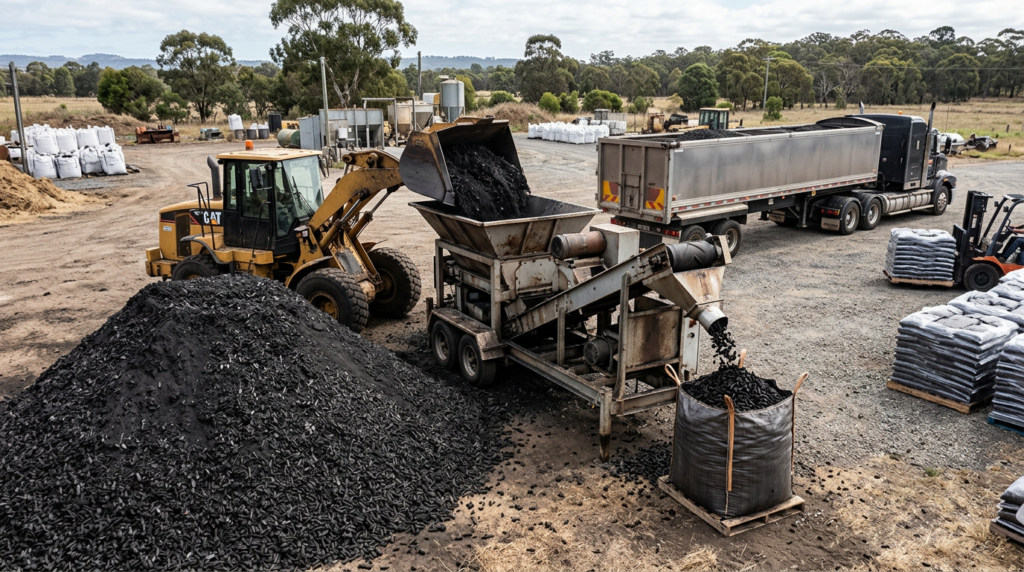
The Physical Realities of Biochar Supply Chains
The industrial deployment of biochar hinges as much on material handling and bulk logistics as it does on pyrolysis kinetics. While carbon removal credits and soil amendment markets highlight the carbon stability and porous architecture of high-temperature biochar, moving that material from production units to agricultural or industrial end-users reveals significant operational friction.
Freshly pyrolyzed biochar presents unique logistical challenges. It is intrinsically light, highly porous, prone to friability, and capable of generating fine fugitive dust. Because freight rates for ground and maritime transport are governed by either volumetric displacement or mass limits, raw biochar routinely causes transport vehicles to cube out long before reaching legal gross vehicle weight ratings. Addressing these logistics bottlenecks requires deliberate engineering decisions across densification, safe storage, and route accounting.
Understanding Bulk Density and the Transport Penalty
Bulk density dictates the economics of moving biochar. While solid biomass feedstocks like hardwood chips or agricultural residues have moderate bulk densities, the thermal degradation of hemicellulose and cellulose during pyrolysis leaves behind a rigid carbon skeleton filled with voids. Depending on the feedstock, pyrolysis temperature, and post-quench moisture content, loose biochar typically exhibits a very low bulk density compared to commercial mineral fertilizers or raw grains.
This low density creates a structural transport penalty:
- Volumetric exhaustion: Standard freight containers and flatbed trailers reach capacity limits by volume while carrying only a fraction of their permissible weight payload.
- High freight cost per ton: Because transport carriers charge based on vehicle utilization, transporting low-density material results in elevated per-ton freight expenses, directly reducing operating margins for project developers.
- Secondary handling degradation: Low-density, brittle biochar fragments easily when moved through conventional pneumatic lines, bucket elevators, or augers, generating unwanted fines and respirable dust.
For project developers looking to integrate with carbon registries or supply large-scale corporate off-takers, this dynamic makes localized processing or early-stage densification essential.
Densification Pathways: Pelleting, Briquetting, and Granulation
To overcome volumetric penalties, operators apply mechanical densification techniques. Transforming low-density char into uniform, dense products improves flowability, minimizes dust generation, and maximizes payload mass per shipment.
Pelletization
Pelletizing biochar forces milled material through a die under mechanical pressure. However, pure biochar lacks the native lignin content found in raw wood, as lignin decomposes during high-heat thermal conversion. Without natural thermal binders, biochar pelletization requires external binding agents or pre-treatment.
- Binder selection: Common binders include starch, bentonite clay, molasses, lignosulfonates, or wet biomass sludges. The choice of binder affects mechanical durability, water resistance, and compatibility with organic agricultural certifications.
- Energy expenditure: Grinding biochar to a uniform mesh size prior to pelleting consumes electrical power. Operators must evaluate whether the energy costs and equipment wear of high-pressure pellet mills offset the freight savings achieved by densification.
- Moisture tuning: The feed mixture must achieve a balanced moisture window to bind effectively without causing steam pockets or mold proliferation during post-pellet cooling.
Briquetting and Extrusion
Briquetting employs hydraulic or mechanical piston presses to produce larger, dense blocks. This process can handle larger aggregate sizes than pellet mills, reducing pre-grinding costs. Briquettes work well when biochar is intended for metallurgical reduction, fuel substitution, or co-firing, though they are less practical for broadcast agricultural distribution, which requires uniform mechanical spreaders.
Granulation and Co-Composting
An alternative to standalone densification is granulating biochar alongside other input streams, such as compost, animal manure, or mineral nutrients. Co-composting biochar inoculates the internal pore structure with microbial life and nutrients while naturally raising the bulk density through moisture and organic matter aggregation. Granulation systems then roll this composite into uniform prills suitable for standard fertilizer spreaders, mitigating dust risks while simplifying application logistics.
Safe Storage: Self-Heating, Dust, and Moisture Control
Biochar handling operations must manage distinct material hazards, principally spontaneous combustion and combustible dust dispersion. Proper warehouse and yard design mitigates these operational risks.
Managing Spontaneous Combustion and Pyrophoric Tendencies
Fresh biochar is chemically reactive. When exposed to ambient air immediately following pyrolysis, the reactive surface sites on the carbon matrix undergo chemisorption of atmospheric oxygen. This exothermic oxidation can generate localized heat. If biochar is stacked in large, unventilated piles before these active sites stabilize, the internal heat cannot dissipate, potentially causing thermal runaway and spontaneous combustion.
Mitigation strategies include:
- Controlled curing and aging: Permitting biochar to undergo a measured stabilization period, exposing it to ambient conditions in shallow layers to allow reactive sites to passivate safely.
- Moisture management: Applying a calibrated water quench immediately after pyrolysis reduces dust and cools the material. However, moisture must be evenly distributed; pockets of variable moisture can sometimes accelerate microbial heating in composite or high-volatile products.
- Thermal monitoring: Installing continuous infrared sensors or thermal probes within bulk piles and silos to identify internal temperature spikes before open flames appear.
Dust Control and Explosion Hazards
Like any fine carbonaceous material, dry biochar dust presents an explosion risk when suspended in air within an enclosed space near an ignition source. Fugitive dust also represents an occupational health hazard, requiring compliance with particulate matter exposure limits.
Operations require dust collection hoods at conveyor drop points, enclosed transfer chutes, low-velocity belt designs, and anti-static materials within pneumatic conveying equipment. Wet suppression systems remain effective, provided the added water weight does not undermine the transport payload budget.
Transport Realities: Modal Economics and Regulatory Frameworks
Selecting the appropriate freight mode requires balancing distance, route flexibility, handling frequency, and regulatory compliance.
Trucking Logistics
Over-the-road freight is the primary transport mode for regional distribution. Walking-floor trailers, covered tipper trucks, and bulk pneumatic tankers are common choices. Tippers require minimal unloading infrastructure at the destination but present dust management challenges during dumping. Pneumatic tankers eliminate dust emissions during transfer but require biochar to be pelletized or processed to a consistent particle size to avoid bridging and pipe blockages.
Rail and Maritime Transport
For cross-border or long-distance intermodal transit, rail hoppers and ocean containers offer lower freight costs per ton-mile. However, maritime transit introduces strict safety governance. Under the International Maritime Dangerous Goods (IMDG) Code, certain categories of carbon derived from plant sources may be classified under dangerous goods regulations (such as UN 1361, Carbon of animal or vegetable origin) unless they pass specific self-heating testing protocols (e.g., the UN Manual of Tests and Criteria, Part III, subsection 33.4.6).
Producers exporting biochar must carry verified laboratory certificates confirming that their specific material passes self-heating safety thresholds to secure standard cargo status and avoid costly hazardous freight surcharges.
Embodied Emissions and dMRV Integration
The core commercial value of carbon removal biochar rests upon its net negative carbon balance. Every kilometer a shipment travels, and every kilowatt-hour consumed during grinding, drying, or pelletizing, adds Scope 1, Scope 2, or Scope 3 emissions to the life cycle assessment (LCA).
If transportation distances are excessive, or if inefficient diesel transport moves wet, un-densified char, the emissions penalty can consume an unacceptable share of the gross carbon removal credits issued for the project. Independent carbon accounting methodologies require rigorous substantiation of transport distances, vehicle fuel efficiencies, and secondary energy inputs.
A modern digital Monitoring, Reporting, and Verification (dMRV) framework directly addresses these compliance challenges:
- Batch-level geotracking: Linking individual production batches to specific delivery waybills and GPS tracking records ensures verifiable chain-of-custody data.
- Automated LCA deductions: Integrated platforms ingest transport weigh-scale tickets, densification energy receipts, and vehicle telemetry to subtract transport emissions dynamically from gross project removals.
- Registry compliance: Producing transparent, auditable digital records streamlines registry verification under global carbon standards and domestic programs like the Green Credit Programme (MoEFCC).
Engineering a Resilient Biochar Logistics Model
Treating biochar logistics as an afterthought introduces operational bottlenecks, safety liabilities, and margin compression. Successful deployment requires evaluating physical density, safety protocols, and freight planning simultaneously with pyrolysis design. By addressing bulk density through targeted densification or co-composting, implementing strict curing and thermal monitoring protocols, and tracking freight emissions via digital MRV, project developers can build scalable, durable biochar supply chains.
To evaluate biochar logistics infrastructure, develop bankable carbon removal projects, or establish automated dMRV systems for your supply chain, contact the team at ForestTwin.