
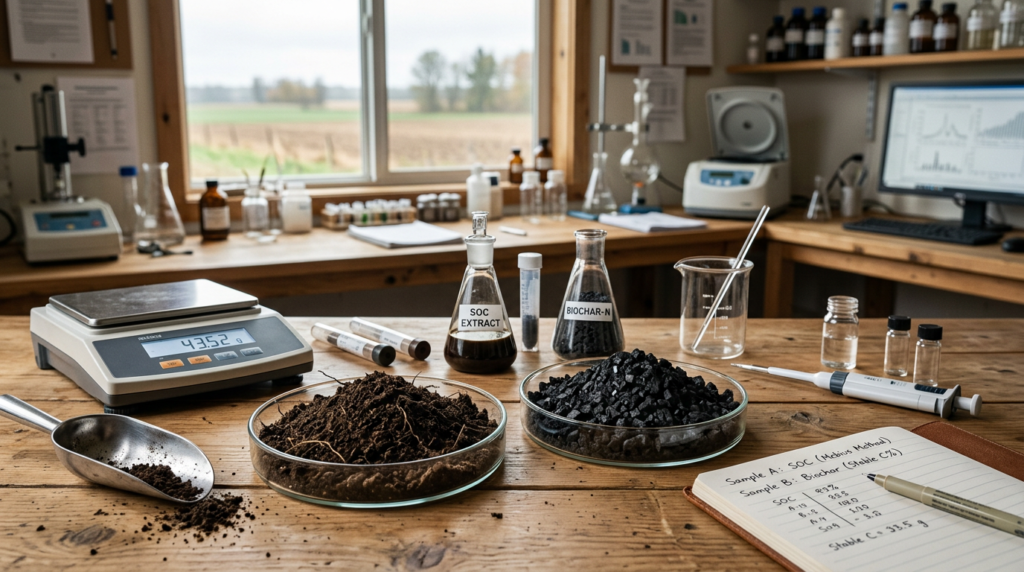
Understanding the Fundamental Carbon Distinction
In terrestrial carbon management and regenerative agriculture, discussions often conflate soil organic carbon (SOC) with biochar carbon. While both reside in the soil matrix once applied, their chemical composition, residence times, and analytical pathways differ fundamentally. Understanding these differences is critical for project developers, carbon accounting professionals, and land managers seeking to issue high-integrity carbon removal credits or verify corporate Scope 3 removals.
Soil organic carbon represents the broad, heterogeneous pool of carbon derived from plant residues, root exudates, microbial biomass, and decomposed biological matter. It is inherently dynamic, cycling through labile, slow, and passive pools over time horizons that vary from days to decades. By contrast, biochar carbon is predominantly pyrogenic carbon: a stable, polycyclic aromatic matrix formed via the thermochemical conversion of biomass under oxygen-limited conditions. This structural divergence dictates how each pool is sampled, quantified, and validated under carbon crediting protocols.
Analytical Laboratory Techniques: How Each Pool Is Quantified
Accurate quantification begins in the laboratory, where standard soil testing techniques often fail to separate dynamic biological carbon from inert pyrogenic structures without specialized preparation.
Soil Organic Carbon Analytical Methods
Historically, laboratories determined SOC using wet chemical oxidation, most notably the Walkley-Black chromic acid digestion method. However, because wet oxidation methods rely on empirical recovery factors that fluctuate based on soil mineralogy, modern certification programs mandate dry combustion via automated elemental (CHN) analyzers or the Dumas method.
In dry combustion, the soil sample is heated to elevated temperatures in the presence of pure oxygen to convert all carbon to carbon dioxide, which is then measured via non-dispersive infrared (NDIR) detection or thermal conductivity. To isolate organic carbon from inorganic carbonates (such as calcite or dolomite), samples must undergo acid pre-treatment (such as sulfurous or hydrochloric acid fumigation) to remove inorganic carbon prior to combustion. Failure to account for inorganic carbonates leads to an overestimation of the biological soil carbon stock.
Biochar Carbon Analytical Protocols
Biochar carbon measurement does not rely on bulk soil testing; it requires specialized solid-state characterization governed by distinct standards, such as those from the International Biochar Initiative (IBI) or the European Biochar Certificate (EBC). Key parameters include:
- Total Organic Carbon (Corg): Quantified through elemental analysis after subtracting total inorganic carbon determined via acid digestion.
- Hydrogen-to-Organic Carbon (H:Corg) Ratio: The premier proxy for aromatic condensation and structural stability. Pyrolysis strips hydrogen and oxygen from biomass, forming condensed carbon rings. An H:Corg molar ratio below 0.7—and ideally below 0.4—signals a highly stable matrix resistant to biological mineralization.
- Oxygen-to-Carbon (O:C) Ratio: Evaluates the degree of oxidation and provides secondary validation of thermochemical conversion efficiency.
- Proximate Analysis: Determines volatile matter, ash content, and fixed carbon through controlled heating profiles defined by ASTM standards.
When biochar is incorporated into soil, conventional dry combustion cannot distinguish between the carbon inherent to the native soil and the newly added pyrogenic carbon. Resolving this requires complex isotope ratios, spectroscopic methods (such as 13C-NMR), or physical density fractionation, which are commercially prohibitive at scale. Consequently, crediting systems treat the quantification of biochar carbon as an ex-situ manufacturing metric rather than an in-situ bulk soil metric.
Sampling Protocols and Spatial Heterogeneity
The spatial and physical dimensions of field measurement highlight practical differences between crediting agricultural soil carbon enhancements versus crediting biochar additions.
The Challenge of Measuring SOC in the Field
Quantifying baseline SOC and detecting statistically significant changes over time requires rigorous field sampling programs. Soil carbon stocks are governed by the equation:
Carbon Stock (t C/ha) = Depth (m) × Bulk Density (g/cm³) × SOC Concentration (%) × (1 – Coarse Fragment Fraction)
Every variable introduces measurement error. Soil bulk density varies with compaction, moisture content, and tillage regimes. Furthermore, agricultural fields exhibit extreme spatial heterogeneity; SOC levels vary across microtopographies, soil textural classes, and management zones. Detecting annual SOC changes typically requires hundreds of composite core samples taken down to at least 30 centimeters—and increasingly to one meter—to account for deep carbon movements. Projects must also employ equivalent soil mass (ESM) calculations rather than fixed-depth methods to prevent false signals generated by changes in soil bulk density over time.
Biochar Carbon: Chain of Custody and Mass Balance
Biochar carbon measurement sidesteps spatial field noise by establishing the carbon removal quantification upstream at the production facility. The project developer establishes:
- The dry mass of certified biomass entering the reactor.
- The production yield of biochar across defined batch runs.
- The laboratory-verified total organic carbon and H:Corg ratio of the specific biochar lot.
- Georeferenced chain of custody confirming transport, blending, and physical application to agricultural or forestry acreage.
Instead of relying on field soil coring to isolate the biochar from the baseline soil organic matter, certification methodologies verify that a calculated mass of stable pyrogenic carbon has been safely and permanently placed into a soil sink. The measurement burden shifts from complex soil science in the dirt to industrial quality assurance, precise weigh scales, and verified application tracking.
Permanence, Degradation Kinetics, and Reversal Risks
The operational divide between SOC and biochar carbon is underscored by their divergent decay pathways, which fundamentally shape crediting mechanisms.
Dynamic Equilibrium in Soil Organic Carbon
Soil organic carbon exists in a state of dynamic equilibrium governed by carbon inputs (crop residues, cover crops, root turnover) and carbon outputs (microbial respiration, mineralization, erosion). Soil biological activity fluctuates with temperature, rainfall, and oxygen availability. A sudden change in land management—such as a return to intensive tillage, an extreme drought, or prolonged waterlogging—can rapidly mineralize accrued SOC back into atmospheric carbon dioxide.
Because of this vulnerability to reversal, crediting frameworks for SOC require substantial buffer pools (often withholding a significant percentage of issued credits), long-term monitoring commitments spanning 30 to 100 years, and complex soil biogeochemical models (such as RothC or DNDC) calibrated against continuous ground-truth sampling.
Predictable Degradation Kinetics in Biochar
Biochar is not entirely inert, but its degradation follows a distinct two-pool kinetic model. A minor fraction (typically consisting of volatile compounds and unpyrolyzed residues) decomposes within the first several years. The remaining vast majority consists of persistent pyrogenic carbon that degrades via slow abiotic oxidation and peripheral microbial weathering.
Scientific consensus, reflected in methodologies by the Intergovernmental Panel on Climate Change (IPCC) and voluntary market registries like Puro.earth and Verra (VM0044), models biochar persistence based directly on the measured H:Corg ratio and mean soil temperatures. Because this decay rate is predictable over centuries, biochar credits can be calculated using conservative discount factors (such as subtracting an estimated decay fraction over 100 years) rather than enforcing decades of repetitive soil core re-sampling to prove non-reversal.
Digital MRV (dMRV): Contrasting Technology Implementations
Modern measurement, reporting, and verification (dMRV) architectures reflect these structural differences, applying different technology stacks to each carbon pathway.
Remote Sensing and Hybrid Modeling for SOC
For land-based SOC monitoring, dMRV platforms merge remote sensing data (such as multispectral imagery from Sentinel and Landsat) with digital elevation models, climatic records, and machine learning algorithms. Spectral reflectance can approximate surface soil characteristics, but it cannot directly read sub-surface carbon stocks below a few millimeters. Developers must deploy stratified random sampling programs to ground-truth and calibrate these predictive models. The MRV challenge lies in refining statistical confidence intervals to distinguish true carbon gains from environmental baseline noise.
Industrial IoT and Traceability for Biochar
For biochar, dMRV systems prioritize operational telemetry over spatial spectral analysis. Key platform components include:
- Continuous temperature sensors inside pyrolysis retorts to confirm operating thresholds necessary for high carbonization.
- Automated scales tracking feedstock mass and biochar output yields.
- Direct integration of laboratory batch testing data (CHN analysis and H:Corg ratios).
- Tamper-proof digital manifests linking transport logistics to georeferenced application zones.
The biochar dMRV objective is not to map a dynamic biological flux, but to maintain an unbroken audit trail proving that a quantified mass of stable carbon was converted from biomass and permanently introduced to an eligible soil sink.
Implications for Carbon Markets and Corporate Procurement
The measurement differences between biological and pyrogenic carbon lead to divergent classifications in carbon markets. Soil organic carbon projects fall primarily under land management carbon reduction or carbon removal enhancement frameworks. They offer rich ecological co-benefits—such as increased water-holding capacity, improved biodiversity, and enhanced soil fertility—but their credits trade with scrutiny regarding permanence and reversal risks.
Biochar credits are categorized as engineered, durable carbon dioxide removal (CDR). Buyers seeking compliance alignment, durable high-durability portfolios, or low-risk Scope 3 balance-sheet removals often favor biochar carbon precisely because its measurement does not rest on uncertain, long-term soil carbon equilibrium modeling. The carbon accounting is deterministic: production metrics are verifiable, degradation discounts are mathematically established, and the physical asset is fixed into the earth.
Understanding these measurement nuances ensures that project developers select the correct methodological framework, deploy appropriate capital for measurement infrastructure, and generate credits that withstand regulatory and market scrutiny.
ForestTwin provides end-to-end expertise across biochar carbon removal, dMRV implementation, and environmental disclosure alignment. Contact our team to evaluate your project or advisory needs: Speak with a ForestTwin specialist.