
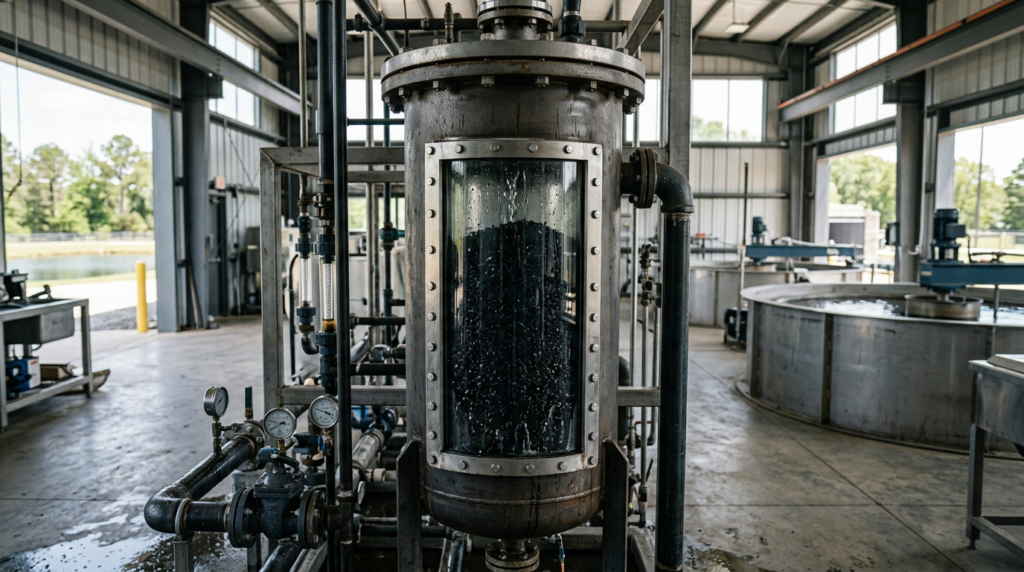
The Evolving Role of Carbonaceous Adsorbents in Industrial Effluent Management
Industrial facility operators and environmental compliance engineers face growing regulatory pressure to reduce chemical oxygen demand, extract heavy metal fractions, and strip recalcitrant synthetic compounds from process water prior to discharge. At the same time, corporate sustainability teams are scrutinizing the embodied carbon of treatment consumables. Traditional granular activated carbon (GAC) remains an industry benchmark for adsorption, but its reliance on fossil-based feedstocks such as coal, combined with energy-intensive activation processes, creates an operational footprint that many facilities now seek to lower.
Biochar has emerged as a functional, biomass-derived alternative. Produced through the thermal decomposition of organic biomass under oxygen-limited conditions (pyrolysis), biochar exhibits physical and chemical properties well-suited for effluent polishing and contaminant capture. However, industrial adoption requires a clear, technically rigorous understanding of its capabilities. Biochar is not a universal substitute for activated carbon, but rather a versatile adsorbent that excels in specific industrial streams while working symbiotically alongside existing multi-barrier treatment trains.
Primary Adsorption Mechanisms of Biochar
The efficacy of biochar in treating industrial process water depends directly on its physicochemical architecture, which is governed by feedstock selection and pyrolysis temperature. Understanding these mechanisms allows plant engineers to predict breakthrough curves and select the appropriate grade for specific wastewater profiles.
Pore Size Distribution and Physical Trapping
Unlike standard activated carbons that are industrially engineered to maximize microporosity (pores smaller than 2 nanometers), biochar naturally develops a broad, hierarchical pore network consisting of micropores, mesopores (2 to 50 nanometers), and macropores (greater than 50 nanometers). This distribution makes biochar particularly effective at capturing larger organic molecules, suspended colloidal particles, and high-molecular-weight dyes that often blind or clog the narrow micropores of conventional GAC.
Surface Functional Groups and Ion Exchange
At lower-to-moderate pyrolysis temperatures, biochar retains significant fractions of oxygen-containing functional groups on its surface, including carboxyl, hydroxyl, and phenolic groups. These functional groups impart a negative surface charge across typical industrial pH ranges, facilitating cation exchange. This mechanism allows biochar to readily capture positively charged metal ions from solution, forming stable surface complexes.
Electrostatic and Pi-Pi Interactions
Higher production temperatures drive off volatile matter and induce the formation of graphitic, aromatic carbon sheets. These conjugated carbon rings facilitate pi-pi electron-donor-acceptor interactions, which play a central role in stripping aromatic hydrocarbons, phenolic compounds, and complex synthetic chemicals from aqueous solutions.
Target Industrial Use Cases for Biochar Adsorption
While biochar can be deployed across various stages of water purification, several industrial sectors benefit most clearly from its pore structure and surface chemistry.
1. Heavy Metal Remediation in Mining and Metallurgy
Mining operations, metal finishing facilities, and printed circuit board manufacturers frequently generate wastewater carrying elevated levels of copper, lead, zinc, nickel, and cadmium. Biochar functions effectively in these contexts through a combination of ion exchange, surface precipitation, and surface complexation.
Because biochar often contains residual alkaline ash components (such as calcium and magnesium carbonates), it can exert a localized buffering effect in acidic mine drainage or acidic wash waters. This mild alkalinity promotes the precipitation of dissolved metals as hydroxides or carbonates directly within the porous carbon matrix, minimizing the chemical additions typically required for neutralisation.
2. Textile and Dyehouse Effluent Decolorization
Textile finishing facilities discharge high volumes of water containing recalcitrant synthetic azo dyes, surfactants, and residual salts. The broad mesoporous network of biochar provides an advantage in this application. Bulky dye molecules that struggle to diffuse into the micropores of conventional coal-based carbon can access adsorption sites within biochar mesopores. Treating raw dyehouse discharge with biochar reduces both visible color and chemical oxygen demand (COD), protecting downstream biological treatment units from shock loading.
3. Nutrient Capture in Agro-Industrial and Food Processing Streams
Effluents from dairy processing, slaughterhouses, and fermentation facilities often carry excessive concentrations of dissolved nitrogen and phosphorus. While unmodified biochar has a predominantly negative surface charge that limits raw nitrate adsorption, biochar engineered with polyvalent metal salts (such as iron or magnesium) or processed at controlled temperatures demonstrates reliable phosphate capture.
In these applications, the spent adsorbent can present circular lifecycle opportunities. Provided the process water is free of toxic industrial solvents and priority heavy metals, nutrient-laden biochar can potentially be repurposed for agricultural land application or compost stabilization, subject to local environmental discharge regulations.
4. Stormwater and Industrial Runoff Interception
Facilities maintaining large outdoor storage yards, scrap recycling terminals, or transport depots generate intermittent runoff carrying suspended solids, trace fuel hydrocarbons, and tire-wear zinc. Deploying biochar within passive filter swales, permeable reactive barriers, or perimeter trench filters provides effective passive treatment without requiring continuous pumping energy or complex instrumentation.
Biochar Versus Activated Carbon: Comparative Realities
To avoid treatment plant failures, engineers must balance environmental goals with the practical operational limits of biochar compared to virgin activated carbon. Biochar is not a direct one-to-one replacement across every operational metric.
- Specific Surface Area: Standard commercial activated carbons routinely achieve Brunauer-Emmett-Teller (BET) surface areas exceeding 1,000 square meters per gram due to physical or chemical activation. Standard unactivated biochars generally present lower specific surface areas, frequently ranging from dozens to several hundred square meters per gram depending on the feedstock and processing conditions.
- Micropollutant Polishing: When treating trace pharmaceutical compounds, per- and polyfluoroalkyl substances (PFAS), or regulated drinking-water contaminants at parts-per-billion or parts-per-trillion levels, activated carbon remains the industry standard. Biochar rarely matches the rapid equilibrium kinetics and low breakthrough thresholds required for deep micropollutant removal without undergoing secondary activation steps.
- Hydraulic Performance: Raw biochar can be more friable than extruded or agglomerated activated carbon pellets. In deep fixed-bed contactors subjected to high superficial flow velocities, non-pelletized biochar can generate fines, leading to head-loss buildup and short backwash intervals. Pelletization or blending with coarse aggregate is often necessary for high-rate pressurized vessels.
- Cost-to-Volume Profile: Where biochar offers a distinct operational advantage is in high-load, bulk-removal stages. Because biochar is typically more economical to produce than activated carbon, it can be deployed as an upstream, sacrificial roughing media. In this design, biochar removes the bulk of fats, suspended oils, and larger COD fractions, extending the operational life of expensive downstream activated carbon polishing beds.
Engineering and Operational Considerations
Integrating biochar into an industrial effluent scheme requires careful technical planning across several stages:
Feedstock Homogeneity and Quality Control
Industrial water managers must avoid treating biochar as an undifferentiated commodity. A biochar derived from softwood forestry residues exhibits vastly different pore architecture, ash content, and abrasion resistance than one manufactured from agricultural husks or municipal green waste. Securing a reliable, high-volume supply with consistent ash content, fixed carbon ratios, and uniform grain sizing is non-negotiable for stable plant hydraulics.
Regeneration and End-of-Life Protocols
Activated carbon is traditionally regenerated in off-site thermal kilns, an energy-intensive supply chain loop. Biochar, depending on the nature of the adsorbed contaminants, can follow different pathways. If loaded with heavy metals, it must be disposed of in compliance with hazardous waste regulations or stabilized in inert matrices. If loaded with non-hazardous organics, it may be suitable for thermal valorization or blending into controlled environmental applications, reducing disposal costs relative to spent commercial carbon.
Aligning Effluent Management with Sustainability Governance
Decisions surrounding industrial consumables are increasingly intertwined with corporate climate disclosures and sustainability reporting frameworks. Switching a portion of a facility's adsorption demands from fossil-derived coal carbon to certified biochar directly addresses Scope 3 supply chain emissions.
Under standards such as IFRS S2 (Climate-related Disclosures), organizations must track their material transition risks and decarbonization pathways. High-durability biochar, verified through accurate digital monitoring, reporting, and verification (dMRV) systems, can serve as a dual-benefit asset: treating operational water risks while delivering auditable carbon removals. In regions participating in market programs, such as India's Green Credit Programme under the MoEFCC, comprehensive water management strategies that incorporate sustainable biomass solutions can contribute to recognized corporate environmental credits.
For facilities operating within regulated discharge catchments, pairing measurable chemical oxygen demand reductions with high-integrity carbon removal claims creates measurable value across environmental compliance and financial accounting domains.
If your organization is evaluating the technical and economic feasibility of biochar for industrial wastewater treatment or seeking to align effluent management with verified carbon and water accounting standards, contact our advisory team at ForestTwin Contact to discuss your plant's specific operational requirements.