
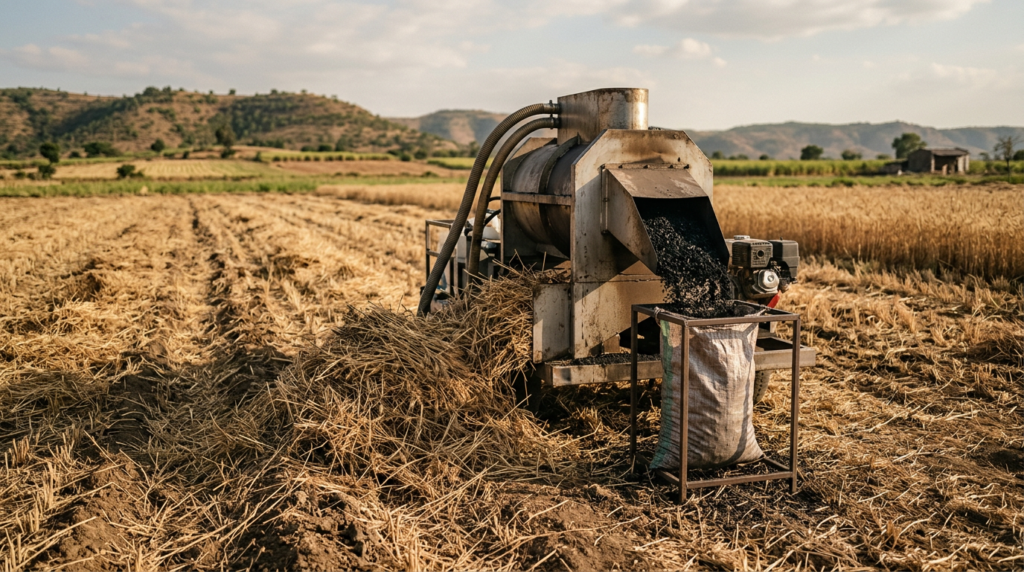
The North Indian Stubble Burning Challenge
Seasonal agricultural residue burning across the Indo-Gangetic Plain presents an acute atmospheric and economic challenge each post-monsoon cycle. The primary driver of this practice is operational rather than ideological: the narrow window between harvesting paddy and preparing seedbeds for wheat—often spanning only two to three weeks—forces farmers to clear millions of tonnes of straw rapidly. Traditional in-situ soil incorporation often requires specialized mechanization, increases seedbed pest pressures, or slows decomposition in dropping winter temperatures. Consequently, open-field combustion remains a widespread default.
Addressing this recurring issue requires looking beyond punitive enforcement toward durable economic mechanisms. Turning non-feed crop residue into biochar through controlled pyrolysis represents a technically mature, commercially viable route. By transforming low-density, problematic lignocellulosic waste into stable elemental carbon, industrial stakeholders and agricultural cooperatives can establish self-sustaining value chains that address air quality mandates, enhance soil physics, and generate tradeable environmental assets.
The Dual Archetypes: In-Situ vs. Ex-Situ Management
Mitigation strategies for stubble management broadly divide into two operating models, each defined by distinct logistical and fiscal profiles.
In-Situ Interventions
In-situ methods retain residue on the field through mechanization like surface mulchers, zero-till seed drills (such as Happy Seeders or Super Seeders), or microbial spray consortia designed to accelerate decomposition. While these practices preserve soil organic carbon over extended timelines, their adoption faces systemic operational hurdles. Heavy mulch can impede seed germination if moisture levels deviate, specialized tractor attachments require capital subsidies or leasing infrastructure, and decomposition sprays often fail to break down thick silica-rich paddy stalks within the compressed turnaround window between planting seasons.
Ex-Situ Valorization
Ex-situ alternatives remove biomass from the farm gate for utilization elsewhere. Common industrial pathways include co-firing in thermal power stations, conversion into compressed bio-gas (CBG), pulp and paper production, and biomass-to-energy facilities. However, ex-situ off-takers frequently struggle with biomass supply instability, elevated logistics expenses, and boiler slagging caused by the high alkali and silica content of paddy straw. Pyrolysis—thermal degradation in an oxygen-depleted environment—accommodates these structural properties more effectively, yielding solid biochar alongside synthesis gases and bio-oils that can be recovered for process heat.
The Residue-to-Biochar Economic Framework
Assessing the viability of crop residue pyrolysis requires a clear breakdown of capital costs, variable logistics, operational inputs, and diversified revenue lines. Rather than viewing residue as an environmental disposal liability, this economic framework structures it as a continuous industrial feedstock.
Feedstock Aggregation and Logistics Expenses
The foremost operational hurdle in biomass conversion is logistics. Paddy straw exhibits low bulk density, making raw hauling economically non-viable beyond short radii. The operational cost framework consists of several distinct stages:
- Harvesting and Baling: Field gathering, raking, and compaction into square or round bales to increase density prior to loading.
- First-Mile Transport: Hauling bales from field boundaries to decentralized aggregation yards via tractors and flatbed trailers.
- Secondary Transport: Long-distance freight using heavy commercial vehicles from intermediate yards to centralized processing plants.
- Storage and Weather Protection: Warehousing or tarping to mitigate degradation, spontaneous combustion risks, and moisture infiltration from winter rains or dew.
Because transportation expenses scale sharply with distance, production facilities must either locate within compact biomass catchments (a hub-and-spoke model) or deploy modular, mobile pyrolysis units that process feedstocks near intermediate aggregation yards.
Capital Expenditure (CapEx) Considerations
Capital outlays depend on the processing architecture chosen for the project:
- Centralized Continuous Systems: Large continuous retorts or rotary kilns offer high operational throughput, automated controls, and robust syngas recirculation systems that offset external process energy needs. These facilities require substantial civil infrastructure, raw material drying systems, automated baling handling, and emissions abatement equipment.
- Decentralized or Semi-Continuous Units: Modular, transportable batch or semi-continuous kilns require smaller direct outlays and minimal civil foundations. While unit labor requirements are typically higher per tonne of output, these systems reduce hauling requirements by operating closer to the biomass origin.
Operational Expenditure (OpEx) Drivers
Ongoing operating budgets are driven by four core inputs: biomass procurement prices (including payments made to farm cooperatives or aggregator margins), electricity and fuel for shredding and feeding systems, regular maintenance to combat silica-induced equipment wear, and site labor for sorting, processing, and packaging.
Revenue Architecture: Commercializing Biochar
A resilient residue-to-biochar enterprise model does not rely on a single income stream. Instead, it balances physical product off-take, circular energy utilization, and environmental asset generation.
Physical Off-Take Channels
Biochar generated from crop residue possesses structural characteristics suited to diverse industrial and agricultural applications:
- Agricultural Soil Amendments: Biochar improves cation exchange capacity (CEC), enhances moisture retention in sandy soils, and buffers pH. Blended with organic or chemical fertilizers, it reduces nutrient leaching in intensive cropping systems.
- Industrial and Construction Markets: Finely milled biochar serves as an additive for asphalt, concrete, and composite building materials, improving structural density while embedding biogenic carbon into permanent infrastructure.
- Metallurgy and Energy: In select applications, biochar functions as a renewable reductant in foundries or a high-energy substitute for metallurgical coke.
Syngas and Thermal Energy Utilization
Exothermic pyrolysis reactions generate syngas containing carbon monoxide, hydrogen, and methane. Modern industrial kilns route this off-gas directly back into the combustion chamber to sustain processing temperatures, reducing external fuel requirements. Excess thermal energy can be directed toward feedstock pre-drying or piped to co-located industrial processes, improving the overall plant heat balance.
Durable Carbon Removal Credits
Because pyrolysis converts volatile plant carbon into highly recalcitrant aromatic carbon structures, biochar remains chemically stable for hundreds of years when applied to soil or building materials. Consequently, international voluntary carbon markets issue high-integrity carbon dioxide removal (CDR) credits for verified biochar operations.
Achieving credit monetization requires verifiable proof of origin, stable operating parameters, independent laboratory testing for H:Corg ratios, and comprehensive supply chain tracking. Modern digital Monitoring, Reporting, and Verification (dMRV) systems integrate platform sensors, satellite biomass mapping, and distributed ledger ledgers to log chain-of-custody data, transforming physical processing metrics directly into audited carbon balance sheets.
Policy Context and Regulatory Catalysts in North India
The economics of converting residue to biochar are heavily influenced by the regional regulatory framework. In North India, industrial compliance and agricultural directives operate under mandates issued by the Commission for Air Quality Management (CAQM) across the National Capital Region (NCR) and adjoining areas.
Key regulatory components shaping this landscape include:
- Mandatory Biomass Co-Firing: Power generation plants are increasingly directed to blend agricultural biomass pellets alongside coal, creating an operational baseline for straw aggregation systems that biochar processors can also utilize.
- Subsidies for Ex-Situ Machinery: State agriculture departments continue to support capital allocation for balers, rakes, and transport loaders via custom hiring centers, indirectly lowering the upfront procurement friction for industrial off-takers.
- The Green Credit Programme (GCP): Administered under the Ministry of Environment, Forest and Climate Change (MoEFCC), domestic market-based frameworks increasingly incentivize private and communal investments in air quality enhancement, soil health revitalization, and emissions reductions. Biochar processing aligns directly with the environmental priorities targeted by these mechanisms.
- Local Air Quality Restrictions: Strict pollution control board guidelines demand that any thermal processing facility run clean emissions scrubbing units, reinforcing the necessity of high-efficiency pyrolysis systems over informal kilns.
Corporate Strategy and Sustainability Disclosures
For mid-sized and large enterprises, investing in or procuring from crop residue conversion projects extends beyond local air quality remediation; it serves as a measurable corporate decarbonization tool. Under standards like IFRS S2 (Climate-related Disclosures), reporting entities must identify physical and transition climate risks and account for greenhouse gas mitigation across Scope 1, Scope 2, and upstream/downstream Scope 3 categories.
Sourcing biochar for enterprise supply chains—whether as a raw material input or as an intervention to decarbonize agricultural sourcing regions—enables organizations to report verified carbon interventions with robust governance trails. Integrating residue projects into these disclosure frameworks strengthens investor confidence and protects against greenwashing risks through auditable performance benchmarks.
Building Operational Feasibility
Transitioning from the open burning of crop residue to an integrated biochar production ecosystem requires rigorous logistical engineering, appropriate capital allocation, and proactive alignment with compliance standards. By coordinating mechanical baling fleets, optimizing kiln operations, and connecting output to both physical bulk markets and carbon finance instruments, project developers can establish durable commercial models that eliminate seasonal field burning while generating enduring environmental value.
To evaluate the technical feasibility, project economics, and carbon credit certification pathways for converting agricultural residue into high-value biochar assets, contact the advisory and project development team at ForestTwin.