
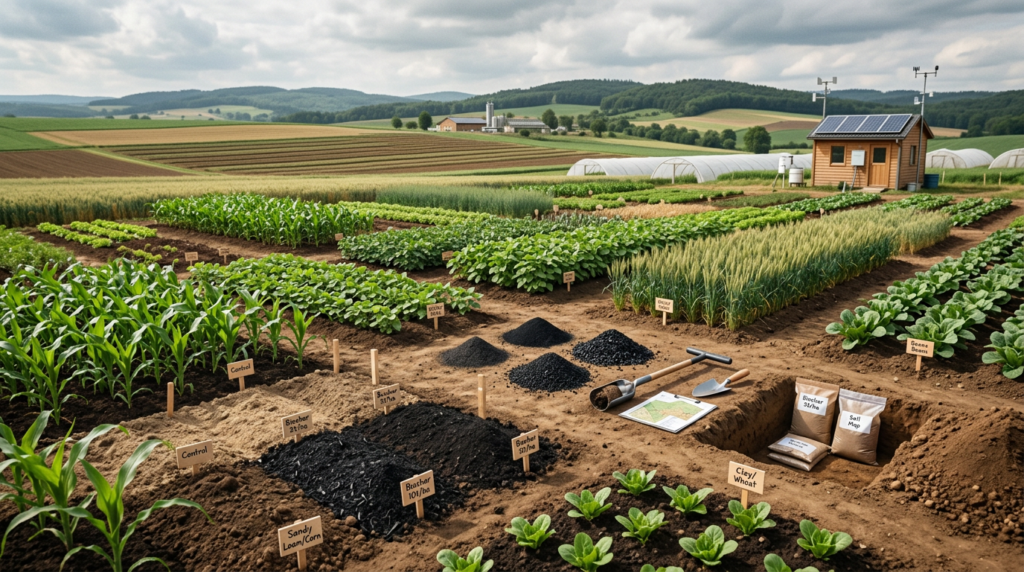
Navigating Biochar Dosages in Commercial Agriculture
Biochar has established itself as an enduring soil amendment capable of enhancing soil physical structure, improving nutrient retention, and building persistent organic carbon pools. However, treating biochar as a uniform input applied at a static rate across all agricultural contexts leads to inconsistent agronomic and economic outcomes. Determining an effective application rate requires an understanding of the complex interactions between soil physicochemical baseline conditions, crop nutritional demands, and the intrinsic properties of the biochar itself.
Agricultural literature demonstrates that yield responses to biochar follow non-linear response curves. Under-application may fail to overcome baseline soil limitations such as high bulk density or low cation exchange capacity (CEC), while excessive application can cause unintended nutrient immobilization, micronutrient deficiencies through excessive pH shifts, or unnecessary capital expenditure. Developing an evidence-based application strategy requires evaluating site-specific variables rather than relying on broad generalities.
Primary Determinants of Application Rates
Before specifying dosages for individual crop categories, farm managers and project developers must assess three foundational variables that govern how biochar behaves in the soil matrix: soil texture, soil chemistry, and biochar physicochemical properties.
1. Soil Texture and Hydraulic Properties
Soil texture substantially influences how biochar alters moisture dynamics and porosity. In coarse, sandy soils with low water-holding capacity, biochar acts as a physical sponge. Its internal micro- and mesoporosity increases plant-available water capacity and reduces the percolation rate of soluble nutrients. Consequently, sandy soils often exhibit favorable agronomic responses at moderate to higher application rates.
Conversely, in fine-textured clay soils, the primary agronomic constraint is frequently poor aeration, high bulk density, and low hydraulic conductivity. Biochar can improve the structural aggregation and macroporosity of heavy clays, facilitating deeper root penetration and faster drainage. However, because clay particles already possess high surface area and moderate-to-high baseline CEC, the marginal gain in nutrient retention is typically lower than in coarse soils, requiring calibrated, moderate rates to prevent structural disruption.
2. Baseline Chemistry and pH Buffering
Most biochar produced through medium- to high-temperature pyrolysis exhibits an alkaline pH, often ranging between 8.0 and 10.5, alongside measurable calcium carbonate equivalent (CCE) values derived from mineral ash constituents. In acidic soils (pH below 5.5), biochar acts as a liming agent. In these contexts, application rates can be calculated to simultaneously remediate soil acidity and reduce aluminum and manganese toxicity.
In contrast, applying alkaline biochars to neutral, calcareous, or alkaline soils at elevated rates can elevate the soil pH beyond the optimal window for phosphorus and micronutrient availability (particularly iron, zinc, and manganese). When working with alkaline soils, operators must either select biochars produced from feedstocks with lower ash alkalinity, utilize lower application rates, or pre-acidify and condition the material before field distribution.
3. Biochar Physicochemical Characteristics
The agronomic efficacy of biochar depends directly on its production parameters. Low-temperature biochars (produced between 350 and 450 degrees Celsius) typically retain higher fractions of volatile matter, possess lower specific surface area, and feature higher cation exchange capacity due to unpyrolyzed functional groups. High-temperature biochars (produced between 600 and 800 degrees Celsius) exhibit high specific surface area, elevated aromatic carbon recalcitrance, and higher porosity, but lower initial surface functionalization.
Furthermore, raw biochar is fundamentally an amendment rather than a complete fertilizer. Untreated, high-surface-area biochar contains unoccupied sorption sites that can temporarily adsorb native or applied soil nitrate and ammonium, leading to transient nitrogen immobilization. Calibrating application rates must account for whether the material is applied unamended or co-applied with biological inoculants, compost, or mineral fertilizers.
Evidence-Based Application Ranges Across Major Crop Categories
Published agronomic literature and field trials show marked differences in crop sensitivity and economic returns relative to application volume. Below are evidence-based ranges and operational considerations categorized by crop type.
1. Cereal and Grain Crops (Maize, Wheat, Rice)
Broadacre cereal production operates on narrow margins per hectare, making application efficiency critical. Extensive field literature indicates that broadcast applications of biochar in cereal systems typically yield positive agronomic responses when applied within conservative to moderate ranges.
- General Application Range: 5 to 15 metric tons per hectare (broadcast and incorporated), or 1 to 3 metric tons per hectare when banded in-furrow.
- Agronomic Focus: For maize and wheat, yield benefits correlate strongly with reduced nitrate leaching and improved moisture resilience during critical grain-filling periods. In sandy loam and degraded ultisols, researchers observe significant increases in nitrogen-use efficiency when biochar is applied alongside standard fertility programs.
- Paddy Rice Considerations: In flooded paddy environments, biochar incorporation alters redox dynamics, reduces toxic soluble iron concentrations in highly weathered acidic soils, and can suppress methane emissions depending on pyrolysis temperature and soil organic matter levels. However, excessive application in poorly drained paddies can impede mechanized tillage and delay early-stage seedling establishment.
2. Grain Legumes and Pulses (Soybean, Chickpea, Field Pea)
Leguminous crops exhibit a distinct biological relationship with biochar amendments due to their reliance on symbiotic biological nitrogen fixation (BNF) mediated by Rhizobium bacteria.
- General Application Range: 3 to 10 metric tons per hectare (broadcast) or targeted seed-furrow placement.
- Agronomic Focus: Published studies demonstrate that moderate biochar applications stimulate root nodulation and nitrogenase enzyme activity. This response is attributed to biochar’s capacity to buffer rhizosphere acidity, provide trace elements such as molybdenum and boron, and create protective micro-habitats for nodulating bacteria within internal pore spaces.
- Precautionary Thresholds: Excessive application can inhibit nodulation if the amendment introduces high concentrations of soluble salts or shifts soil pH too rapidly, which can depress initial seedling emergence.
3. High-Value Horticultural and Vegetable Crops
Horticultural systems—such as solanaceous crops (tomatoes, peppers), brassicas, and leafy greens—are characterized by high nutrient turnover, frequent irrigation, and elevated crop values per hectare. These systems justify higher application rates and more intensive pre-conditioning methods.
- General Application Range: 10 to 25 metric tons per hectare (broadcast and thoroughly tilled), or 5 to 10 metric tons per hectare concentrated within raised planting beds.
- Agronomic Focus: Vegetable crops benefit substantially from improved moisture retention and stable soil electrical conductivity. Field evaluations indicate that biochar helps sustain continuous nutrient delivery when blended directly into the root zone. Leafy greens show marked reductions in drought-induced leaf tip burn and physiological stress.
- Application Strategy: In intensive vegetable beds, biochar should rarely be applied uncharged. Blending the material with composted manure or liquid organic fertilizers prior to application prevents early-stage nitrogen deficiencies that can quickly reduce marketable yields.
4. Perennial Orchards, Vineyards, and Agroforestry
Perennial tree crops, vineyards, and plantation forestry require distinct management strategies compared to annual crops. Because the soil profile cannot be mechanically disrupted once the permanent root architecture is established, placement depth and timing are vital.
- General Application Range: 5 to 15 metric tons per hectare equivalent, calculated based on localized application to the tree row or root zone, or 2 to 5 kilograms per tree planting hole during establishment.
- Establishment Phase: Incorporating biochar into the planting pit and backfill soil during orchard establishment promotes rapid mycorrhizal colonization, increases deep moisture infiltration, and reduces transplant shock.
- Mature Plantations: For established tree crops, surface broadcasting is inefficient because biochar does not readily migrate downward through the soil column without physical mixing. Sub-surface vertical mulching, deep trenching along the drip line, or pneumatic injection directly into the root zone delivers the amendment where feeder roots can access it without destroying structural roots.
Strategic Application Techniques: Banding vs. Broadcasting
The total volume of biochar required to achieve an agronomic response depends heavily on the chosen placement technique. Understanding these application methods allows farm operators to optimize capital expenditure and input logistics.
Broadcast and Full-Profile Incorporation
Broadcasting distributes biochar evenly across the entire soil surface, followed by mechanical incorporation using disc harrows, rotary tillers, or deep plows to a depth of 10 to 20 centimeters. This approach is standard for broadacre annual cropping and degraded pasture rehabilitation.
- Pros: Homogenizes the entire plow layer, improves overall field hydraulic performance, and provides uniform carbon distribution for digital carbon accounting and monitoring protocols.
- Cons: Requires large volumes of material per hectare, higher freight and handling costs, and presents potential dust generation challenges during spreading if moisture levels are not maintained around 20 to 30 percent.
Precision Banding and In-Furrow Application
Precision banding places biochar directly beneath or adjacent to the seed line, concentrated in the immediate root exploitation zone. This approach mimics banded fertilizer applications.
- Pros: Achieves comparable localized root zone concentrations using roughly one-third to one-fifth of the material needed for broadcast methods. This approach substantially reduces transport and handling expenses while concentrating nutrient and moisture retention where seedling roots emerge.
- Cons: Requires specialized application equipment (such as modified fertilizer boxes or pneumatic seeders) and does not improve the bulk hydraulic conductivity of the inter-row soil matrix.
The Necessity of Co-Composting and Biological Charging
A primary cause of agronomic underperformance in field trials is the application of fresh, untreated biochar directly to nutrient-sensitive annual crops. Pristine biochar possesses empty sorption sites and sterile surfaces. When placed in the soil, it immediately equilibrates with the surrounding environment, absorbing soluble nitrate, ammonium, and water-soluble phosphorus from the soil solution.
To prevent transient crop stress, biochar should undergo biological pre-conditioning, commonly referred to as “charging” or “inoculation.” Evidence confirms that co-composting biochar with green waste, animal manures, or agricultural residues significantly enhances its agronomic performance. During co-composting, the organic acids generated by microbial activity oxidize the biochar surfaces, generating carboxylic and phenolic functional groups that dramatically increase its cation exchange capacity. Concurrently, the porous structure becomes colonized by beneficial bacteria and fungi, and its internal pores become saturated with organic nutrients. Charged biochar functions as a slow-release nutrient carrier from the moment of field application.
Integrating Agronomic Rates with Digital MRV and Carbon Markets
For agricultural enterprises participating in voluntary carbon markets or national credit frameworks, such as the Green Credit Programme administered by the Ministry of Environment, Forest and Climate Change (MoEFCC) in India, biochar application serves a dual purpose: improving soil fertility and generating verified, durable carbon removals.
Carbon crediting methodologies require robust validation of the volume, carbon purity, and stability (H:Corg ratios) of applied biochar, as well as precise geographic tracking of soil placement. Farm operators cannot treat biochar as an unmonitored bulk input; application rates must be documented through digital Measurement, Reporting, and Verification (dMRV) platforms. Integrating geospatial boundaries, delivery manifests, and calibrated spreader telemetry ensures that the carbon permanence claims align with verifiable standards. By maintaining this alignment, farms maximize soil health while establishing transparent audit trails suitable for environmental asset monetization and ESG compliance under frameworks like IFRS S2.
Ultimately, selecting the correct biochar application rate requires balancing soil baseline constraints, crop sensitivity, equipment capabilities, and operational logistics. When calculated on rigorous agronomic evidence and deployed through targeted placement strategies, biochar functions as a durable asset for modern agricultural resilience.
To evaluate biochar supply, design optimized application programs, or establish digital MRV systems for soil carbon credits, contact ForestTwin to speak with our technical team.