
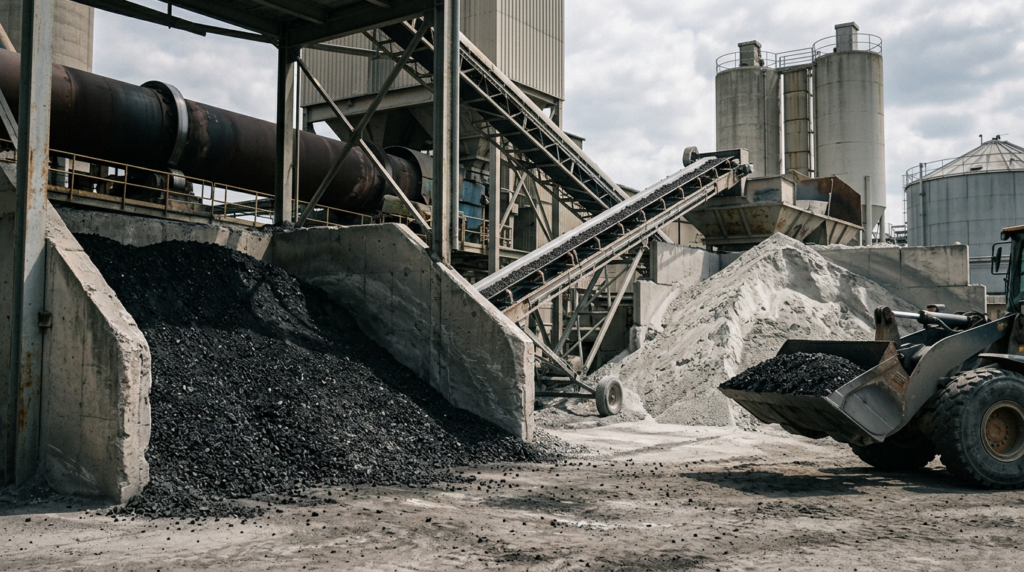
The Decarbonization Challenge in Clinker Production
Cement manufacturing remains one of the most emissions-intensive industrial sectors globally. The carbon footprint of Portland cement originates primarily from two distinct points: fuel combustion within the pyroprocessing system to reach kiln temperatures exceeding 1400 degrees Celsius (accounting for roughly one-third of direct emissions), and the chemical calcination of limestone where calcium carbonate decomposes into calcium oxide and carbon dioxide (accounting for the remaining two-thirds). While alternative fuels, clinker-to-cement ratio reduction, and energy efficiency upgrades have made incremental progress, reaching deep decarbonization mandates requires examining unconventional solid carbon materials.
Biochar—a stable, carbon-rich solid produced through the thermochemical conversion of biomass under oxygen-limited conditions (pyrolysis)—has gained significant technical attention across heavy industry. In cement manufacturing, biochar cannot be approached as a single uniform input. Depending on the production temperature, feedstock source, particle morphology, and post-processing treatments, biochar exhibits vastly different thermal, chemical, and physical characteristics. To assess its viability objectively, plant operators and sustainability teams must evaluate biochar across three separate substitution pathways: as an alternative thermal fuel, as a raw-mix additive, and as a post-clinker mineral addition or micro-filler. Each route presents specific chemical advantages alongside rigid engineering constraints.
Pathway 1: Alternative Thermal Fuel in Precalciners and Kilns
Industrial cement kilns have utilized solid waste materials for decades, including refuse-derived fuels (RDF), tires, and raw agricultural residues. Biochar presents distinct advantages over raw biomass fuels because the pyrolysis process removes high-moisture fractions and low-temperature volatile compounds, concentrating fixed carbon and elevating lower heating values (LHV) to levels comparable with standard petcoke or thermal coal.
Combustion Kinetics and Flame Stability
Kiln burners require fuels that provide immediate, stable flame profiles to maintain sintering zones without causing thermal instability. Raw biomass typically introduces substantial moisture and low bulk density, reducing flame temperatures and increasing gas volumes in the kiln. Biochar, when pulverized, exhibits combustion characteristics closer to semi-anthracite or bituminous coal. However, volatile matter content varies sharply depending on whether the biochar was produced through slow or fast pyrolysis. Lower-temperature slow pyrolysis leaves higher residual volatile matter, which ignites more readily but produces lower fixed-carbon content. High-temperature biochar possesses high fixed carbon and minimal volatiles, which can retard ignition speed if introduced into main burners without optimization.
Ash Chemistry and Clinker Mineralogy
Every solid fuel injected into a cement kiln contributes its inorganic ash fraction directly into the molten clinker matrix. Cement chemists calculate strict saturation factors, including the Lime Saturation Factor (LSF), Silica Modulus (SM), and Alumina Modulus (AM). Plant operators evaluating biochar must carefully examine feedstock ash composition:
- Alkali metals (Sodium and Potassium): Certain agricultural biochar feedstocks (such as crop straws or husks) carry elevated potassium levels. Excessive alkalis increase the risk of kiln preheater build-ups, ring formations in the burning zone, and long-term alkali-silica reactions (ASR) in concrete products made from the resulting clinker.
- Chlorides and Sulfur: Volatile recirculating elements can lead to severe blockages in cyclone preheaters. While biochar generally presents lower sulfur than petcoke, chloride content in specific biomass sources must be audited continually.
- Phosphorus and Heavy Metals: Biochars derived from sewage sludge or treated wastes introduce elements that interfere with alite formation and prolong initial setting times.
For these reasons, precalciner firing is far more forgiving than main burner firing. Temperatures in the precalciner (around 850 to 900 degrees Celsius) allow biochar to replace traditional pulverized coal for calcination duty, provided residence times are sufficient for full burnout and particle sizes are carefully controlled.
Pathway 2: Raw-Mix Component and Calcination Behavior
Another theoretical pathway involves introducing biochar into the raw meal before it enters the preheater tower. The concept rests on positioning fixed carbon in direct contact with limestone to facilitate solid-state reactions or reduce external heating requirements during the endothermic decarbonation reaction.
Thermal Inefficiencies and Sequestration Loss
In practice, blending biochar directly into the raw mix introduces severe thermal and carbon-efficiency challenges. As the raw meal descends through the upper preheater cyclones, it encounters counter-current hot exhaust gases containing oxygen at temperatures between 400 and 700 degrees Celsius. In this environment, biochar combusts prematurely—well before the meal reaches the calciner or burning zone.
This premature oxidation releases carbon dioxide high in the preheater tower without transferring usable heat efficiently to the primary calcination zone. More critically, oxidizing biochar in this manner entirely eliminates the durable biogenic carbon storage value of the material. Instead of preserving the recalcitrant carbon matrix permanently, the carbon is converted immediately back into atmospheric CO2 emissions. Consequently, industrial consensus favors keeping biochar out of the precalciner raw-feed blend unless specific low-temperature reductive chemistry is explicitly targeted.
Pathway 3: Post-Clinker Mineral Addition and Concrete Admixtures
The most promising pathway for achieving carbon negativity alongside material performance is utilizing biochar post-pyroprocessing, either inter-ground with clinker as a Supplementary Cementitious Material (SCM) or utilized as a carbonaceous micro-filler during dry-mix cement or concrete batching.
Microstructure, Hydration Kinetics, and Filler Effects
When properly milled to micro-scale dimensions, biochar acts as a functional filler that influences the hydration mechanics of cement paste:
- Nucleation Site Provision: Finely ground biochar particles provide heterogeneous nucleation surfaces, accelerating the precipitation of calcium silicate hydrate (C-S-H) gels during early hydration phases.
- Pore Refinement: Microscopic biochar grains can settle into the interstitial voids between clinker grains, refining the capillary pore network and reducing overall permeability in hardened mortar.
- Internal Curing Properties: The internal micro-porosity of certain porous biochars allows them to retain water during mixing and release it slowly as the cement matrix self-desiccates during hydration, lowering autogenous shrinkage and microscopic crack formation.
Rheological Trade-offs and Water Demand
Despite microstructural benefits, biochar introduces steep rheological penalties if replacement levels exceed low single-digit percentages. The primary engineering bottleneck is biochar’s irregular particle morphology, internal porosity, and exceptionally high specific surface area. When mixed with water, biochar absorbs free water from the mix rapidly.
This surge in water demand decreases the effective workability (slump) of the fresh mix. To maintain acceptable slump values, batching plants must either increase the water-to-binder ratio—which severely compromises 28-day compressive and flexural strength—or increase superplasticizer (polycarboxylate ether) dosages. Chemical admixtures add direct material costs that can quickly undermine the financial logic of the substitution.
Mechanical Limits and Replacement Thresholds
Industrial literature and laboratory trials show that compressive strength development follows a non-linear curve as biochar substitution increases. At low substitution rates (typically between 0.5% and 2.0% by weight of cementitious material), compressive strength is frequently maintained or marginally enhanced due to micro-filler packing and accelerated nucleation. However, exceeding higher replacement levels (typically above 5% to 8%) often causes pronounced declines in early and late-stage mechanical strength. The low intrinsic stiffness of porous carbon particles combined with workability loss establishes an upper engineering threshold that prevents biochar from serving as a direct one-to-one volumetric replacement for high-volume SCMs such as blast furnace slag or natural pozzolans.
Carbon Accounting, dMRV, and Standards Alignment
Quantifying the decarbonization impact of biochar in cement requires rigorous separation between emissions avoidance (Scope 1 fossil fuel substitution) and durable carbon dioxide removal (CDR / permanent sequestration in the built environment). Conflating these two mechanisms violates international accounting principles and risks disqualification under carbon audit frameworks.
Fuel Substitution vs. Permanent Sequestration
When biochar is combusted in the kiln or precalciner, the carbon accounting treats the biogenic emissions as neutral under standard corporate greenhouse gas protocols (provided the biomass feedstock meets strict land-use and non-depletion criteria). The plant records a direct reduction in fossil Scope 1 emissions by displacing coal or petcoke. However, this is an emissions avoidance claim; no carbon removal credits can be generated because the carbon is released into the atmosphere.
Conversely, when biochar is embedded into the concrete matrix as a filler, the recalcitrant carbon fraction remains permanently trapped throughout the service life and eventual demolition of the structure. This qualifies as carbon sequestration. To monetize or disclose this benefit under frameworks such as IFRS S2 climate-related disclosures, cement producers must prove the additionality, feedstock sustainability, and permanence of the biochar without double-counting the avoided emissions of the clinker it displaces.
The Role of digital Monitoring, Reporting, and Verification (dMRV)
Ensuring compliance across environmental claims requires robust data lineage from the source biomass to final product curing. Digital MRV (dMRV) systems track continuous operational telemetry: pyrolysis operating temperatures (to verify H:Corg ratios and fixed-carbon permanence), batch moisture, grinding fineness, and mix proportions. Within regulatory frameworks such as the MoEFCC Green Credit Programme in India or voluntary carbon crediting standards, digital verification provides defensible audit trails that establish physical permanence and protect manufacturers against greenwashing scrutiny.
Systemic Obstacles: Logistics and Supply Chain Fragmentation
Beyond material science and carbon accounting, cement manufacturers face significant supply chain barriers. Cement production operates on an immense continuous scale; a single mid-sized production line consumes thousands of tonnes of material daily. In contrast, the current biochar industry is fragmented, characterized by decentralized conversion facilities with variable production capacities and fluctuating feedstock supplies.
Cement kiln operators cannot recalibrate burning parameters weekly to accommodate variations in ash content, volatile matter, or moisture. Biochar suppliers must deliver uniform, pelletized or bulk-stabilized product that complies with strict quality management protocols (ISO 9001, ASTM standards). Long-distance transportation of low-density, unpelletized biochar can also erode the net lifecycle emissions balance, making localized sourcing and centralized processing critical components of project feasibility.
Engineering an Objective Decarbonization Roadmap
Biochar is neither an immediate drop-in replacement for coal nor a direct functional substitute for hydraulic slag. Instead, it represents a specialized material capable of fulfilling distinct, complementary roles across cement decarbonization programs when engineered correctly. As a fuel, it demands precise integration at the precalciner stage with strict limits on alkali and volatile cycling. As an additive, it requires fine grinding, functional surface engineering, and controlled dosage thresholds to preserve rheology and structural strength while permanently locking biogenic carbon into infrastructure products.
Executing successful biochar integration requires a joint engineering and sustainability framework: evaluating kiln compatibility, conducting rigorous mortar testing, ensuring supply chain scalability, and building auditable carbon tracking structures.
ForestTwin provides the deep technical, regulatory, and carbon accounting advisory required to evaluate biochar integration across your manufacturing footprint, alongside digital MRV systems, project development services, and carbon disclosure alignment under IFRS S1/S2 frameworks. Connect with our engineering and sustainability advisory team directly by visiting foresttwin.com/contact to discuss biochar feasibility, technical testing, and compliance strategies.