
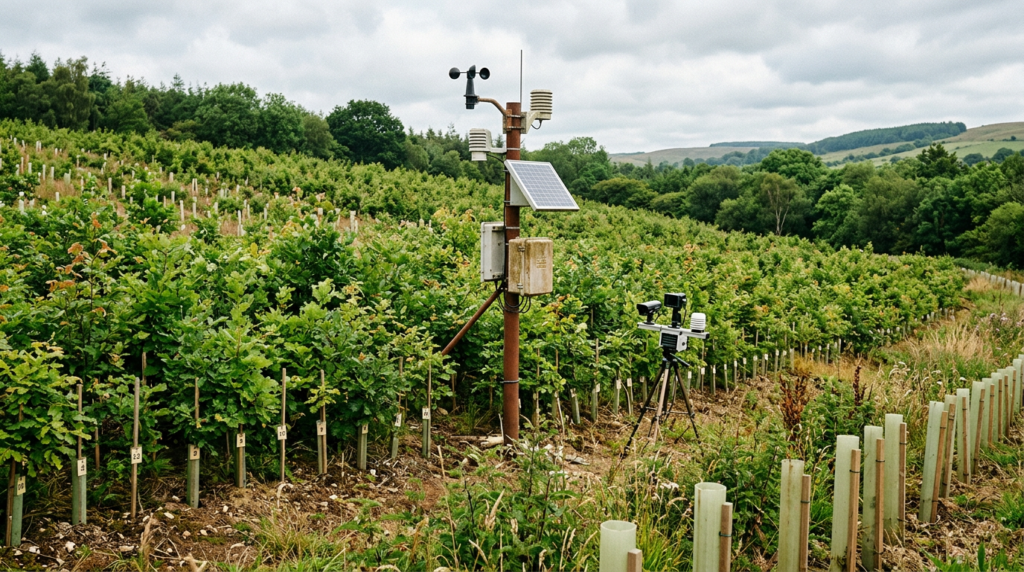
The Shift from Planting Targets to Verifiable Survival
In environmental project management, the act of planting saplings represents an operational beginning rather than a regulatory finish line. Under India’s Green Credit Programme (GCP), administered by the Ministry of Environment, Forest and Climate Change (MoEFCC) through the Indian Council of Forestry Research and Education (ICFRE), tree plantation is governed by rigorous qualification frameworks. Generating tradeable Green Credits requires establishing not just that saplings entered the ground, but that those plantings mature into persistent, ecologically viable woody biomass.
For public and private entities investing in afforestation or ecological restoration on degraded forest land, wasteland, or river basins, the real compliance challenge begins post-planting. Green Credits are issued based on verified survival rates, canopy density, and land stewardship over multi-year verification windows. Failing an audit months or years after capital deployment results in financial write-downs, compliance exposure, and reputational vulnerability. Establishing a monitoring and verification architecture that withstands regulatory scrutiny is essential for any organisation deploying capital under the GCP framework.
The GCP Regulatory Framework: Post-Planting Expectations
The Green Credit Rules, notified under the Environment (Protection) Act, outline clear operational pathways for generating credits via tree plantation. While baseline registration involves mapping land parcels and securing approvals from state forest departments or local administration, the issuance mechanism hinges on independent assessment.
State Forest Departments, designated agencies, and accredited technical verifiers evaluate projects against standard operational procedures. Key compliance criteria enforced during post-planting evaluations include:
- Baseline Demarcation: Accurate georeferencing of designated plots to ensure clear boundary isolation and avoid boundary disputes or dual-claim registrations.
- Density and Species Mix: Verification that planting densities adhere to local agro-climatic requirements, avoiding prohibited non-native or invasive monocultures in favour of native biodiversity.
- Survival Benchmarks: Documenting the percentage of saplings surviving through seasonal transitions, pest pressures, and thermal stress across critical intervals.
- Additionality and Land Status: Confirming that the afforested land has not been diverted from other statutory conservation commitments or counted under parallel carbon offset registries without proper reconciliations.
Regulators scrutinise discrepancies between self-reported project milestones and actual ground conditions. When independent inspectors visit a site, discrepancies between submitted documentation and physical forest cover lead directly to delays, credit discounts, or disqualification.
Core Verification Metrics That Regulators Scrutinise
Meeting post-planting compliance demands an understanding of the specific operational and ecological metrics evaluated by verifiers. Regulators do not rely solely on contractor invoices or nursery dispatch slips; they assess functional indicators of ecosystem establishment.
1. Species-Specific Survival Rates
Survival rates are the foundational metric for GCP plantation credit issuance. Regulators expect survival data to reflect actual field counts rather than projected statistical survival tables. Mortality must be tracked, reported, and mitigated through infill planting within approved seasonal windows. If mortality exceeds permissible thresholds without prompt corrective planting, the project runs the risk of failing its verification cycle.
2. Crown Density and Canopy Stratification
As the plantation advances, verifiers shift focus from individual stem counts to crown cover expansion. High-resolution optical assessments evaluate whether trees are successfully occupying the canopy space. Canopy closure serves as proxy evidence for root establishment, local microclimate regulation, and weed suppression.
3. Biomass Accumulation and Soil Health
Healthy vegetative growth correlates directly with soil quality. Verifiers increasingly review soil management records, particularly on degraded sites where baseline soil organic matter was marginal. In projects incorporating soil amendments such as biochar to bolster water retention and nutrient stability, documenting baseline-versus-operational soil parameters provides concrete technical evidence of active land stewardship.
4. Absence of Spatial Overlaps
A primary failure point in corporate restoration programmes is spatial ambiguity. State agencies must confirm that the land parcel registered under the Green Credit Programme does not overlap with existing Compensatory Afforestation Fund Management and Planning Authority (CAMPA) activities, joint forest management (JFM) areas, or commercial timber concessions. Clear boundary files are mandatory to clear this checkpoint.
Designing an Audit-Ready Monitoring Protocol (dMRV)
Relying on occasional manual inspections and paper logbooks is inadequate for institutional-grade compliance. Terrestrial inspections are subject to human error, spatial sampling bias, and documentation loss. To satisfy regulatory scrutiny, project proponents require a robust digital Monitoring, Reporting, and Verification (dMRV) pipeline.
Multi-Tiered Remote Sensing
A defensible monitoring protocol pairs open-access medium-resolution satellite data with targeted high-resolution commercial optical and synthetic aperture radar (SAR) feeds. Optical imagery tracks vegetative indices (such as NDVI and EVI) over time, providing continuous proof of greenness and photosynthetic activity. SAR data supports canopy structure analysis, functioning effectively even across cloudy monsoon seasons when optical passes fail.
Time-Stamped, Geotagged Ground Truth
Satellite observation requires ground-truth validation. Field crews equipped with mobile data applications must record coordinates, photo evidence, and biometric measurements (such as collar diameter and height) for established sample plots. To satisfy external auditors, data records must carry immutable timestamps, cryptographic hashes, and unalterable geographic coordinates that eliminate any possibility of retrospective data manipulation.
Drone-Assisted Photogrammetry
For mid-scale project areas with variable topography, fixed-wing or multi-rotor drones offer sub-centimetre spatial resolution. Drone photogrammetry creates detailed point clouds and orthomosaics, enabling direct individual tree counting and early detection of canopy stress long before mortality becomes visible on coarse satellite sweeps. This aerial record forms a permanent visual archive for third-party verifiers.
Common Post-Planting Pitfalls That Jeopardise Compliance
Organisations navigating the Green Credit Programme often encounter structural challenges that delay certification. Identifying these operational risks early prevents costly remediation efforts downstream.
- Neglecting Dry-Season Mortality: Saplings often survive the initial monsoon planting phase, only to suffer severe mortality during the dry pre-summer months. Projects without dedicated moisture management plans or soil-conditioning interventions face sudden biomass loss, triggering audit failures.
- Fragmented Record-Keeping: Maintaining planting invoices, replacement schedules, nursery certificates, and boundary coordinates across disparate spreadsheets creates audit friction. When external verifiers request historical intervention logs, fragmented data slows verification.
- Disregarding Local Communities: Restoration plots established without local stakeholder engagement often suffer from cattle grazing, accidental fires, or fuel-wood gathering. Sustainable compliance requires community integration through participatory monitoring, firebreak maintenance, and local employment models.
- Failure to Harmonise Carbon and Green Credit Methodologies: When corporate sponsors intend to register sites for both domestic Green Credits and international voluntary carbon standards, methodology alignment is mandatory to avoid double-counting claims. Accounting frameworks must clearly delineate environmental attributes.
Aligning GCP Outcomes with Corporate Sustainability Disclosures
For enterprise participants, compliance under the Green Credit Programme does not exist in an operational silo. It connects directly with corporate transparency requirements, including the Business Responsibility and Sustainability Report (BRSR) framework in India and the global International Financial Reporting Standards (IFRS S1 and S2).
IFRS S2 requires companies to disclose physical climate-related risks, transition strategies, and verifiable nature-based activities. If an enterprise claims capital expenditure or emissions resilience through domestic land restoration initiatives, those claims must rest on auditable data. A GCP project supported by a defensible dMRV system provides the empirical foundation needed to defend sustainability disclosures before financial auditors and environmental regulators alike.
Transparent, auditable data bridges the gap between statutory compliance under MoEFCC guidelines and governance metrics required by capital markets, transforming green commitments into defensible corporate assets.
End-to-End Compliance Execution with ForestTwin
Managing the lifecycle of a Green Credit project demands technical coordination across forestry sciences, remote sensing, soil agronomy, and regulatory liaison. ForestTwin provides end-to-end technical support designed to ensure plantation projects meet and sustain MoEFCC and ICFRE standards over long-term compliance cycles.
ForestTwin’s operational approach integrates:
- Baseline Site Assessment and Land Screening: Determining ecological suitability, historical land-use classifications, and perimeter verification to prevent tenure conflicts.
- Soil Conditioning and Biochar Strategies: Formulating targeted biochar applications and soil enrichment protocols that improve seedling survival, enhance water conservation, and build soil carbon in degraded terrain.
- Digital MRV Architecture: Deploying automated satellite surveillance, high-resolution aerial mapping, and field data collection tools that generate an immutable, audit-ready data trail.
- Regulatory Verification Management: Navigating technical submissions, liaising with designated inspection authorities, and providing evidentiary dossiers to expedite credit issuance.
- Corporate Reporting Integration: Aligning project outcomes with BRSR, IFRS S1/S2, and financial reporting standards, ensuring that environmental claims withstand international investor scrutiny.
By replacing speculative survival assumptions with continuous, auditable monitoring, project sponsors protect their capital deployments and deliver real, enduring ecological outcomes.
To evaluate your land restoration pipeline or upgrade your compliance infrastructure for the Green Credit Programme, contact ForestTwin’s environmental compliance specialists today.