
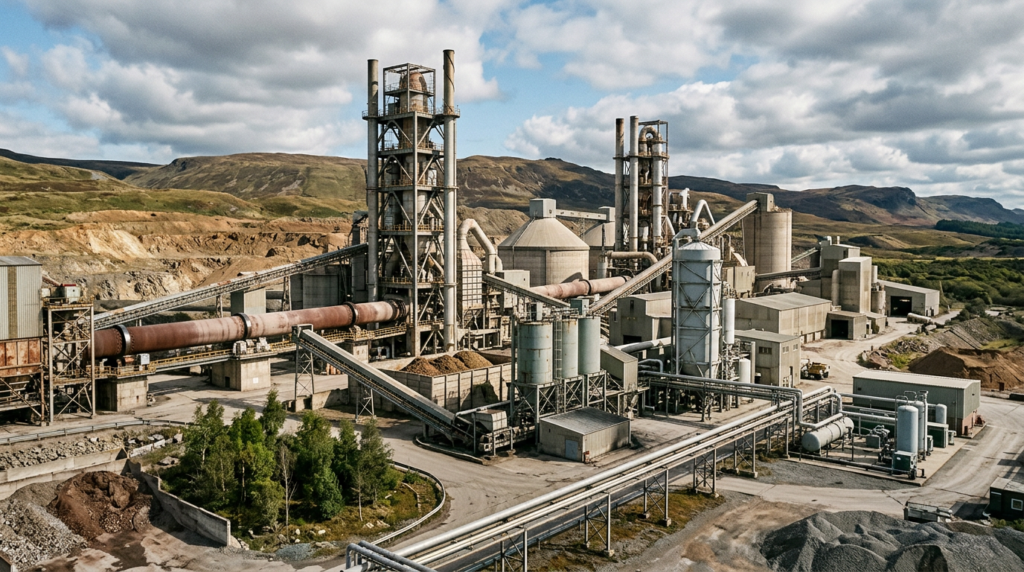
Decarbonization Realities in Cement Manufacturing
Cement production remains one of the most emissions-intensive industrial activities. The fundamental chemistry of clinker manufacturing presents a dual challenge: process emissions generated by the calcination of limestone (converting calcium carbonate into calcium oxide and carbon dioxide) account for the majority of direct emissions, while high-temperature thermal energy and electrical demands make up the remainder.
Because process emissions are chemically intrinsic to conventional clinker production, a single intervention cannot address the entire footprint. Plant operators, technical directors, and chief sustainability officers must deploy a rigorous, sequenced decarbonization hierarchy. Moving prematurely to high-cost interventions or relying excessively on off-site market instruments without first addressing thermodynamic and material baselines invites commercial inefficiency and regulatory exposure. An effective transition requires four distinct stages executed in sequence: operational and thermal efficiency, alternative fuels and raw materials, biogenic carbon and biochar integration, and high-integrity carbon credits to address residual emissions.
Stage 1: Energy Efficiency and Clinker Factor Optimization
The foundation of any industrial decarbonization roadmap is the optimization of existing assets to reduce primary energy demand per ton of cementitious material produced. This phase requires internal operational capital and operational discipline, offering immediate operating cost improvements alongside baseline carbon reductions.
Thermal and Electrical Efficiency
Thermal efficiency targets focus heavily on the preheater, precalciner, and kiln systems. Key technical interventions include:
- Upgrading multi-stage preheater cyclones to minimize pressure drop and improve heat transfer between raw meal and kiln exhaust gases.
- Modernizing clinker coolers to increase secondary and tertiary air temperatures, returning recovered thermal energy back to the combustion zones.
- Deploying waste heat recovery (WHR) installations across the preheater exhaust and clinker cooler exhaust. WHR systems generate captive electricity, directly offsetting grid power reliance and indirect Scope 2 emissions.
- Replacing legacy ball mills with vertical roller mills (VRM) or high-pressure grinding rolls (HPGR) across raw meal, solid fuel, and final cement grinding circuits to lower specific power consumption.
Clinker Factor Reduction
Because the clinker phase generates the vast majority of direct process emissions, reducing the clinker-to-cement ratio remains the most direct operational lever to reduce emissions intensity per ton of product. This involves formulating blended cements using supplementary cementitious materials (SCMs):
- Granulated blast-furnace slag (GBFS) and pulverized fuel ash (fly ash), where available in compliance with regional standards.
- Calcined clays and limestone calcined clay cement (LC3) formulations, which offer scalable alternatives in regions where industrial byproducts like slag and fly ash are constrained.
- Finely ground limestone filler to displace clinker without compromising standard compliance.
Stage 2: Alternative Fuels and Raw Materials (AFR)
Once baseline energy performance is optimized, plants must shift focus to fuel switching. The thermal energy required to sustain calciner and kiln operations traditionally relies on carbon-dense solid fuels such as petroleum coke (petcoke) and imported or domestic thermal coal.
Thermal Substitution Rate (TSR) Expansion
Increasing the thermal substitution rate involves replacing fossil fuels with alternative fuels possessing appropriate calorific values, moisture profiles, and combustion kinetics. Common AFR streams include:
- Refuse-derived fuel (RDF) and solid recovered fuel (SRF) sourced from municipal and industrial non-hazardous solid waste.
- End-of-life vehicle tires (whole or shredded), providing high calorific value and partial iron input for clinker mineralogy.
- Agricultural and forestry residues, providing a biogenic, carbon-neutral thermal source when responsibly procured.
Technical and Operational Constraints
Scaling AFR introduces operational challenges that plants must manage carefully:
- Chlorine, sulfur, and alkali bypass systems must be sized correctly to avoid build-up, clogging, and corrosion in the preheater tower.
- Fuel feeding systems require specialized metering and pneumatic injection to ensure steady flame geometry and consistent burning zone temperatures.
- Variability in fuel moisture and particle size must be stabilized through dedicated pre-treatment, drying, and homogenization facilities.
Stage 3: Biochar Integration as a Biogenic Dual-Role Asset
After maximizing efficiency and conventional alternative fuel substitution, cement producers encounter structural limits. Agricultural residues often present feeding, transport, and combustion consistency challenges, while clinker reduction reaches chemical thresholds governed by compressive strength and durability standards. Biochar emerges at this stage as a stable, engineered biogenic carbon material with dual utility: as an upgraded solid fuel and as a functional raw material additive.
1. Biochar as High-Calorific Biogenic Fuel
Raw biomass typically suffers from low bulk density, high moisture, low calorific value, and poor grindability. Pyrolyzed biomass—biochar—undergoes thermal decomposition in an oxygen-deprived environment, resulting in a carbon-dense, dry, and easily pulverized solid. When utilized in cement manufacturing:
- Biochar exhibits high fixed-carbon content and improved calorific values comparable to mid-tier thermal coals.
- The material possesses high grindability, enabling co-milling alongside petcoke or coal in existing fuel preparation circuits without requiring extensive mill retrofits.
- Because it is classified as biogenic carbon, the emissions released during its combustion inside the calciner are accounted as short-cycle carbon under Greenhouse Gas (GHG) Protocol guidelines, directly driving down Scope 1 fossil emissions.
2. Biochar as a Supplementary Cementitious Material and Carbon Sink
Beyond the combustion line, engineered biochar can be incorporated directly into blended cement and downstream concrete mixes. When milled to precise grain sizes and appropriately activated, biochar exhibits technical properties that benefit building materials:
- Its microporous structure can act as an internal curing agent, retaining moisture and releasing it slowly to assist continuous cement hydration.
- It serves as an inert micro-filler that densifies the cement paste matrix, refining pore size distributions and supporting early-stage mechanical strength.
- Most critically, biochar integrated into the matrix permanently sequesters carbon within the built environment. Because the carbon in biochar is chemically transformed into aromatic, highly stable structures resistant to decomposition, its incorporation into concrete fixes biogenic carbon for decades or centuries.
Securing high-volume, standardized biochar requires reliable manufacturing supply chains that ensure consistent fixed-carbon percentages, low volatile matter, and minimal heavy metal or ash contaminants that could disrupt kiln balance or cement hydration chemistry.
Stage 4: Carbon Credits and Residual Emission Management
Even with optimal efficiency, high AFR rates, biochar fuel substitution, and reduced clinker ratios, the cement manufacturing process will retain residual emissions. Chemical calcination cannot be entirely eliminated unless non-carbonate raw materials or commercial-scale carbon capture, utilization, and storage (CCUS) are fully operational. Consequently, high-integrity carbon credits form the necessary final stage of the decarbonization sequence.
Navigating Compliance and Voluntary Carbon Frameworks
Cement enterprises face a complex regulatory terrain spanning domestic compliance mandates, international export controls, and voluntary carbon commitments:
- Domestic Compliance and Schemes: In jurisdictions establishing national carbon systems, such as India’s Carbon Credit Trading Scheme (CCTS) or the Green Credit Programme administered by the Ministry of Environment, Forest and Climate Change (MoEFCC), facilities must align reduction baselines with certified domestic mechanisms.
- Cross-Border Carbon Adjustments: Manufacturers exporting into jurisdictions like the European Union face the Carbon Border Adjustment Mechanism (CBAM), where direct emissions must be verified with extreme analytical rigor to avoid punitive border tariffs.
- Voluntary and High-Durability Credits: For net-zero transition targets, cement producers must prioritize permanent carbon dioxide removal (CDR) over temporary avoided emissions. Procuring carbon removal credits generated from durable interventions—such as certified biochar carbon removal projects—ensures alignment with evolving stakeholder and corporate disclosure expectations.
dMRV, IFRS Disclosures, and Financial Governance
A technical decarbonization sequence cannot succeed in isolation from corporate accounting and financial reporting frameworks. Transition capital expenditures (CapEx) and operational changes must be matched with rigorous data infrastructure to withstand regulatory audit and maintain investor confidence.
Digital Measurement, Reporting, and Verification (dMRV)
Manual monitoring, infrequent stack testing, and paper-based fuel manifests are inadequate for modern compliance. Digital MRV architectures automate the ingestion of raw plant data: continuous emission monitoring systems (CEMS), automated weighbridge readings for AFR and biochar intake, and calorific testing laboratory feeds. By anchoring operational data in a validated digital pipeline, plants can:
- Provide real-time visibility into specific Scope 1 emissions intensity per product grade.
- Track precise biogenic versus fossil carbon ratios entering the calciner and kiln.
- Generate auditable data trails required by registry bodies for carbon credit issuance or regulatory compliance verification.
IFRS Sustainability and Financial Disclosures
The International Sustainability Standards Board (ISSB) has established global reporting standards via IFRS S1 (General Requirements for Disclosure of Sustainability-related Financial Information) and IFRS S2 (Climate-related Disclosures). Cement manufacturers must reflect their physical pathway within these disclosures:
- Transition Plans: Under IFRS S2, companies must disclose detailed operational transition plans, capital resource allocation, and specific dependency assumptions regarding alternative fuels, new additives, and external credit procurement.
- Scenario Analysis and Carbon Pricing: Entities must document how their asset base responds to internal carbon pricing, escalating compliance penalties, and cross-border adjustments.
- Integration with Financial Statements: Asset retirement obligations, useful life adjustments for legacy fossil-fired grinding or burning assets, and revenue recognition under IFRS 15 for products carrying specific green premium attributes must be transparently reported alongside disclosures governed by IFRS 9 and IFRS 7 for carbon asset and liability management.
Structuring the Implementation Roadmap
To implement this pathway without operational disruption, plant leadership should follow a clear execution cadence:
- Diagnostic Baseline and WHR Review: Audit current specific thermal and electrical energy metrics. Maximize clinker-to-cement substitution ratios based on regional standard limits and evaluate waste heat recovery potential across all exhaust circuits.
- AFR and Fuel Handling Upgrades: Assess bypass system capacity and mechanical fuel processing assets to target higher thermal substitution rates through solid waste and agricultural residuals.
- Biochar Procurement and Co-processing Trials: Establish supply relationships for standardized, high-carbon biochar. Conduct test runs to evaluate grindability in solid fuel circuits and evaluate pilot concrete integration for product performance certification.
- Data Infrastructure and dMRV Deployment: Replace siloed plant spreadsheets with an automated dMRV layer to aggregate operational data for both compliance tracking and potential carbon credit project registration.
- Financial and Registry Alignment: Align carbon asset management and transition timelines with IFRS S1 and S2 reporting guidelines, while positioning residual emissions strategies within credible national and international crediting frameworks.
Executing a cement decarbonization pathway requires direct alignment between technical kiln engineering, consistent biogenic material sourcing, and auditable sustainability governance. To evaluate biochar supply, develop compliant carbon assets, integrate automated dMRV systems, or align your climate disclosure reporting with IFRS standards, contact the ForestTwin advisory team at https://foresttwin.com/contact/.