
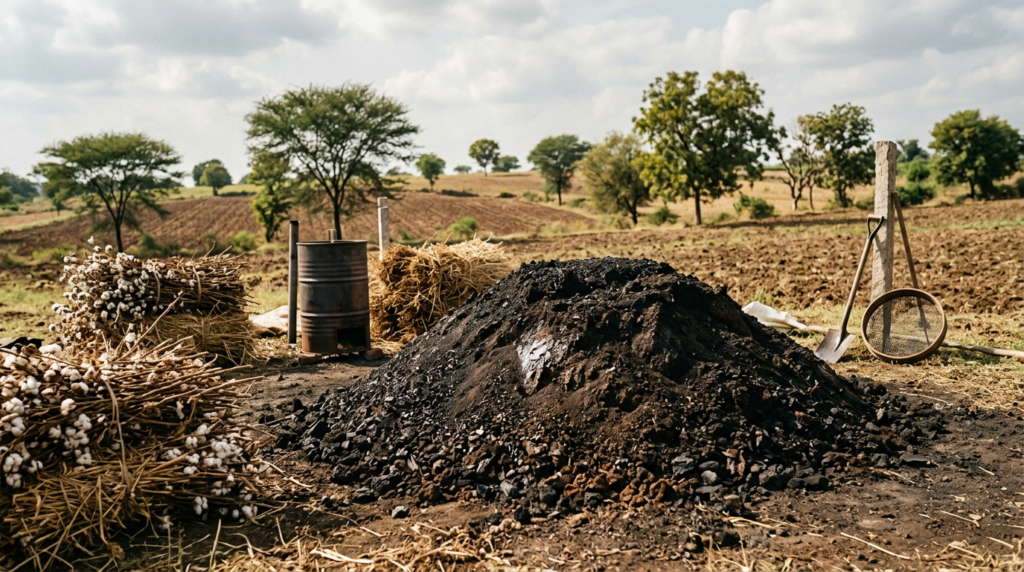
The Emerging Regulatory and Policy Architecture for Biochar in India
India generates hundreds of millions of tonnes of surplus agricultural residues and biomass annually. For decades, the disposal of these residues has presented severe environmental, economic, and logistical hurdles, manifesting visibly in seasonal crop residue burning across northern plains and widespread open-field burning in other agro-ecological zones. In response, policymakers at both central and state levels have established frameworks aimed at turning agricultural and forestry biomass into stable, value-added resources. Biochar—a solid, carbon-rich product derived through the thermochemical conversion of biomass under limited oxygen conditions—stands at the center of this transition.
While biochar is not always regulated under an isolated, singular national policy, it is increasingly woven into cross-ministerial initiatives across agriculture, renewable energy, rural development, and environmental protection. Organizations considering biochar production, supply chain deployment, or carbon dioxide removal (CDR) projects must understand the intersecting state and central schemes. Because program allocations, subsidy rates, and administrative guidelines shift across fiscal cycles, enterprise stakeholders should continually verify current operational status and notifications from relevant nodal agencies.
Central Frameworks: Agriculture, Fertilizers, and Soil Management
The Ministry of Agriculture and Farmers Welfare, alongside the Ministry of Chemicals and Fertilizers, oversees several frameworks designed to promote organic soil inputs, reduce chemical fertilizer dependency, and manage agricultural residues at scale.
The Fertilizer (Inorganic, Organic or Mixed) (Control) Order (FCO)
A foundational regulatory milestone for biochar commercialization within Indian agriculture is its inclusion under the Fertilizer (Inorganic, Organic or Mixed) (Control) Order, 1985. The FCO establishes quality standards, testing parameters, and compliance thresholds required for the manufacture, import, and sale of biochar as a soil amendment. Conforming to FCO specifications enables commercial producers to distribute biochar legally to farming communities and corporate agri-businesses across state lines. Stakeholders must evaluate strict parameters covering organic carbon content, pH levels, moisture limits, and upper thresholds for heavy metal contaminants to ensure regulatory clearance.
PM-PRANAM and Alternate Fertilizers
The PM Programme for Restoration, Awareness, Nourishment and Amelioration of Mother Earth (PM-PRANAM) focuses on incentivizing state governments to rationalize the use of synthetic chemical fertilizers in favor of alternative nutrient systems and organic soil conditioners. Under this mechanism, states that reduce their fiscal expenditure on chemical subsidies can secure capital grants to deploy sustainable soil management infrastructure. Biochar projects integrated with composting, bio-fertilizers, or microbial inoculants fall naturally within this broader mandate, helping agrarian systems retain soil organic matter while minimizing chemical runoff.
National Mission on Sustainable Agriculture (NMSA)
Administered under national climate change adaptation priorities, NMSA supports integrated nutrient management and in-situ moisture conservation. Components under the Soil Health Card initiative and sub-missions focused on rainfed area development frequently permit states to subsidize organic amendments. Biochar’s high cation exchange capacity and durable porous structure align with NMSA targets for restoring degraded land, mitigating drought stress, and enhancing micronutrient availability in marginal soils.
The Green Credit Programme (GCP) and MoEFCC Frameworks
Environmental governance in India is moving toward market-based incentive structures that reward quantifiable ecological enhancements. The Ministry of Environment, Forest and Climate Change (MoEFCC) introduced the Green Credit Programme (GCP) to create voluntary environmental actions that complement mandatory emission regulations.
Incentivizing Eco-Restoration and Soil Health
The Green Credit rules establish a voluntary market framework covering various activities, including waste management, sustainable agriculture, and the restoration of degraded or scrub land. Biochar applications intersect with multiple target areas:
- Soil Health and Regeneration: Applying stable biogenic carbon to restore exhausted lands or mine reclamation zones qualifies under systematic ecological restoration targets.
- Residue Valorization: Converting crop waste that would otherwise undergo open burning into a long-lived soil additive qualifies under circular waste management tracks.
- Water Conservation: Enhancing the water-holding capacity of sandy or severely degraded soils supports drought resilience programs monitored under watershed restoration guidelines.
Because the Green Credit Programme continues to refine its methodologies and administrative registries, project developers should inspect baseline establishment, audit protocols, and crediting cycles directly through the designated administrative agencies.
Biomass Management and Energy Policies: MNRE and MoP Directives
Beyond agricultural soil application, the conversion of biomass residues into biochar is intrinsically tied to renewable thermal energy, syngas generation, and industrial decarbonization initiatives guided by the Ministry of New and Renewable Energy (MNRE) and the Ministry of Power (MoP).
Biomass Co-firing Guidelines
The Ministry of Power has mandated varying targets for co-firing biomass pellets alongside coal in thermal power plants. While this program primarily addresses direct fuel pellets, it has stimulated decentralized biomass aggregation logistics, collection hubs, and supply chains throughout rural districts. These aggregation models lower the operational costs of sourcing raw feedstock for biochar pyrolysis installations.
Waste to Energy and Biomass Gasification Schemes
The MNRE supports gasification, bio-methanation, and related conversion projects through capital subsidies, soft loans, and interest subvention mechanisms. High-temperature pyrolysis systems producing both combustible off-gases (utilized for process heat or power) and solid biochar often qualify for specialized renewable energy incentives. Project developers must confirm technical specifications, emission limits, and financial eligibility criteria directly with the Indian Renewable Energy Development Agency (IREDA) and relevant state nodal bodies.
State-Level Schemes and Crop Residue Management
State governments execute the practical, operational rollout of central mandates, while frequently deploying state-specific fiscal outlays to target localized agro-environmental crises.
Northern Plains: Crop Residue Management (CRM) Subsidies
In states such as Punjab, Haryana, and Uttar Pradesh, the central Sub-Mission on Agricultural Mechanization (SMAM) and dedicated Crop Residue Management (CRM) schemes provide financial assistance for farm machinery. These incentives cover:
- Individual farmer subsidies and higher grants for Custom Hiring Centers (CHCs) to procure balers, rakes, super-seeders, and biomass collection machinery.
- State incentives for establishing decentralized collection yards where straw can be stored securely without posing a fire hazard.
- Industrial operational subsidies for facilities processing non-fodder paddy straw into secondary products, creating reliable feedstock channels for dedicated pyrolysis infrastructure.
Western and Southern States: Agro-Industrial Biomass Programs
States with substantial agro-processing footprints, such as Maharashtra, Gujarat, Karnataka, and Tamil Nadu, provide distinct policy ecosystems tailored to residues from sugar mills, cotton processing, coconut groves, and oilseed pressing:
- Bagasse and Press Mud Initiatives: Sugar-producing belts support co-generation and soil enrichment programs that incorporate pyrolyzed bagasse and composted press mud.
- State Industrial Development Policies: Several State Industrial Development Corporations (SIDCs) offer accelerated land allocation, power tariff concessions, and stamp duty exemptions for green industrial setups that manage agro-industrial solid waste.
- Horticultural Grants: State horticulture missions often provide co-funding for organic soil conditioning, creating an institutional consumer base for high-grade, certified biochar.
Connecting Policy Incentives to Carbon Markets and dMRV
Public policy subsidies provide baseline capital support, but long-term economic durability for biochar projects frequently relies on monetization through international carbon dioxide removal (CDR) markets and domestic compliance trading platforms. Biochar represents durable carbon storage because the pyrolysis process locks carbon into recalcitrant aromatic rings that resist microbial degradation for centuries.
Digital Measurement, Reporting, and Verification (dMRV)
Securing revenue across both carbon markets and domestic schemes such as the Green Credit Programme requires rigorous data fidelity. Developers must trace biomass provenance to prove it does not drive land-use conversion, verify pyrolysis temperature profiles, quantify yield coefficients, and track final application in agricultural or industrial sinks. A robust digital Measurement, Reporting, and Verification (dMRV) framework integrates IoT-enabled pyrolyzer telemetry, soil mapping, and remote sensing to prove additionality, durability, and absence of secondary environmental harm.
Corporate Disclosures and Compliance: IFRS S1 and S2 Integration
As corporate reporting frameworks harden under international standards—specifically the International Financial Reporting Standards (IFRS) S1 (General Requirements for Disclosure of Sustainability-related Financial Information) and S2 (Climate-related Disclosures)—companies operating in or sourcing from India must treat biochar supply chains with heightened financial rigor.
Using biochar as a carbon offset, in-situ soil remediation tool, or decarbonization pathway for hard-to-abate materials carries clear reporting obligations under IFRS S2. Organizations must account for:
- Physical risks affecting biomass supply chains, including drought, irregular monsoon patterns, or localized transportation bottlenecks.
- Transition risks associated with shifts in agricultural policy, carbon credit import/export bans, or changing domestic FCO purity standards.
- Financial asset valuation, impairment risks, and revenue recognition under relevant accounting standards (such as IFRS 9, 7, and 15) when transacting carbon credits derived from biochar projects.
Organizations should avoid relying on informal assumptions regarding credit eligibility, carbon durability, or subsidy permanence. Due diligence requires aligning physical production, contract structures, and transparent reporting metrics before integrating biochar into long-term net-zero balance sheets.
Strategic Roadmap for Industrial Buyers and Project Developers
Deploying biochar successfully within India requires a methodical approach to navigating overlapping policies:
- Confirm Regulatory Classification: Ensure the end product satisfies current FCO standards if distributing into the domestic agricultural market, or complies with industrial material specifications if supplying metallurgical or construction sectors.
- Analyze Dual-Stream Incentives: Identify whether local projects qualify for capital subsidies through renewable energy programs (MNRE/IREDA) alongside operational support under residue management schemes.
- Establish Verified Feedstock Linkages: Partner with local farmer producer organizations (FPOs) and Custom Hiring Centers supported by state agricultural programs to guarantee stable feedstock volumes.
- Implement Enterprise dMRV: Use digital monitoring architectures to track the carbon lifecycle from harvest residue to pyrolyzer to soil incorporation, ensuring eligibility across both the Green Credit registry and global carbon standards.
- Audit Periodically: State policies and ministerial guidelines evolve. Routinely evaluate gazette notifications and scheme circulars to maintain full regulatory alignment.
Navigating India's evolving biochar policy landscape requires technical precision across regulatory compliance, digital MRV deployment, and financial reporting standards; consult with the advisory team at ForestTwin to align your biochar production, Green Credit participation, and carbon asset strategies with current statutory frameworks.