
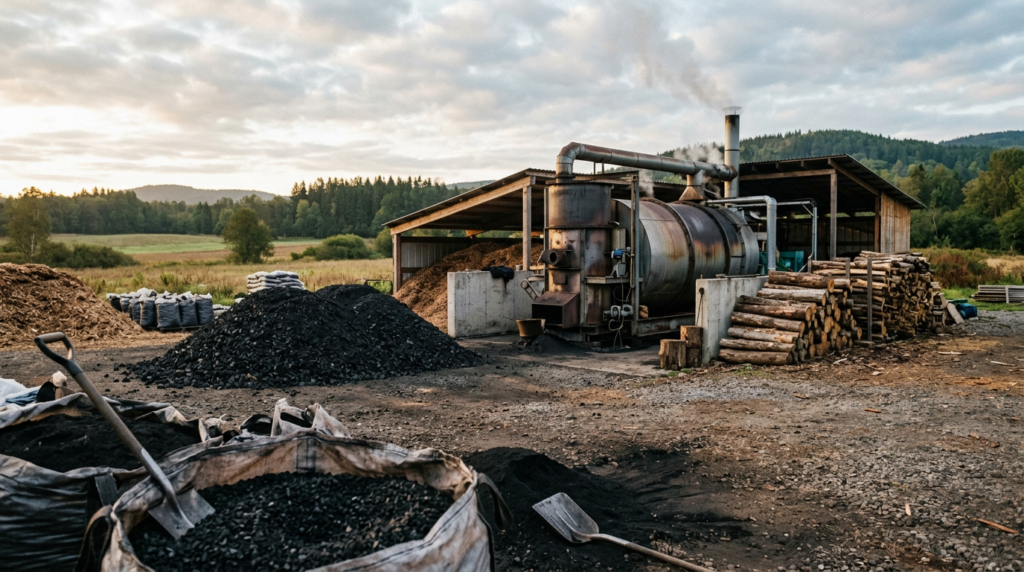
Navigating the Biochar Capital Stack: From Pyrolysis CAPEX to Bankability
Industrial biochar systems present a compelling mechanism for high-durability Carbon Dioxide Removal (CDR). Pyrolysis converts biogenic carbon from residual agricultural biomass and forestry residues into a stable solid form that persists in soils or industrial matrices for hundreds to thousands of years. Despite the technical maturity of high-efficiency retort and continuous pyrolysis systems, developers frequently encounter financing bottlenecks when moving from pilot installations to commercial-scale deployment.
Biochar facilities require substantial upfront capital expenditures (CAPEX) for thermal processing units, feedstock drying and handling infrastructure, emissions control systems, and automated material handling. Traditional commercial lenders frequently hesitate to underwrite these assets solely on projected balance sheet strength or unproven spot market sales. Commercial banks often classify standalone biochar operations as specialized industrial projects with dual market dependencies: physical product demand and voluntary carbon market (VCM) dynamics.
To secure non-recourse or limited-recourse project finance, developers must establish predictable, creditworthy cash flows. The primary instruments for establishing bankability are long-term physical biochar offtake agreements, carbon removal pre-purchase agreements, and structured blended finance vehicles. When assembled systematically, these revenue contracts transform carbon project risk profiles into investment-grade opportunities.
The Twofold Value Stream: Physical Product Offtake vs. Environmental Attribute Contracts
Biochar project economics differ fundamentally from conventional energy or chemical projects due to the structural decoupling of the physical output from its environmental attribute. Achieving project finance readiness requires developing parallel commercialization channels, each governed by distinct contractual terms and risk mitigations.
1. Physical Biochar Offtake Agreements
Physical biochar serves functional commercial roles across multiple sectors: agricultural soil amendment, composting accelerator, livestock feed supplement, filtration media, and raw material inputs for asphalt, concrete, or metallurgical applications. Physical offtake contracts must account for end-use specifications that govern commercial viability:
- Quality Specifications: Precise parameters for fixed carbon content, H:C and O:C molar ratios, moisture percentage, surface area, and limits on heavy metals or polycyclic aromatic hydrocarbons (PAHs), verified through standards such as the International Biochar Initiative (IBI) or the European Biochar Certificate (EBC).
- Pricing Structures: Fixed-rate agreements, indexed market pricing, or cost-plus arrangements that protect production margins against volatile biomass acquisition and energy costs.
- Delivery Commitments and Take-or-Pay Clauses: Mechanisms ensuring baseline operational absorption, protecting the facility from physical inventory build-up that can halt continuous pyrolysis operations.
2. Carbon Dioxide Removal (CDR) Offtakes
The carbon removal attribute associated with permanent biochar carbon storage represents a significant portion of an industrial project’s enterprise value. Major corporate buyers, institutional advance market commitments, and compliance entities look for high-durability credits verified under established methodologies, such as Puro.earth (Puro Standard) or Verra (VM0044 methodology for biochar utilization).
In standard CDR offtake contracts, the buyer contracts to purchase verified carbon credits—often quantified as CO2 Removal Certificates (CORCs) or Verified Carbon Units (VCUs)—at a predetermined price or pricing structure across multi-year vintages. These contracts specify delivery milestones, buffer pool contributions to address potential reversal risks, and the specific digital registry where retirements or transfers will occur.
Pre-Purchase Agreements: Converting Forward Environmental Attributes into Project Capital
While a standard forward offtake contract guarantees a buyer upon credit issuance, developers often face liquidity gaps prior to procurement and commissioning. Pre-purchase agreements bridge this gap by committing capital ahead of credit generation, serving as quasi-equity or subordinated debt within the financing structure.
In a pre-purchase agreement, the buyer advances capital directly to the project developer against future vintages of verified CDR credits, typically at a discount relative to projected spot market rates. This mechanism yields two structural advantages:
- CAPEX Funding Without Dilution: Project developers secure non-dilutive capital to purchase equipment, install civil works, or secure long-term biomass feedstock supply concessions.
- Commercial Validation for Senior Lenders: Having a creditworthy entity execute a binding pre-purchase contract signals technical and carbon integrity to risk-averse institutional lenders, facilitating debt syndication for the remaining project balance.
Contractual Safeguards and Delivery Risk Management
Pre-purchase agreements introduce performance and delivery risks that require careful legal structuring. If equipment commissioning encounters delays, biomass moisture spikes, or registry approvals take longer than planned, the project may face a delivery shortfall. Standard market mechanisms to address these risks include:
- Staged Milestone Disbursements: Capital is released in tranches linked to verifiable project development gates (e.g., procurement of continuous pyrolysis reactors, dry-run commissioning, baseline soil or biomass characterization, formal validation by an accredited validation and verification body).
- Make-Whole Provisions and Volume Replacement: Covenants outlining remedies for missed vintages, such as the option to deliver credits from subsequent operational years or provide replacement credits from pre-approved alternative projects of equivalent durability and certification standards.
- Security Interests and Escrow Architecture: Establishing senior or junior liens on project equipment, physical inventories, or registry accounts to protect the capital provider against outright developer insolvency.
Blended Finance Architectures for Large-Scale Deployment
Commercial-scale biochar initiatives, especially those utilizing agricultural residues in emerging markets or capital-constrained rural economies, increasingly rely on blended finance. Blended finance strategically combines concessional public or philanthropic capital with commercial private capital to adjust the risk-adjusted returns of investments.
Structuring the Capital Stack
A typical blended finance vehicle for biochar infrastructure integrates three distinct layers of capital:
- Junior / First-Loss Capital: Subsidized debt, junior equity, or philanthropic grants provided by multilateral development banks, climate funds, or impact investors. This tier absorbs initial losses from project underperformance, technological commissioning delays, or localized feedstock supply interruptions.
- Mezzanine Capital and Concessional Loans: Patient capital with subordinated repayment priorities or flexible debt service profiles that match early operational ramp-up periods.
- Senior Commercial Debt: Conventional commercial bank loans, project finance facilities, or infrastructure green bonds that require investment-grade credit risk metrics, including debt service coverage ratios (DSCR) supported by binding pre-purchase and offtake agreements.
By absorbing initial development and market-entry risks through concessional instruments, biochar developers can secure commercial senior debt at rates that allow long-term operational profitability.
Aligning Project Financing with IFRS and Financial Disclosure Standards
As corporate reporting frameworks advance under the International Sustainability Standards Board (ISSB), project developers, investors, and corporate offtakers must ensure that contractual structures align with statutory accounting and sustainability disclosure rules.
IFRS 15: Revenue from Contracts with Customers
Biochar revenue recognition requires careful analysis under IFRS 15. The generation of a physical product bundled with a carbon attribute requires determining whether the sale of the physical biochar and the transfer of the associated carbon credit constitute distinct performance obligations. If a single customer contracts for both physical material and verified CDR credits, revenue must be allocated according to their standalone selling prices and recognized at the distinct point in time when control of each asset passes to the buyer.
IFRS 9: Financial Instruments and Forward Offtake Treatment
Long-term offtake agreements and pre-purchase contracts must be reviewed under IFRS 9 to determine whether they qualify as derivative financial instruments or fall under the “own-use” exemption. If a forward contract includes net settlement provisions, index-linked volume flexibilities, or cash-settlement clauses upon non-delivery, it may be classified as a derivative asset or liability requiring fair-value measurement through profit or loss. Structuring contracts explicitly for physical delivery and direct attribute retirement helps project sponsors and enterprise buyers maintain straightforward accounting treatment.
IFRS S1 and IFRS S2 Disclosures
Corporate buyers structuring large multi-year pre-purchases face increased scrutiny under IFRS S1 (General Requirements for Disclosure of Sustainability-related Financial Information) and IFRS S2 (Climate-related Disclosures). Enterprises must disclose how their climate mitigation targets rely on carbon removals, the contractual durability of those removals, and the financial risks embedded in forward purchase obligations. Developing projects with auditable, traceable methodologies directly supports the compliance needs of these institutional corporate buyers.
Mitigating Execution Risk with Digital Monitoring, Reporting, and Verification (dMRV)
The enforceability and bankability of both physical and carbon offtake agreements rest entirely on operational transparency. In the past, periodic, manual auditing introduced verification lags, exposing lenders and pre-purchase funders to significant timing and volume risks. Digital MRV (dMRV) platforms remove this friction by integrating operational data collection directly into carbon registry workflows.
Core Components of Institutional dMRV
Modern biochar dMRV systems integrate automated data collection at critical operational nodes:
- Feedstock Origin Tracking: Continuous digital logs capturing agricultural biomass sourcing, transport distances, and moisture content, confirming compliance with sustainability criteria and avoiding deforestation or competition with food security.
- Pyrolysis Operating Parameters: Industrial Internet of Things (IIoT) sensors continuously recording operational temperatures, residence times, and process emissions, providing unalterable evidence that the production run achieved permanent carbonization and met international quality criteria.
- Output and Application Registry Integration: Cryptographically logged mass balances recording physical biochar production, transport to agricultural or industrial application sites, and soil-application confirmations to close the MRV loop.
By automating the data trail from biomass collection to carbon credit issuance, developers can provide project financiers with live operational dashboards, shortening issuance cycles and ensuring pre-purchased credits are delivered on schedule.
Structuring Bankable Biochar Offtake Contracts: Key Provisions
To withstand legal and credit analysis from project finance lenders, biochar contracts must balance commercial flexibility with legal enforceability. Developers and off-takers should focus on five core provisions:
1. Volume Allocation and Ramp-Up Schedules
Continuous industrial systems require a ramp-up phase. Contracts should incorporate tiered delivery schedules that allow for initial commissioning fluctuations without triggering default clauses, paired with defined mechanisms for allocation if production volumes fall between minimum baseline and maximum capacity thresholds.
2. Registry and Methodology Adaptability
Methodologies within the voluntary carbon market and statutory frameworks (such as India’s Green Credit Programme administered by the MoEFCC) continue to mature. Contracts must define protocols for handling registry transitions, methodology updates, or standard changes, ensuring that the project can adapt its issuance pathway without invalidating underlying commercial terms.
3. Pricing Floors, Collars, and Gain-Share Structures
To satisfy senior debt requirements, developers need predictable revenue floors that cover operating costs and debt service obligations. Offtakers, conversely, seek upside participation. Structuring pricing with a contract floor alongside indexed upward participation or gain-share mechanisms protects project solvency while maintaining competitive market upside for the capital provider.
4. Force Majeure and Regulatory Change Provisions
Biochar facilities are exposed to localized biomass supply interruptions due to weather events or regional agricultural shifts, as well as evolving national carbon export restrictions under Article 6 of the Paris Agreement. Contracts must define force majeure parameters precisely, addressing what happens if government authorities introduce corresponding adjustment mandates or domestic market retention policies.
5. Clear Default and Cure Architecture
Lenders require comprehensive step-in rights. In the event of technical underperformance or developer insolvency, debt providers must maintain the legal right to substitute operational management or assign offtake rights to a third party to preserve asset cash flows and service outstanding debt.
Building Durable Financing Foundations
Securing project capital for biochar production requires bringing together thermal process engineering, transparent digital verification, and disciplined corporate finance. Developers who structure legally secure pre-purchase contracts, align physical and environmental attribute sales, and integrate digital MRV provide the predictability required by commercial banks and institutional buyers. Establishing this operational and contractual rigor transforms biomass processing into a stable, scalable, and bankable asset class.
For enterprise developers and institutional buyers seeking to design, finance, and deploy high-integrity biochar systems, ForestTwin provides end-to-end support across biochar project development, dMRV implementation, Green Credit Programme advisory, and IFRS-aligned sustainability disclosures. Contact our carbon finance and project development advisory team to structure bankable biochar initiatives aligned with your strategic capital objectives.