
Decarbonization at a Crossroads: Insetting vs Offsetting
Corporate sustainability teams face intensifying scrutiny over how they manage emissions. As global reporting frameworks such as IFRS S2 take hold alongside regional environmental disclosure mandates, the mechanisms businesses use to substantiate their climate commitments must withstand rigorous technical and financial audits. For years, corporate carbon strategy leaned heavily on conventional offsetting—purchasing external carbon credits generated outside a company’s immediate commercial ecosystem. Today, leaders increasingly turn toward insetting: implementing direct interventions within their own value chains.
Biochar has emerged as a premier pathway for durable carbon dioxide removal (CDR). However, companies evaluating biochar often struggle with strategic positioning. Is biochar an external offset to balance hard-to-abate Scope 1 and Scope 2 emissions, or is it an insetting mechanism that drives Scope 3 decarbonization while strengthening supply chain stability? Answering this question requires a clear understanding of carbon accounting boundaries, commercial realities, and corporate risk management.
Defining the Mechanics: Offsetting vs Insetting
The distinction between offsetting and insetting lies primarily in operational boundaries and carbon ownership.
Carbon Offsetting refers to the practice of compensating for an organization’s greenhouse gas (GHG) emissions by financing climate action projects elsewhere. These projects are typically executed by third parties in locations completely decoupled from the buyer’s supply chain. While high-quality offset credits generated by verified removal methods play a role in global net-zero models, they do not transform the purchasing company’s core business operations or reduce its underlying carbon intensity.
Carbon Insetting, conversely, represents interventions designed to avoid, reduce, or sequester carbon emissions directly within an organization’s upstream or downstream value chain. Insetting aligns capital expenditures directly with the raw materials, logistics, agricultural suppliers, and post-consumer systems that define the business. Rather than outsourcing environmental action, insetting treats decarbonization as an operational priority, generating co-benefits like soil restoration, resource efficiency, and supply chain resilience.
The Strategic Advantages of Insetting
While offsets provide an accessible market mechanism for managing residual emissions, insetting delivers long-term strategic and regulatory advantages that external credits cannot match.
- Alignment with Corporate Disclosures: Standards such as the GHG Protocol Corporate Standard and Science Based Targets initiative (SBTi) require absolute Scope 1, 2, and 3 reductions before residual emissions are addressed through external neutrality claims. Insetting reduces the baseline inventory rather than balancing it with off-balance-sheet credits.
- Supply Chain Resilience: Insetting projects invest directly in suppliers, agricultural partners, and local infrastructure, mitigating operational risks tied to climate vulnerability, soil degradation, and resource scarcity.
- Mitigation of Greenwashing Risk: Regulatory bodies scrutinize environmental claims that rely purely on external voluntary carbon credits. Value chain interventions offer higher defensibility because the interventions are tangible and integrated into internal reporting lines.
- Regulatory and Trade Preparedness: With border adjustment mechanisms and Scope 3 reporting becoming standard under frameworks like IFRS S1 and S2, embedding carbon removals into primary production reduces exposure to future carbon tariffs.
Understanding Biochar as a Durable Carbon Removal Mechanism
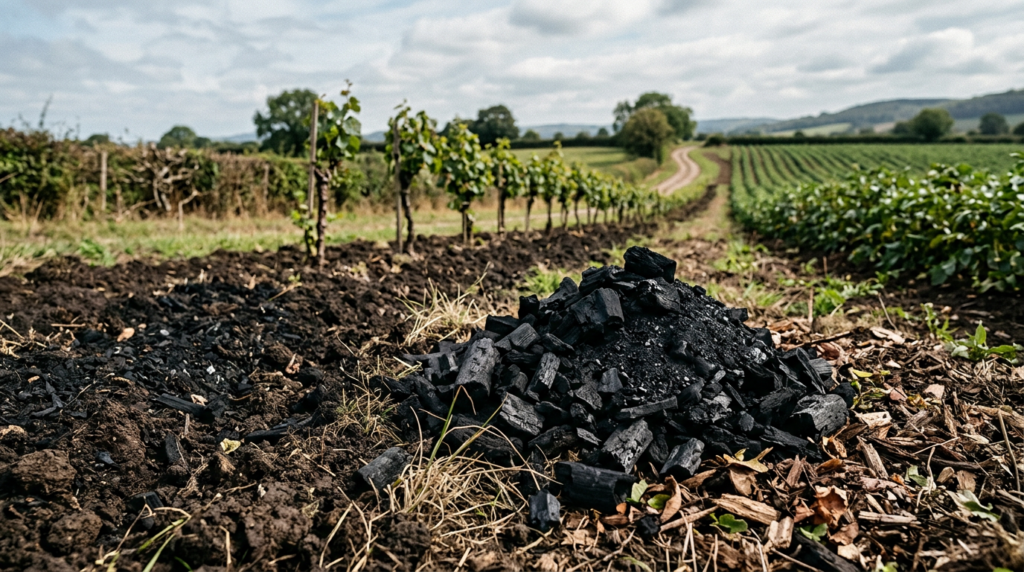
Biochar is a carbon-rich solid produced through biomass pyrolysis—the thermal decomposition of organic material under oxygen-limited conditions at elevated temperatures. In natural biological cycles, plants absorb atmospheric carbon dioxide through photosynthesis, but this carbon quickly returns to the atmosphere when biomass decomposes or burns. Pyrolysis interrupts this cycle, converting labile organic carbon into highly stable, recalcitrant carbon structures.
When applied to soils or integrated into industrial composites, biochar sequesters carbon for hundreds or even thousands of years, making it a recognized category of durable carbon dioxide removal. Beyond its permanence, biochar possesses structural properties—such as high surface area and porous matrix structures—that enhance water holding capacity, improve nutrient retention, and promote microbial activity in agricultural systems.
Where Biochar Fits in Your Value Chain: The Insetting Pathways
For organizations operating in agriculture, forestry, food and beverage, manufacturing, and consumer goods, biochar offers practical points of integration across the value chain.
1. Upstream Agricultural Insetting (Scope 3, Category 1)
Agribusinesses, textile manufacturers, and food brands rely heavily on farmed commodities. These upstream networks represent the largest share of overall Scope 3 emissions for many consumer-facing industries. Companies can implement biochar insetting by supporting contract growers with biochar applications.
Applying biochar directly to the agricultural soils that supply raw materials yields multiple compounding benefits:
- Soil Moisture Retention: Improving the water-holding capacity of arable land helps buffer against drought and irregular rainfall patterns.
- Fertilizer Optimization: Biochar binds to nutrients, reducing leaching into surrounding waterways and potentially lowering the need for synthetic nitrogen fertilizers, which are significant contributors to agricultural nitrous oxide emissions.
- Direct Soil Carbon Enhancement: The recalcitrant carbon embedded in biochar contributes to long-term soil organic carbon pools, creating measurable, durable removals directly on supplier farmlands.
2. Operational Biomass Valorization (Scope 1 and Scope 3, Category 5)
Many processing plants, sawmills, and manufacturing facilities generate substantial volumes of agricultural or forestry residues, such as husks, bagasse, shells, and off-cuts. Historically treated as waste or incinerated for low-efficiency heat, these byproducts represent significant carbon liabilities.
By establishing localized pyrolysis infrastructure, companies can process processing residues on-site or through centralized regional hubs. This operational integration accomplishes two key objectives:
- Avoided Methane and Decomposition Emissions: Diverting organic residues from open burning or anaerobic decomposition directly lowers waste-related emissions.
- Co-generation Opportunities: Pyrolysis produces synthesis gas (syngas) and bio-oil as thermal byproducts. These can be captured and redirected to replace fossil fuels in industrial boilers or drying systems, lowering direct Scope 1 energy emissions.
3. Circular Product and Material Development (Scope 3, Category 11 and 12)
Beyond land management, biochar can be incorporated into physical products, including green construction materials, concrete aggregates, asphalt, and packaging. Incorporating biochar into building materials locks carbon into the built environment for decades, creating low-carbon product variants that help downstream customers lower their own Scope 3 footprint.
Biochar as an External Offset: Strategic Procurement
While insetting provides an integrated operational pathway, deploying biochar as an external carbon offset remains a vital option for many organizations. Not every enterprise possesses land holdings, an agricultural supply base, or biomass residues suitable for localized conversion. Technology companies, financial institutions, and specialized logistics providers often lack the operational touchpoints required for biochar insetting.
For these organizations, procuring verified biochar carbon dioxide removal (CDR) credits serves as a reliable mechanism to manage residual emissions. High-durability CDR credits produced by certified facilities are increasingly preferred over nature-based avoidance offsets due to their low reversal risk, clear baseline additionality, and long containment lifespans. In this context, purchasing credits supports capital deployment toward global pyrolysis infrastructure without requiring direct supply chain redesign.
Navigating the MRV Challenge: Transparency and Double Counting
Whether pursued through an insetting program or external credit procurement, biochar initiatives require rigorous digital Measurement, Reporting, and Verification (dMRV). The boundary lines between carbon accounting methods must be maintained with extreme precision to avoid regulatory penalties and commercial double counting.
When implementing biochar within a corporate value chain, organizations must clearly define the claim being made:
- The Scope 3 Inventory Approach: If a company claims the carbon removal to reduce its Scope 3 emissions footprint under the GHG Protocol, it cannot simultaneously issue, tokenize, and sell an external carbon credit from the same biochar volume on the voluntary carbon market. Selling the offset relinquishes the environmental attribute to the buyer.
- Feedstock Traceability: Pyrolysis inputs must be verified to ensure they originate from sustainable residues rather than primary forests or lands with high conservation value. Digital tracking tools confirm feedstock provenance from source to processing.
- Application Verification: Sequestration claims require proof of application. dMRV platforms utilize satellite imagery, geolocation tags, and application records to prove that biochar was incorporated into designated land parcels or materials.
Financial and Disclosure Alignment: IFRS S1 and S2
The International Sustainability Standards Board (ISSB) standards, specifically IFRS S1 and S2, require companies to disclose climate-related risks and opportunities that affect their financial position, cash flows, and access to capital. The distinction between insetting and offsetting directly shapes these disclosures.
Under IFRS S2, corporate entities must disclose their climate transition plans, including how emissions targets are achieved and the extent to which external offsets are utilized. Transition plans built on continuous third-party offset purchases carry ongoing financial exposure to volatile carbon market pricing. In contrast, insetting investments represent capital allocations that directly build physical resilience into primary assets, enhance operating margins, and secure raw material stability against systemic physical climate risks.
Structuring Your Biochar Road Map
To determine the appropriate approach for your enterprise, evaluate your current carbon footprint and operational profile through this structured decision framework:
- Audit Supply Chain Biomass: Assess the volume, consistency, and disposal costs of organic waste and residues generated across your operational facilities and agricultural suppliers.
- Evaluate Land Influence: Determine the degree of commercial influence you maintain over the agricultural or forestry land within your Scope 3 perimeter. Long-term supplier agreements create favorable conditions for soil-based insetting.
- Establish Clear Accounting Governance: Decide whether project outputs will be retained internally to meet corporate net-zero targets or monetized as high-durability credits to fund initial capital investments.
- Implement Digital Tracking: Deploy robust dMRV platforms early to capture baseline soil conditions, feedstock weights, pyrolysis operating parameters, and final distribution records.
Achieving Long-Term Decarbonization Value
Balancing decarbonization goals with commercial reality requires selecting solutions that deliver both measurable carbon removal and operational value. Biochar offers a versatile approach, serving either as a high-durability external offset or as an integrated insetting project that restores supplier soils and transforms agricultural residues.
To evaluate how biochar can integrate into your supply chain, structure your dMRV infrastructure, or align your climate targets with international reporting standards, contact our advisory team at ForestTwin.