
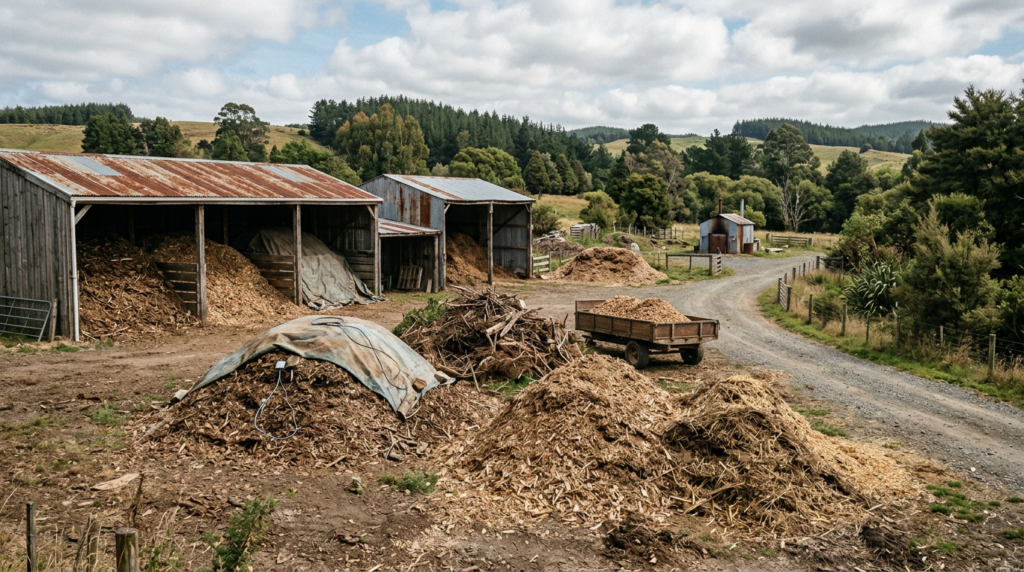
Operational Realities in Biochar Feedstock Procurement
Scaling a biochar project requires stable, predictable biomass supplies that align with pyrolyzer technical specifications and carbon certification standards. While engineering design and pyrolysis technology receive substantial attention during project planning, feedstock procurement frequently presents the most complex ongoing operational challenge. Biomass is geographically dispersed, subject to climatic variability, and prone to significant quality fluctuations across seasons.
For project developers and carbon asset managers, feedstock sourcing directly impacts key unit economics: throughput rates, thermal efficiency, carbon stability indices, and transportation overhead. A failure to control physical variables such as moisture content or bulk density leads to operational downtime, lower yield efficiency, and heightened audit risk under international carbon removal registries. Designing a resilient procurement strategy demands rigorous contract structuring, practical moisture management protocols, and clear logistical buffers against seasonal supply shortfalls.
Contract Structures for Biomass Supply
Biomass procurement contracts must balance volume security for the processing facility against operational risk for the agricultural or forestry partner. Spot-market purchases introduce excessive price and volume volatility, while rigid long-term fixed-price commitments can fail if local market dynamics shift or seasonal yields decline. Successful biochar operators typically utilize structured, multi-tier contracting frameworks.
1. Take-or-Pay Agreements with Quality Bands
A take-or-pay agreement provides the processing plant with guaranteed baseline volumes while offering the supplier dependable off-take. However, for biochar production, standard take-or-pay language must be supplemented with specific feedstock rejection or price-adjustment thresholds based on quality indicators.
- Moisture Thresholds: Contracts should establish standard pricing based on dry metric tons (DMT) rather than wet delivered weight. Delivering high-moisture biomass inflates transport costs and reduces net pyrolyzer throughput. Price adjustments or deductions should apply when moisture exceeds agreed operational thresholds.
- Ash Content and Contamination: Inorganic contaminants (soil, stones, metals) cause severe equipment wear in shredders and feed augers, while high intrinsic ash decreases fixed carbon content in the finished char. Contracts should stipulate clear rejection criteria for foreign matter.
- Particle Size Range: Pyrolysis kilns require specific particle distributions to maintain uniform heat transfer and prevent hot spots or unpyrolyzed cores. Contracts should define sizing tolerances whether the biomass is pre-chipped at source or processed at the plant gate.
2. Indexed Pricing Models
Fixed-rate contracts over multi-year horizons often collapse during regional biomass shortages or sharp fluctuations in diesel fuel costs. Structuring agreements that index biomass pricing against diesel benchmarks or regional agricultural indices can keep supply terms viable for both parties over extended operations.
3. Shared Logistics and Aggregator Agreements
In regions dominated by smallholder agriculture or decentralized forestry operations, contracting directly with individual farms can generate high administrative overhead. Collaborating with aggregators—such as forestry residues contractors, ginning mills, or sawmills—simplifies logistics. In these setups, contracts should specify custody transfer points, weighbridge calibration standards, and sampling protocols to preserve transparent traceability for digital Measurement, Reporting, and Verification (dMRV) systems.
Navigating Seasonality and Supply Chain Interruptions
Biomass availability rarely matches the continuous, year-round operating profile of an industrial pyrolysis plant. Crop harvests occur in concentrated windows, while seasonal rains can restrict forestry access or halt field collection completely. Managing seasonality requires a combination of feedstock diversification, off-peak storage infrastructure, and operational flexibility.
Supply Calendar Analysis
Every biochar facility should construct a multi-feedstock availability matrix across a 12-month calendar. Depending entirely on a single seasonal crop residue, such as cotton stalks or rice husks, leaves a facility vulnerable during the inter-crop period. Identifying complementary regional residues—such as forestry thinnings, orchard prunings, or agricultural processing by-products—helps smooth supply dips across quarters.
When evaluating alternative feedstocks, facilities must confirm that changes in raw biomass will not compromise the consistency of the biochar or violate the specific biomass sustainability guidelines mandated by carbon standards like Puro.earth or the Verified Carbon Standard (VCS). Any transition between feedstocks requires updated laboratory testing to verify fixed carbon ratios, H:Corg ratios, and heavy metal concentrations.
Buffer Storage and Capital Working Requirements
To operate through off-harvest or monsoon periods, facilities must maintain on-site or regional consolidation yards. Designing buffer storage requires balancing real estate and material handling costs against operational disruption:
- Inventory Sizing: Buffer inventory should cover the longest historical regional downtime window, plus a safety margin to account for unexpected transport bottlenecks.
- Working Capital Deployment: Procuring the majority of annual feedstock within limited harvest windows places high demands on working capital. Project financial models must account for these seasonal cash flow troughs rather than assuming evenly distributed monthly expenses.
- Biomass Deterioration Prevention: Prolonged open-air storage leads to biological degradation, fungal decay, and dry matter loss. Implementing strict First-In, First-Out (FIFO) material handling ensures that older inventory is processed before dry matter losses compromise pyrolyzer yields.
Moisture Management: Physics, Logistics, and Processing
Moisture is arguably the single most critical variable in biochar production. Water content impacts every stage of the lifecycle: haulage economics, handling mechanics, thermal balance inside the reactor, and downstream carbon credit yield calculations.
The Thermodynamic Cost of Water
Pyrolysis is a thermochemical process that requires elevating biomass to temperatures typically between 400°C and 700°C in an oxygen-limited environment. If feedstock enters the reactor with high moisture, a substantial portion of the available thermal energy is consumed simply evaporating water rather than driving endothermic pyrolysis reactions.
Feedstocks with excessive moisture (often above 20% to 25% for continuous industrial systems, depending on equipment design) lead to incomplete carbonization, reduced hourly biochar output, and potential tar condensation in syngas handling systems. While autothermal reactors utilize the combustion of process syngas to maintain internal heat, wet feedstock reduces syngas calorific value, often requiring supplemental auxiliary fuel to sustain stable operating temperatures.
Field Drying vs. Mechanical and Waste-Heat Drying
Managing moisture requires an intentional combination of source-level conditioning and plant-level drying systems:
- Passive Field Drying: Allowing agricultural or forestry residues to dry in the field under ambient conditions is the most cost-effective drying method. However, field drying increases exposure to unexpected rainfall, elevates soil contamination risks from ground contact, and can interfere with a farmer’s planting schedule for subsequent crops.
- Waste-Heat Integration: Industrial biochar plants generate surplus heat via syngas combustion or exhaust streams. Integrating this thermal energy into rotary drum dryers or belt dryers provides consistent moisture reduction independent of weather conditions, bringing incoming material down to the optimal 10% to 15% range prior to reactor feeding.
- Mechanical Dewatering: For high-moisture agricultural processing by-products (such as bagasse, press cake, or fruit residues), mechanical pressing can remove free water prior to thermal drying, lowering overall process energy requirements.
Moisture Accounting in Carbon Registries
Carbon credit methodologies require exact, dry-weight accounting to determine baseline carbon mass and subsequent permanence calculations. Water weight cannot be credited as sequestered carbon. Inaccuracies in moisture measurement directly distort project carbon balances.
Continuous moisture tracking—utilizing calibrated in-line microwave or near-infrared (NIR) sensors paired with manual oven-dry validation runs—ensures baseline data integrity. Incorporating these real-time data inputs into a dMRV platform simplifies audit cycles, prevents baseline discrepancies, and eliminates friction during annual verification events.
Storage Protocols and Fire Safety
Bulk biomass storage presents serious operational risks that demand stringent site controls, particularly related to spontaneous combustion, biological decomposition, and structural layout design.
Preventing Spontaneous Combustion
Moist, finely divided organic material stacked in deep piles provides ideal conditions for thermophilic microbial activity. As microorganisms metabolize available sugars, internal pile temperatures rise. If heat cannot dissipate, internal temperatures can cross self-ignition thresholds, resulting in smoldering internal fires that are exceptionally difficult to extinguish.
Best practices for inventory storage include:
- Limiting storage pile heights to allow internal heat dissipation.
- Installing continuous internal temperature telemetry probes within large chip piles to detect internal hot spots early.
- Maintaining regular pile turning schedules to release accumulated heat and moisture pockets.
- Ensuring clear physical separation between raw biomass stockpiles, processed dry feedstocks, and finished biochar handling areas.
Covering and Weather Protection
In wet or monsoon-prone environments, uncovered storage quickly undoes prior field-drying efforts. Investing in covered storage bays, pole barns, or specialized breathable, water-shedding tarpaulins protects valuable dry inventory, lowers dryer fuel consumption, and prevents operational delays caused by waterlogged feedstocks.
Integration with dMRV and Regulatory Disclosures
Feedstock sourcing is not simply a supply chain matter; it forms the foundation of project eligibility under carbon removal registries and corporate sustainability frameworks. Sourcing decisions intersect directly with sustainability criteria, land-use baselines, and scope emissions.
Traceability and Chain of Custody
Carbon certification frameworks enforce strict biomass sustainability criteria to avoid negative environmental impacts, such as deforestation or competition with food security. Project developers must provide verifiable chains of custody establishing that the biomass originates from genuine residues or sustainably managed lands.
Implementing digital tracking platforms that capture geolocation, harvest timing, weighbridge delivery slips, and transport distances provides third-party validation bodies with an unbroken audit trail. This level of traceability is equally critical for regional compliance initiatives, such as the Green Credit Programme under the Ministry of Environment, Forest and Climate Change (MoEFCC) in India, where strict ecological provenance must be demonstrated.
Aligning Procurement with IFRS S1 and S2 Disclosures
As international capital markets increasingly align with IFRS Sustainability Disclosure Standards (specifically IFRS S1 for general sustainability disclosures and IFRS S2 for climate-related risks), biochar operators and corporate off-takers must evaluate feedstock resilience through a structured enterprise risk lens:
- Physical Climate Risks (IFRS S2): Assessing how changing precipitation patterns, shifting harvest windows, and heightened drought or flood frequencies impact raw biomass availability across long-term horizons.
- Transition Risks (IFRS S2): Preparing for regulatory changes affecting biomass collection, regional bioenergy subsidies, or regional policies on residue burning that could alter local feedstock economics.
- Scope 3 Upstream Accounting: Tracking transportation emissions and pre-processing energy use within supply agreements ensures accurate lifecycle emission factors when calculating net carbon dioxide equivalent (tCO2e) removal values.
Structuring Sustainable Biomass Partnerships
Reliable feedstock procurement for biochar facilities cannot be achieved through ad-hoc purchasing. It requires a systematic operating framework that blends commercial discipline, material handling science, and regulatory compliance. Facilities that invest early in structured quality-adjusted contracts, diversified seasonal calendars, engineered moisture management, and robust digital traceability establish durable competitive advantages, ensuring steady production, predictable financial performance, and high-integrity carbon credits.
To evaluate your biomass supply chain, establish robust feedstock contracts, or align your biochar operations with leading carbon removal methodologies and dMRV standards, contact the sustainability and carbon project team at ForestTwin.