
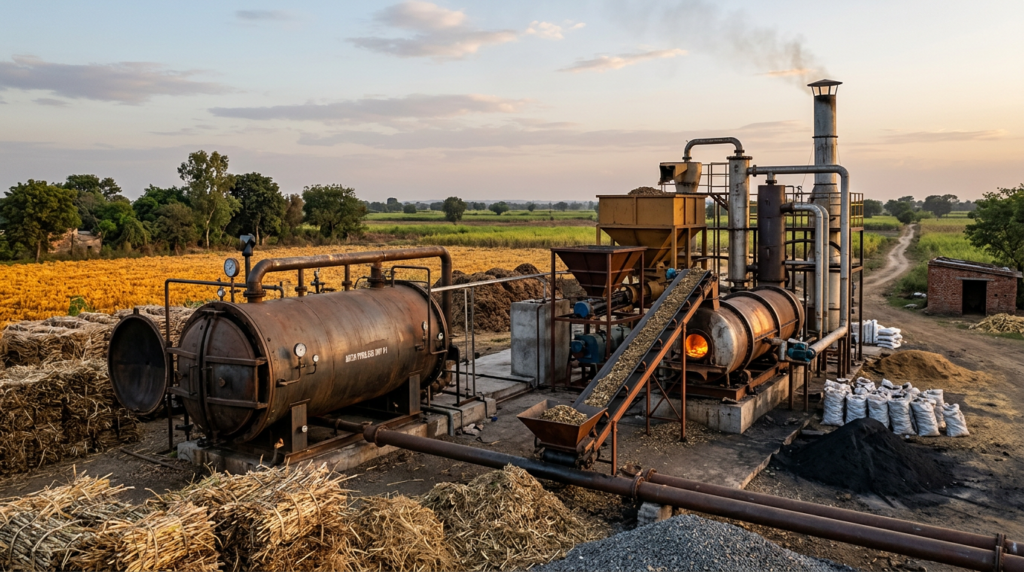
Navigating the Pyrolysis Technology Choice in the Indian Biomass Landscape
India generates hundreds of millions of tonnes of agricultural residue and agro-industrial waste annually. From the paddy straw of the Indo-Gangetic plains to cotton stalks in Maharashtra and Gujarat, bagasse in Uttar Pradesh, and invasive woody species such as Prosopis juliflora in the arid zones, the sheer variety of available biomass makes India a prime geography for biochar production. However, converting this biomass into high-stability carbon requires selecting the appropriate pyrolysis reactor design.
For project developers, industrial operators, and carbon asset managers, the primary technological fork in the road is deciding between batch and continuous pyrolysis systems. Each operational model presents distinct trade-offs across capital expenditure (capex), operating expenditure (opex), processing capacity, feedstock handling requirements, and regulatory emissions compliance. Furthermore, reactor choice directly influences your ability to satisfy monitoring, reporting, and verification (dMRV) standards mandated by carbon credit registries such as Puro.earth, the European Biochar Certificate (EBC), and emerging domestic frameworks like the Green Credit Programme administered by the Ministry of Environment, Forest and Climate Change (MoEFCC).
Capital Expenditure and Scaling Profiles
The upfront financial requirements of batch versus continuous systems diverge sharply, dictating how project developers structure debt, equity, and operational phasing.
Batch Systems: Lower Entry Barrier and Modular Deployment
Batch pyrolysis units—ranging from modernized retort kilns to containerized multi-chamber designs—exhibit a comparatively modest initial capex profile. Because batch designs typically lack complex automated conveying systems, airlocks, and high-frequency sensor networks across multiple heating zones, the engineering and fabrication costs remain low. Fabrication can often take place locally using domestic steel grades and standard refractories.
For developers operating in decentralized agricultural collection catchments, batch systems offer a modular path forward. Rather than concentrating capital into a single centralized processing plant, an operator can deploy multiple batch units across agricultural consolidation centers. This reduces upfront exposure while establishing biomass sourcing logistics. However, scaling through multiplication of batch units leads to a linear increase in labor requirements and maintenance touchpoints, meaning opex does not decline proportionally with scale.
Continuous Systems: High Upfront Capital with Economies of Scale
Continuous pyrolysis reactors—such as rotary drums, auger/screw pyrolyzers, and fluidized bed reactors—involve significant upfront capital investment. A complete continuous system requires precision engineering for continuous feed hoppers, rotary valves, nitrogen-purged airlocks, dynamic internal heating jackets, automated biochar quenching systems, and sophisticated thermal oxidizers.
In addition to the core reactor, the balance of plant (BoP) for a continuous installation demands substantial civil works, automated biomass drying infrastructure, precision hammer mills, and integrated programmable logic controller (PLC) systems. While the initial capital outlay is multiples higher than a batch facility of comparable initial footprint, continuous systems achieve substantial economies of scale. When operated 24/7 with high utilization rates, the per-tonne amortization of capital equipment and operational labor costs falls significantly below that of batch setups.
Throughput and Operational Efficiency
Throughput performance is governed not just by internal thermal mechanics, but by how materials move through the reaction chamber.
Batch Operations: Intermittent Thermal Cycles
Batch systems process biomass in discrete cycles. Each batch involves loading, sealing the retort, heating through external or auto-thermal combustion, maintaining the target pyrolysis temperature, cooling the biochar down to a safe handling temperature, and discharging the product. This thermal cycling introduces unavoidable operational downtime.
Cooling the biochar within the reactor without exposing it to oxygen often consumes several hours, during which the reactor vessel cannot process new feedstocks. While water-quenched batch containers or interchangeable retorts can shorten this downtime, overall facility throughput remains constrained. Thermal energy is also lost during each cycle, as the reactor walls must be reheated from ambient or reduced temperatures, which lowers overall thermodynamic efficiency.
Continuous Operations: Steady-State High Volume
Continuous systems maintain a constant thermal equilibrium. Once the reactor reaches its target operating window (typically between 500°C and 700°C for stable biochar), biomass enters steadily while biochar discharges continuously through airtight cooling screws or closed-loop wet quenchers. Thermal mass is preserved, allowing the syngas produced by the biomass to sustain the process without external fossil fuel inputs after startup.
Because operations run continuously across shifts, continuous reactors deliver predictable, high-volume throughput. This consistency is essential for enterprise supply agreements where industrial buyers require verified monthly delivery volumes for soil amendment, steel decarbonization, or construction materials.
Feedstock Flexibility and Pre-treatment Sensitivity
Biomass in India is characterized by high seasonal variability, fluctuating moisture contents, diverse bulk densities, and high inorganic ash fractions. How a reactor handles these physical and chemical variations determines operational reliability.
Batch Resilience to Irregular Particle Sizes
Batch retorts show high tolerance for physical feedstock heterogeneity. They can accommodate larger wood cuts, unchopped cotton stalks, or loose biomass with minimal physical preparation. Because there are no internal moving screws or narrow pneumatic transport lines, the risk of physical blockages, jamming, or mechanical wear from abrasive materials is low.
However, batch systems struggle with internal thermal uniformity when loaded with dense, non-uniform biomass. The exterior zones of the batch may achieve full carbonization while the core lags behind, resulting in uneven volatile matter content and variable carbon stability across the batch.
Continuous Demands for Feedstock Homogeneity
Continuous pyrolyzers demand strictly prepared feedstocks to avoid mechanical failure and maintain uniform residence times. Operators must invest in dedicated pre-treatment lines, including:
- Particle Sizing: Rotary and screw pyrolyzers typically require uniform sizing (often between 5 mm and 20 mm). Irregular stalks or fibrous residues like bagasse can bridge in feed hoppers or wrap around rotating shafts.
- Moisture Control: Moisture must generally be reduced below 15% to 20% prior to entering the reactor. High moisture drops internal reactor temperatures, disrupts syngas quality, and prolongs residence requirements.
- Ash Handling: Indian agricultural residues such as rice straw often contain high levels of silica and alkali minerals. In continuous reactors operating at elevated temperatures, these ash components can cause slagging, fouling of heat transfer surfaces, and accelerated mechanical wear on moving parts. Continuous units processing these materials require carefully calibrated temperature monitoring to stay below ash fusion thresholds.
Emissions Control, Syngas Flaring, and Regulatory Compliance
State Pollution Control Boards (SPCBs) and the Central Pollution Control Board (CPCB) enforce stringent guidelines regarding particulate matter, carbon monoxide, volatile organic compounds (VOCs), and fugitive emissions. Choosing a pyrolysis design directly dictates your pollution control architecture.
The Emissions Challenge in Batch Configurations
Controlling emissions in batch pyrolysis presents major engineering challenges. During the initial heating phase, moisture and low-temperature volatile compounds are released, followed by a surge in energy-rich syngas, which gradually tapers off as the biomass carbonizes. This fluctuating gas volume and variable caloric value make continuous, complete combustion difficult.
Unless batch systems are fitted with specialized secondary combustion chambers and auxiliary fuel burners that handle variable gas flows, they run the risk of emitting unburnt hydrocarbons, methane, and particulate matter. Methane slippage does not just violate local environmental norms; it can disqualify the project from international carbon credit certification, where non-CO2 greenhouse gas emissions must be conservatively accounted for and penalized against gross carbon removals.
Continuous Systems: Controlled Combustion and Closed-Loop Syngas Utilization
Continuous reactors produce a stable, predictable volume of syngas with a consistent caloric value. This steady stream can be routed into an integrated thermal oxidizer operating at temperatures exceeding 850°C to 1000°C with controlled residence times, ensuring the complete combustion of tars, carbon monoxide, and methane.
The thermal energy generated from this syngas can be ducted into pre-drying systems to dry moist incoming biomass, creating an integrated, self-sustaining thermal loop. For environmental clearance, continuous installations allow for standard CEMS (Continuous Emission Monitoring Systems) integration, providing stack data that simplifies audits by environmental authorities and carbon credit verification bodies.
Aligning Technology Choice with Carbon Standards and dMRV
Carbon removal marketplaces and registries evaluate biochar projects on permanent carbon sequestration value. Key metrics include the molar hydrogen-to-organic-carbon (H:Corg) ratio, total organic carbon content, physical stability, and the elimination of fugitive processing emissions.
- Process Stability and Traceability: Continuous systems provide clear data logs. Automated sensors track temperature profiles, residence times, and feed rates minute-by-minute. These automated feeds integrate into digital Monitoring, Reporting, and Verification (dMRV) platforms, establishing an auditable chain of custody from raw biomass intake to bagged biochar.
- Batch Verification Hurdles: While high-quality biochar can be produced in batch retorts, certifying each batch requires frequent physical sampling and laboratory testing to prove uniformity. The risk of batch-to-batch variation means conservative deduction factors are often applied by carbon registries, reducing the net credits issued per tonne of biochar.
- Green Credit Programme Alignment: Under India’s evolving domestic carbon and green credit mechanisms, transparency regarding emissions and resource efficiency is central. Continuous systems with integrated thermal recovery offer a clearer audit trail for environmental additionality.
Comparative Overview: Batch vs Continuous Pyrolysis
When assessing deployment in the Indian market, project developers should evaluate the core performance attributes side by side:
- Capital Expenditure (Initial): Batch is moderate to low, requiring minimal balance of plant; continuous requires substantial capital for reactors, automation, and pre-processing machinery.
- Labor Requirements: Batch requires high manual intervention for loading, unloading, and monitoring; continuous operates with low manual labor per tonne, relying instead on skilled technicians.
- Feedstock Preparation: Batch tolerates diverse particle sizes and variable moisture; continuous demands strict screening, chipping, and uniform pre-drying.
- Throughput Scalability: Batch scales linearly by adding units with higher cumulative footprint and labor; continuous scales through larger reactor diameters and sustained 24/7 operation.
- Emissions Profile: Batch faces fluctuating syngas production with higher risks of fugitive emissions and methane slip; continuous enables steady-state thermal oxidation and simplified SPCB/CPCB compliance.
- Carbon Registry Auditability: Batch demands rigorous physical sampling across discrete runs; continuous provides automated sensor streams suitable for automated dMRV integration.
Strategic Recommendation for Indian Project Developers
The decision between batch and continuous pyrolysis should reflect your organization’s biomass supply contract structure, geographic distribution, and capital availability.
If your project relies on scattered seasonal residues with short collection windows, where transport economics limit the feasibility of haulage to a central hub, modern engineered batch units can serve as an entry point. They allow developers to establish local supply chains, engage agricultural producer organizations, and generate initial operational insights without heavy upfront balance sheet exposure. In such setups, focus must be directed toward specialized emissions capture systems and rigorous testing protocols to safeguard carbon credit integrity.
Conversely, if your facility secures continuous, year-round feedstock supplies—such as agro-industrial residues from sugar mills, timber processors, or established multi-feedstock aggregation hubs—a continuous pyrolysis plant is the structurally superior choice. The continuous model delivers the operational predictability, uniform product quality, low per-tonne opex, and automated monitoring required to serve institutional off-takers and verify high-value carbon removal credits on international and domestic registries.
If you are evaluating pyrolysis technology configurations, navigating environmental clearances, or structuring your project for carbon removal certification, connect with our project development and dMRV advisory team through the ForestTwin contact page to discuss technical feasibility and end-to-end implementation strategies.