
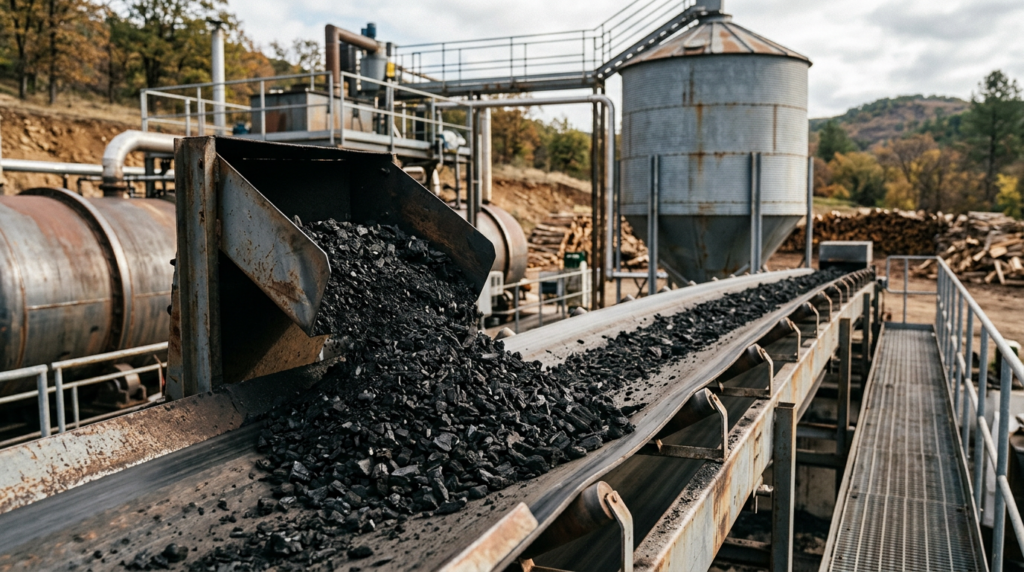
Understanding Biochar: Definition and Fundamentals
Biochar is a stable, solid carbon material obtained through the thermochemical conversion of biomass in an oxygen-limited environment. While superficially similar in appearance to charcoal or activated carbon, biochar occupies a distinct role in industrial procurement due to its specific production pathways, carbon stability, and customizable material characteristics.
For industrial buyers, understanding biochar starts with recognizing that it is not a uniform, singular commodity. Instead, biochar serves as an umbrella term for engineered, carbon-dense materials derived from diverse organic feedstocks—including agricultural crop residues, forestry thinnings, and dedicated non-food biomass. The ultimate utility of the material depends directly on the combination of the input feedstock and the thermal parameters applied during manufacturing.
Unlike raw biomass, which rapidly degrades and releases its stored carbon back into the atmospheric carbon cycle as carbon dioxide or methane, biochar converts biological carbon into recalcitrant aromatic carbon structures. When introduced to soils, construction blends, or technical matrices, high-grade biochar resists chemical and biological breakdown over decades or centuries. As industries face stricter sustainability mandates, supply chain decarbonization pressures, and operational efficiency targets, biochar has transitioned from an agricultural soil amendment to a versatile industrial input.
The Pyrolysis Process: Converting Biomass to Stable Carbon
The standard industrial method for manufacturing biochar is pyrolysis: the thermal decomposition of organic material at elevated temperatures in the substantial absence of oxygen. The thermodynamic environment within the pyrolysis reactor breaks the complex biopolymers in the biomass—primarily cellulose, hemicellulose, and lignin—into three distinct output streams:
- Solid biochar: A carbon-rich char matrix retaining much of the skeletal pore structure of the original plant matter.
- Pyrolysis liquid (bio-oil): A complex mixture of oxygenated organic compounds, condensable hydrocarbons, and water.
- Non-condensable syngas: A mixture of hydrogen, carbon monoxide, methane, and carbon dioxide that can often be recycled to provide thermal energy for the reactor itself.
Pyrolysis operating regimes typically fall into two main categories, each creating different material properties:
Slow Pyrolysis
Slow pyrolysis operates at moderate temperatures, typically between 350°C and 650°C, with relatively long vapor residence times ranging from minutes to hours. This process yields a higher fraction of solid biochar relative to liquids and gases. For procurement specialists seeking biochar for soil applications, civil engineering, or heavy industrial fillers, slow pyrolysis is usually the preferred method because it maximizes solid carbon yield and yields a robust porous structure.
Fast Pyrolysis
Fast pyrolysis utilizes rapid heating rates, finely ground biomass, and very short vapor residence times (often under two seconds) at temperatures around 500°C. This technique is optimized primarily to generate liquid bio-oil, resulting in lower biochar yields. Biochar produced from fast pyrolysis often displays smaller particle sizes and different structural pore profiles than material from slow pyrolysis.
Key Physicochemical Properties for Industrial Procurement
Industrial performance depends on measurable physical and chemical specifications. When evaluating biochar vendors, procurement officers should request comprehensive analytical datasheets covering several fundamental parameters.
Fixed Carbon Content
Fixed carbon represents the non-volatile carbon remaining after moisture, volatile matter, and ash are removed during proximate analysis. High-temperature pyrolysis generally produces biochar with higher fixed carbon percentages and lower volatile matter. For heavy industrial use, metallurgical substitution, or carbon removal documentation, a higher fixed carbon content is typically desirable.
Specific Surface Area and Porosity
Biochar inherits the cellular architecture of its feedstock, developing a network of micropores (less than 2 nm), mesopores (2 to 50 nm), and macropores (greater than 50 nm) as volatile matter escapes during pyrolysis. Specific surface area—measured using nitrogen or carbon dioxide gas adsorption (BET method)—can range widely depending on processing temperature. Macropores facilitate fluid flow and microbial colonization, while micropores govern the adsorption of volatile compounds, heavy metals, and moisture.
Ash Content and Mineral Composition
Ash consists of inorganic minerals present in the parent biomass, such as silica, calcium, potassium, phosphorus, and magnesium. Woody biomass typically yields biochar with low ash content, whereas crop residues, such as rice husk or straw, naturally contain significantly higher silica and ash levels. Industrial buyers using biochar as an additive in materials like concrete, polymers, or metallurgy must monitor ash content closely, as inorganic fractions influence structural integrity, thermal stability, and wear on processing machinery.
pH and Electrical Conductivity
Most biochars exhibit neutral to alkaline pH profiles, often between 7.0 and 10.0, driven by the concentration of alkaline earth metals and basic functional groups formed during heating. Electrical conductivity reflects the concentration of soluble salts. These metrics are critical for agricultural formulation, remediation projects, and integration into pH-sensitive industrial processes.
Moisture Content and Bulk Density
Raw biochar leaving a reactor is practically dry, but it is routinely conditioned with water to suppress combustible dust during handling and transport. Industrial buyers must establish clear agreements regarding delivered moisture content, as excessive moisture inflates transportation costs and affects dry-weight batching in manufacturing plants.
Primary Industrial Application Categories
As biochar production matures from small-scale operations into centralized industrial manufacturing, several high-volume market segments have emerged.
1. Construction and Building Materials
Biochar is increasingly tested and utilized as a functional aggregate or filler in construction materials, including concrete, mortar, asphalt, and composite boards. Incorporating biochar can modulate compressive strength, reduce overall composite weight, and improve thermal and acoustic insulation properties. Furthermore, embedding biochar permanently sequesters carbon within the built environment, enabling infrastructure developers to lower the embodied carbon profile of construction projects.
2. Environmental Remediation and Filtration
Because of its internal porous structure and surface functional groups, biochar serves as an effective adsorbent for water and gas purification. It can immobilize inorganic contaminants, such as heavy metals, and trap synthetic organic compounds, pesticides, and hydrocarbons. Municipalities and industrial plants utilize biochar in storm-water management basins, industrial effluent treatment systems, and landfill capping layers to prevent the migration of contaminants into surrounding water tables.
3. Agriculture and Soil Management
Agricultural use remains a foundational category. Applied to soils, biochar acts as a permanent structural amendment that increases cation exchange capacity (CEC), enhances moisture retention in sandy soils, improves aeration in heavy clay, and provides habitat for beneficial soil microbes. In commercial settings, biochar is often co-composted or pre-loaded with nutrients to avoid temporary nitrogen immobilization following field application.
4. Metallurgy and Industrial Carbon Inputs
In thermal and metallurgical manufacturing, biochar represents a renewable alternative to fossil-based carbonaceous agents such as coal, pet coke, and metallurgical coke. Used as a reductant, carbon raiser, or insulating cover in ladle furnaces, high-purity biochar can reduce the Scope 1 emissions profile of basic materials manufacturing, provided its volatile matter, moisture, and ash chemistry align with furnace operational tolerances.
5. Plastics, Polymers, and Composites
Thermoplastic and thermoset manufacturers evaluate finely milled biochar as a functional, bio-based black pigment and reinforcement filler to replace conventional carbon black derived from petroleum. Key evaluation criteria include dispersibility, abrasive wear on extruder barrels, tensile strength, and impact resistance of the final compound.
Quality Assurance and Standard Verification
Procuring biochar for high-value industrial processes requires strict attention to material consistency and regulatory standards. Because biomass can vary seasonally, robust vendors maintain consistent feedstock segregation and tightly regulated process controls.
Procurement teams should verify compliance with recognized international and national frameworks. Testing protocols established by organizations like the International Biochar Initiative (IBI) and the European Biochar Certificate (EBC) set explicit thresholds for heavy metal concentrations (such as lead, cadmium, arsenic, and mercury), polycyclic aromatic hydrocarbons (PAHs), and polychlorinated biphenyls (PCBs). These compounds can form under improper or incomplete pyrolysis conditions, making certified testing non-negotiable for risk management.
Beyond physical contamination, consistency in particle size distribution (PSD) must be managed contractually. Biochar is inherently friable; unmonitored material handling, conveying, and trucking can lead to particle attrition, turning coarse aggregates into fine dust prior to factory arrival.
Sourcing Biochar in India: Supply Chains and Scalability
India is uniquely positioned for scalable biochar production due to its massive agricultural base and continuous availability of post-harvest biomass residues. Historically, excess crop residues have often faced open-field burning, contributing to regional air quality degradation. Channeling these agricultural byproducts into engineered pyrolysis systems converts an environmental disposal challenge into a secure, domestic industrial material.
However, industrial procurement teams operating in India must assess vendor capabilities beyond basic production. Reliable commercial partnerships require predictable monthly tonnage, centralized processing facilities, batch-to-batch analytical traceability, and reliable logistics infrastructure. ForestTwin produces and supplies biochar across India, serving industrial enterprises seeking dependable material specifications tailored for specific industrial matrices, agricultural enhancement, and emission-reduction strategies.
When scoping an industrial trial, buyers should begin by defining the primary functional objective of the biochar—whether that is adsorption capacity, structural strength, thermal insulation, or carbon content—and request baseline samples characterized against accredited laboratory standards.
To evaluate biochar specifications, request technical datasheets, or discuss reliable volume supply for your industrial applications, contact the ForestTwin procurement and technical team at ForestTwin Contact.