
Moving Beyond Laboratory Hype in Soil Carbon Investments
Biochar occupies a central position in corporate carbon removal discussions and regenerative agriculture programs. Produced through the pyrolysis of biomass under oxygen-limited conditions, biochar transforms labile plant matter into a stable, aromatic carbon matrix capable of persisting in soils for centuries. This permanence makes biochar a primary asset for carbon-credit generation and corporate insetting strategies.
However, an operational gap exists between the controlled conditions of greenhouse pot trials and the messy, heterogeneous realities of multi-hectare commercial field applications. Promotional materials often generalize results from short-term incubation studies or highly degraded tropical plots to suggest that biochar universally enhances crop yields, improves water retention, and reduces fertilizer inputs across every geography. For land management teams, corporate sustainability officers, and agricultural investors, calculating a realistic return on investment requires looking past marketing claims to what peer-reviewed agronomic field trials actually demonstrate.
The Mechanistic Foundation: Feedstock, Temperature, and Soil Interaction
Biochar is not a singular, uniform substance. Its physical and chemical properties vary fundamentally depending on two factors: the organic feedstock used and the highest treatment temperature reached during pyrolysis.
Feedstocks range from woody residues and nut shells to crop straws, animal manures, and biosolid waste. Woody feedstocks pyrolyzed at higher temperatures (typically above 500 degrees Celsius) produce a material characterized by high specific surface area, extensive microporosity, high recalcitrant carbon content, and low ash content. Conversely, manure-based or crop-residue biochars produced at lower temperatures retain more volatile matter, possess lower surface area, and carry higher baseline concentrations of plant-available nutrients such as phosphorus, potassium, and nitrogen.
When incorporated into soil, biochar alters three fundamental domains:
- Physical structure: It modifies bulk density, pore size distribution, and hydraulic conductivity, particularly in coarse-textured soils.
- Chemical dynamics: It influences soil pH, cation exchange capacity, and the adsorption or desorption of inorganic nutrients and organic compounds.
- Biological microenvironments: Its porous internal geometry provides physical habitat that shelters soil microbes, including mycorrhizal fungi, from predation and desiccation.
What Long-Term Field Trials Reveal About Soil Health Metrics
Field literature compiled over decades underscores a consistent finding: the soil health response to biochar application is non-linear, highly site-specific, and governed by the existing limitations of the host soil.
1. Soil Water Retention
Field observations indicate that biochar improves plant-available water capacity primarily in coarse, sandy soils. In sands, the microscopic pores of the biochar act as physical reservoirs, increasing water retention in the root zone and extending the interval before plants reach permanent wilting point during dry periods.
In fine-textured, heavy clay soils, field trials show mixed or negligible hydrologic improvements. In some heavy clays, biochar incorporation can alter macropore connectivity, increasing infiltration rates slightly, but it rarely produces significant gains in total plant-available water capacity. Field teams applying biochar to productive, silty clay loams solely to build drought resilience often observe minimal measurable response in soil moisture metrics compared to unamended control strips.
2. pH Buffering and the Liming Effect
One of the most documented impacts of biochar across global field trials is its liming capacity. Fresh biochars typically have an alkaline pH due to the concentration of basic cations (such as calcium, magnesium, and potassium) present in their mineral ash fraction. When applied to acidic, highly weathered soils, biochar acts as a liming agent, raising the soil pH and reducing toxic aluminum and manganese saturation.
In acidic environments, this neutralization facilitates greater nutrient uptake, allowing roots to access phosphorus that was previously immobilized by aluminum or iron oxides. Conversely, in neutral to alkaline soils, adding high-pH biochar provides no agronomic liming benefit and, in some trials, has elevated pH to levels that induced micronutrient deficiencies, such as iron or zinc chlorosis.
3. Cation Exchange Capacity and Weathering
Freshly produced biochar often possesses a surprisingly low cation exchange capacity (CEC). The functional groups responsible for attracting and holding positive ions (carboxyl, phenolic, and hydroxyl groups) develop primarily as the biochar weathers over time through biotic and abiotic oxidation.
Field trials monitoring biochar plots across multiple growing seasons demonstrate that effective CEC increases as the biochar resides in the soil profile. Exposure to water, organic acids, and microbial respiration gradually oxidizes the edges of the aromatic carbon sheets, creating negative charge sites. Consequently, long-term trials report that biochar helps retain mobile nutrients in the root zone more effectively in year three or four than in the weeks immediately following incorporation.
The Agronomic Yield Reality: Context-Driven Performance
Agronomic literature presents clear evidence regarding crop yield responses to biochar: production gains depend primarily on whether the host soil is degraded or fertile.
Responses in Low-Fertility, Highly Weathered Soils
The largest positive yield responses documented in field literature occur in nutrient-depleted, low-CEC, acidic soils common in humid tropical or subtropical regions. In these conditions, biochar acts simultaneously as a long-term liming agent, a physical anchor for nutrients that would otherwise leach under heavy rainfall, and a source of basic cations. Yield increases in these settings can be substantial, reflecting the mitigation of severe baseline agronomic constraints.
Responses in High-Fertility, Temperate Arable Soils
In productive agricultural regions with deep, organic-rich topsoils, balanced pH, and high cation exchange capacity, multi-year field trials frequently report neutral yield responses. When baseline soil fertility is already optimized through standard agronomic management, adding biochar does not meaningfully elevate grain, oilseed, or forage production.
Furthermore, without proper preparation, applying raw, unamended biochar can cause a short-term yield depression in the first season. Because fresh biochar contains empty internal pore spaces and high surface sorption potential, it can rapidly adsorb nitrate and ammonium ions from the soil solution, alongside applied mineral fertilizers. This temporary nutrient immobilization starves the immediate crop of bioavailable nitrogen until microbial equilibrium is reached.
Overcoming the Nutrient Immobilization Problem: Pre-Activation and Co-Composting
To avoid early yield penalties and improve biological integration, agronomic research has shifted toward pre-activated or “charged” biochars. Rather than applying raw biochar directly from the pyrolysis unit, field trials demonstrate superior results when the material is blended with nutrient-rich organic waste streams prior to field application.
Co-composting biochar with livestock manure, green waste, or food processing residues accelerates the natural weathering process. During the thermophilic composting phase:
- Microbial activity oxidizes the biochar surfaces, introducing oxygen-containing functional groups that build immediate cation exchange capacity.
- Volatile ammonia and organic nitrogen compounds are absorbed into the porous biochar structure, reducing nitrogen volatilization losses from the compost pile while loading the biochar matrix with plant-available nutrients.
- Beneficial microbial consortia colonize the internal pore channels of the biochar, creating a biological inoculum upon soil delivery.
Field comparisons between uncharged biochar and co-composted biochar show that co-composted applications consistently avoid nitrogen tie-up, show faster root colonization, and demonstrate measurable positive yield responses even in moderately fertile soils.
Analyzing the Operational Economics and Capital Realities
Calculating the return on investment for a biochar program requires evaluating physical material costs, logistical handling, and long-term asset improvements.
Material and Transportation Costs
Biochar is a low-density, high-bulk material. Transportation economics present a major constraint on project viability. Hauling biochar long distances from centralized manufacturing facilities to distributed agricultural lands rapidly inflates input costs per hectare. Sourcing locally available feedstocks and utilizing regionally distributed pyrolysis facilities is critical to keeping transport expenditures within practical limits.
Application Rates and Equipment Logistics
Agronomic trials that report noticeable soil property improvements often employ application rates ranging from 5 to 30 tons per dry metric ton per hectare. At commercial prices, broad-acre application at these volumes often presents an insurmountable financial hurdle if justified solely by expected crop yield increments.
Moreover, dry biochar is prone to dusting, which represents both a loss of applied material and a respiratory hazard for operators. Operational field teams address this by applying moistened biochar, using specialized drop-tube spreaders, or blending the biochar into liquid slurries, compost, or wet manure before broadcast application and subsequent mechanical incorporation.
The Role of Carbon Removal Credits in Project Viability
Because immediate crop yield improvements alone rarely cover the cost of purchase, shipping, and application on high-functioning soils, carbon credit mechanisms are increasingly central to project economics. The physical stability of the carbon matrix allows project developers to generate durable carbon removal credits through accredited standards.
When revenue from these carbon credits or supply-chain insetting agreements flows back to the landowner or project operator, the financial balance changes. The carbon value can subsidize the acquisition and spreading costs, turning biochar into a practical multi-year soil improvement project rather than an unrecoverable operational expense.
A Methodical Framework for Field Evaluation
Organizations evaluating large-scale biochar deployments across supply chains or managed acreage should proceed with structured, empirical trials before committing significant capital.
Phase 1: Baseline Soil and Feedstock Audits
Conduct detailed baseline testing across the target land. Evaluate soil texture, baseline organic carbon, cation exchange capacity, pH, and historical yield maps. Simultaneously, analyze the biochar: verify its fixed carbon content, ash composition, pH, heavy metal concentrations, and structural porosity to ensure compatibility with the host soil profile.
Phase 2: Split-Field and Strip Trials
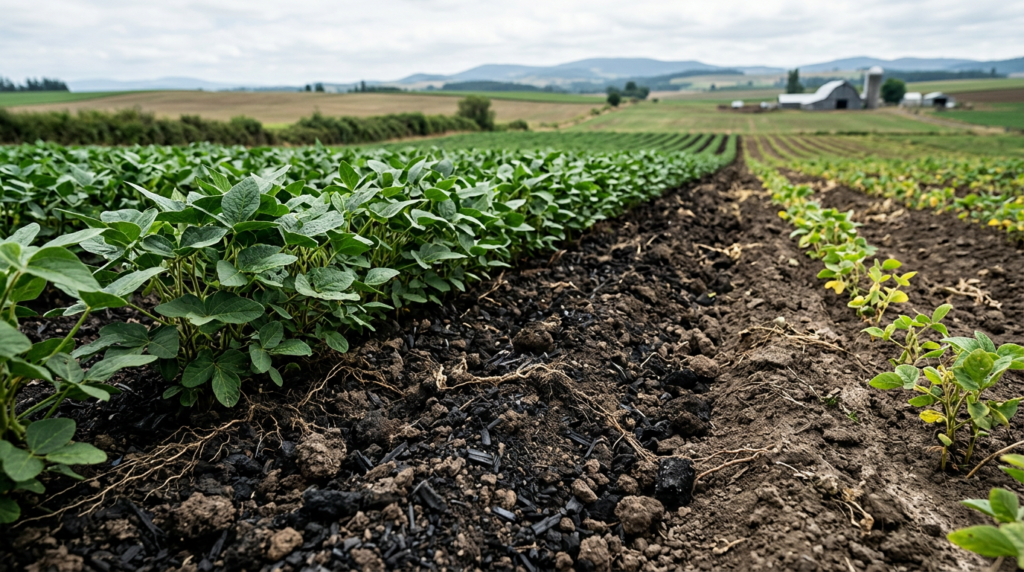
Avoid uniform field-wide applications during initial testing. Implement randomized replicated strips comparing:
- Standard agronomic management (control).
- Raw biochar applied alongside standard fertilizer regimes.
- Co-composted or nutrient-charged biochar.
- Compost-only amendments with equivalent nutrient volumes.
Monitor not only gross yield at harvest, but also seasonal soil moisture depletion curves, crop canopy development, root architecture, and post-harvest nutrient balances.
Phase 3: Multi-Year Accounting and Measurement
Plan monitoring protocols over a multi-year horizon. Because biochar is biologically and chemically durable, its agronomic value must be evaluated as an infrastructure investment in the soil asset rather than as an annual consumable input like synthetic nitrogen or crop protection products.
Measure physical soil density, infiltration rates, and aggregate stability over three to five years to assess structural improvements. Maintain rigorous digital monitoring and reporting to verify the permanent carbon stock for potential certification or sustainability disclosures.
Grounding Biochar Strategy in Empirical Agronomy
Biochar is neither a universal cure for degraded agriculture nor an ineffective additive. It is a stable, porous carbon amendment whose performance is determined entirely by soil chemistry, physical texture, regional climate, and application methodology. When deployed thoughtfully in acidic, coarse-textured, or nutrient-leached soils—and properly paired with organic amendments—biochar provides durable soil conditioning while sequestering atmospheric carbon for the long term.
By structuring biochar initiatives around verified field-trial evidence, rigorous baseline testing, and realistic economic models that integrate carbon market mechanisms, land stewards and corporate sustainability leaders can design soil health programs that deliver verifiable agronomic resilience and measurable ecological value.
To explore how ForestTwin helps agricultural enterprises, project developers, and sustainability teams design rigorous, data-backed land and carbon strategies, connect with our technical specialists at ForestTwin Contact.