
Navigating India’s Green Credit Programme Framework
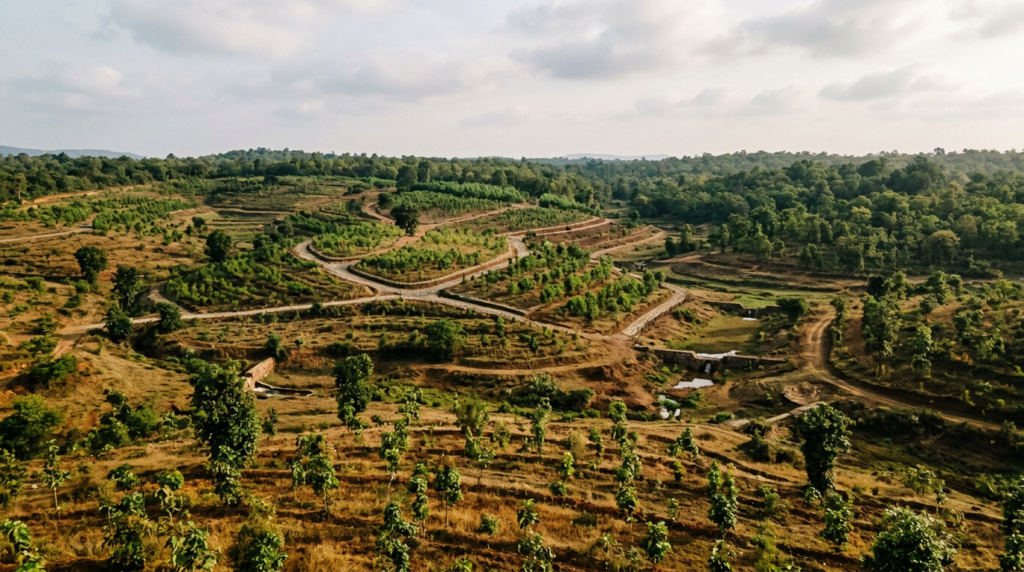
The Green Credit Programme (GCP), notified by the Ministry of Environment, Forest and Climate Change (MoEFCC), establishes a national market-based mechanism to incentivize voluntary environmental actions. Unlike traditional compliance frameworks centered strictly on greenhouse gas emissions, the GCP evaluates tangible environmental outcomes across diverse activities, including afforestation, water management, sustainable agriculture, and waste recovery.
For enterprises operating in India, the GCP provides an avenue to align corporate capital with verified domestic ecological restoration. Corporate entities can direct corporate social responsibility (CSR) capital, ESG investments, and voluntary sustainability budgets into structured environmental assets. However, achieving credit issuance under the GCP requires adherence to specific technical baselines, digital tracking mandates, and regulatory validation processes managed by the Indian Council of Forestry Research and Education (ICFRE), the designated administrator of the programme.
ForestTwin operates as a GCP-subscribed participant and technical solutions provider under Fusionpact’s sustainability vertical. Our specialized advisory and field engineering team manages enterprise initiatives across the entire lifecycle, from preliminary land suitability evaluations to registry onboarding, digital verification, and final credit issuance.
The Operational Bottlenecks in Corporate GCP Adoption
While the strategic benefits of securing Green Credits are clear, direct enterprise participation involves operational hurdles. Many organizations encounter bottlenecks when attempting to bridge statutory policy guidelines with ground-level field forestry and data submission protocols.
- Land Eligibility and Clear Titles: Afforestation initiatives require land parcels that meet specific regulatory criteria, such as degraded forest land, wasteland, or institutional lands without conflicting tenancy or proprietary encumbrances. Identifying, vetting, and securing legal access to eligible parcels remains an initial hurdle.
- Ecological Integrity and Native Selection: The GCP rules discourage monoculture plantings. Projects must prioritize indigenous species suited to local biomes, hydrological conditions, and soil classifications to ensure high survival rates and ecosystem restoration.
- Baseline Documentation: Before site interventions commence, enterprises must establish defensible ecological baselines. Failing to properly document pre-existing soil quality, vegetation cover, and canopy density can disqualify a project during the ICFRE verification stage.
- Long-Term Survival Risks: Credit generation is tied directly to sustained plant survival and growth benchmarks over designated verification intervals. Projects lacking technical maintenance plans and continuous monitoring face substantial risk of credit forfeiture.
- Regulatory Interfacing: Navigating the Green Credit Portal, handling designated audit entities, and reconciling field data with administrative submission guidelines demands dedicated domain knowledge.
ForestTwin’s Lifecycle Framework: From Eligibility to Credit Issuance
ForestTwin provides an integrated execution pathway designed to de-risk corporate participation. Our subscribed team handles the structural, biological, digital, and regulatory requirements through a five-phase execution methodology.
Phase 1: Portfolio Scoping and Land Suitability Assessment
The implementation lifecycle begins with technical due diligence. ForestTwin evaluates corporate capital allocations, geographic preferences, and sustainability objectives against the GCP methodology.
Our team conducts comprehensive remote sensing evaluations and physical ground audits to verify candidate parcels. This involves assessing soil health, microclimate profiles, water table availability, and historical land-use classifications. By confirming legal titling and land readiness prior to committing project capital, enterprises mitigate title-dispute liabilities and ground-level intervention risks.
Phase 2: Scientific Project Design and Ecological Baseline Mapping
Once a viable land footprint is secured, ForestTwin formulates the detailed project design. In alignment with MoEFCC guidelines, our silviculturists develop multi-tiered, native planting strategies designed to restore natural biodiversity, improve local hydrology, and maximize soil organic carbon buildup.
During this stage, we establish digital baseline records. Utilizing high-resolution satellite imagery, multi-spectral drone surveys, and geotagged field sampling, we record the site’s pre-intervention state. This geospatial dataset serves as the immutable reference point required by ICFRE-appointed verifiers to authenticate subsequent ecological uplift.
Phase 3: Administrative Registration and Registry Onboarding
Navigating the statutory registration channel requires meticulous administrative compliance. As a registered GCP-subscribed entity, ForestTwin prepares and submits all required documentation through the national Green Credit Portal.
Our advisory team coordinates the submission of land records, baseline environmental assessments, species allocation maps, and operational maintenance schedules. We manage direct correspondence with the registry administration, addressing technical queries, clarifying spatial parameters, and securing formal approvals to begin project execution under the designated methodology.
Phase 4: Physical Implementation and Digital Verification Systems
Field execution is supported by scientific site preparation, soil conditioning, sapling procurement from certified nurseries, and precision planting. However, successful plantation is only the initial operational step; long-term survival underpins the issuance of Green Credits.
ForestTwin deploys comprehensive digital twin architecture and remote sensing tools to maintain real-time oversight of the project asset:
- Geotagged Asset Inventories: Every planted parcel is spatially cataloged, allowing enterprise stakeholders and auditors to verify planting density and distribution.
- Canopy and Vegetation Indices: Using periodic multispectral satellite data (such as NDVI and NDRE), we monitor vegetative health, canopy expansion, and moisture stress.
- Ground-Truth Maintenance: In-field teams perform scheduled survival counts, biomass estimations, and restorative replanting where natural mortality occurs, maintaining the density thresholds specified by GCP guidelines.
Phase 5: Audit Management and Credit Issuance
Following the requisite stabilization period mandated by the programme, the project undergoes formal verification. The ICFRE assigns designated verifiers to confirm project parameters, plant survival metrics, and overall compliance with the approved project plan.
ForestTwin manages the verification audit from start to finish. We present consolidated geospatial audit trails, survival verification documentation, and site inspection protocols directly to the authorized verifiers. Upon successful verification and audit sign-off, the administrator credits the generated Green Credits directly to the enterprise’s official registry account.
Strategic Value of Green Credits for Enterprise Stakeholders
Acquiring verified Green Credits provides enterprise organizations with concrete strategic and financial advantages within evolving Indian and global regulatory environments.
Business Responsibility and Sustainability Reporting (BRSR) Integration
Under the Securities and Exchange Board of India (SEBI) guidelines, the top 1,000 listed entities must submit annual BRSR reports, with increasing expectations around BRSR Core assurance. Activities certified under the GCP provide verified, audit-grade data points to substantiate disclosures under Principle 6 (Protection and restoration of the environment). Corporate investments backed by official MoEFCC-recognized credits present lower greenwashing scrutiny compared to unverified voluntary claims.
Optimizing Corporate Social Responsibility (CSR) Allocations
Companies subject to the statutory 2% CSR expenditure requirement under the Companies Act, 2013, can channel environmental CSR commitments into verified GCP tree planting and water management activities. Working through an established methodology ensures that CSR capital yields measurable, verifiable, and permanent environmental outcomes rather than fragmented, unmonitored initiatives.
Mitigating Reputational and Regulatory Transition Risks
Global supply chains increasingly scrutinize suppliers and corporate partners regarding their local environmental stewardship. Participating in verified ecological restoration under a formal national governance structure demonstrates tangible compliance and operational maturity to institutional investors, lenders, and global enterprise clients.
Why Partner with ForestTwin for GCP Delivery
Executing ecological restoration within a formal credit framework requires an enterprise partner with combined capabilities in forestry science, corporate project governance, and regulatory administration.
ForestTwin eliminates execution friction for corporations by acting as a single accountability partner across all project workstreams:
- Institutional GCP Subscription: As an onboarded participant in the Green Credit Programme ecosystem, our team understands the operational protocols, policy updates, and administrative mechanics of the ICFRE platform.
- Integrated Technology Infrastructure: Backed by Fusionpact’s engineering foundation, ForestTwin integrates geospatial analysis, satellite tracking, and ground data capture into a unified portal, eliminating gaps between field interventions and corporate reporting.
- Risk-Adjusted Execution: We structure project models around survivability and regulatory validation, embedding replanting guarantees and long-term care regimes into our implementation agreements to protect capital investments against compliance failures.
- Complete End-to-End Governance: From soil testing to final credit deposit in the national registry, enterprise teams do not need to coordinate multiple vendors, nurseries, field contractors, and regulatory liaisons. ForestTwin manages the operational chain in its entirety.
Structuring Your Enterprise Green Credit Roadmap
Transitioning from strategic intent to registered Green Credit generation requires timely planning. Land assessment, seasonal nursery procurement, and pre-monsoon site preparation must be carefully scheduled to align with biological planting cycles and administrative review timelines. Organizations that initiate their site assessments and regulatory filings ahead of planting seasons secure optimal land parcels, avoid nursery shortages, and ensure their baseline data is validated without delays.
ForestTwin works directly with sustainability leaders, chief financial officers, and CSR committees to design tailored GCP deployment roadmaps that align capital outlay with official credit issuance schedules.
Initiate your enterprise Green Credit Programme portfolio with verified project scoping, regulatory onboarding, and field delivery by connecting with our technical advisory team directly at https://foresttwin.com/contact/?utm_source=blog&utm_medium=organic&utm_campaign=seo_engine.